 Newsinc24 Team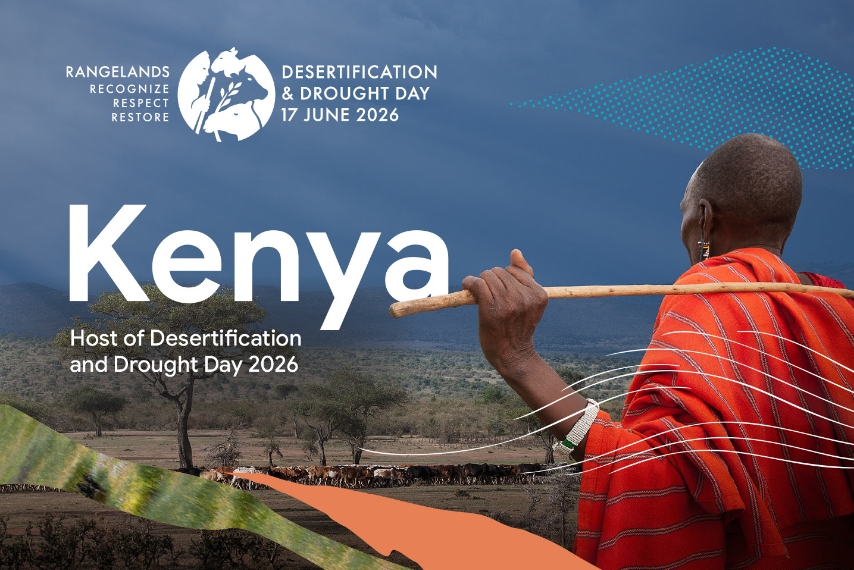
Up to half of the world's rangelands are already degraded or face the risk of degradation as rising temperatures, recurring droughts and unsustainable land use put growing strain on ecosystems that support nearly two billion people, the United Nations Convention to Combat Desertification said on Wednesday.The warning came as Kenya hosted the global observance of Desertification and Drought Day 2026, drawing attention to the worsening condition of rangelands that provide close to 70 per cent of the world's livestock feed and play a critical role in food production, water security and biodiversity conservation.
Held under the theme "Rangelands: Recognize. Respect. Restore.", the event took place in Kilifi County and brought together government officials, scientists, community leaders, youth representatives and development partners to discuss ways to strengthen drought resilience and restore degraded landscapes.
The concerns are far from theoretical.
From the vast Eurasian steppes to the grasslands of South America and the savannas of Southern Africa, communities that depend on livestock and grazing lands are increasingly confronting longer dry spells, shrinking water resources and declining land productivity.In a message marking the occasion, United Nations Secretary General António Guterres said the International Year of Rangelands and Pastoralists offers an opportunity to support Indigenous communities and pastoralists whose traditional knowledge remains vital for protecting fragile ecosystems."To protect our future, we must protect the land," Guterres said.Rangelands cover more than half of the Earth's land surface. Yet they often receive less attention than forests or croplands in global climate and conservation discussions.
Scientists say that is becoming harder to ignore.
Recent studies cited by the UNCCD show that grasslands across Eurasia suffered productivity losses of up to 43 per cent during periods of extreme drought. The region, stretching from the Black Sea to northern China, represents one of the largest continuous grazing landscapes in the world.Climate change is compounding existing pressures. Rising temperatures are accelerating soil degradation, reducing water availability and weakening biodiversity across many grazing regions.
South America faces a different challenge.
Some of its most productive grasslands, including parts of the Gran Chaco, Cerrado and Pampas regions, are coming under pressure from expanding agriculture, deforestation and large scale land conversion. Prolonged droughts and intense heatwaves are further reducing the resilience of native vegetation.In Southern Africa, where roughly 70 per cent of land is used for livestock grazing, local communities are turning to traditional land management practices to cope with changing climatic conditions.
Countries such as Zimbabwe and Angola are increasingly promoting rotational grazing systems and pastoral approaches that help restore vegetation cover, improve water retention and reduce competition over scarce natural resources.UNCCD Executive Secretary Yasmine Fouad said the challenge is no longer identifying solutions but expanding their implementation."As droughts intensify and competition over land and water resources grows, restoring rangelands must become part of how countries strengthen resilience, secure food systems, reduce risk and support livelihoods," she said.
Kenya's Cabinet Secretary for Environment, Climate Change and Forestry Deborah Barasa said the issue directly affects millions of people whose lives depend on healthy land and water resources."For us, this is not just another global event," Barasa said. "It is a conversation that touches the daily lives of our pastoralists, farmers, women, youth and communities living in rangelands."
Despite mounting pressures, experts say recovery remains possible. Practices such as rotational grazing, pastoral mobility, community led land management and the integration of Indigenous knowledge are showing encouraging results in restoring degraded landscapes while sustaining livelihoods.The issue is expected to receive greater international attention during the seventeenth session of the Conference of the Parties to the UNCCD, scheduled to be held in Ulaanbaatar, Mongolia, from August 17 to 28.
With droughts becoming more frequent and severe across many parts of the world, delegates are expected to push for stronger cooperation and increased financing for land restoration efforts.The message emerging from Kenya was clear: protecting rangelands is no longer only an environmental priority. For millions of people facing a hotter and drier future, it is increasingly an economic and social necessity.


Related Posts
India, Uganda reaffirm mutual appreciation for bilateral partnership
India's core sector output slows to 4.8% in August
Asian Games: Suchika wins historic bronze medal for India in MMA