 Nisha Singh
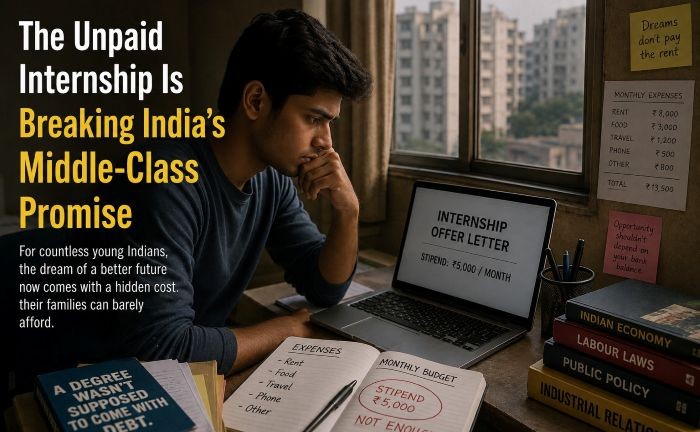
Somewhere in Delhi right now, a young man from Osmanabad is packing extra breakfast for lunch because his ₹5,000 government internship stipend does not cover both rent and food in the city he is required to live in for his opportunity.
He is not struggling because he is undeserving. He is struggling because the system built to give him a foothold is structurally designed for someone who already has one.
This is the quiet violence of the unpaid internship in India.
We do not talk about it that way. We dress it up as "industry exposure," "real-world learning," and "resume building." But strip the language away and what remains is a straightforward transaction: a young person's labour, exchanged for access that should not require a family subsidy to obtain.
The numbers are hard to dismiss. A 2025 Internshala report found that 35% of internships in India offered no stipend at all, while another 25% paid below ₹3,000 a month. Survey data suggests that unpaid internships are becoming increasingly common among undergraduates, with participation rising sharply in recent years. This is not a niche problem. It is becoming the norm.
And who absorbs the cost? Not the companies. Not the institutions mandating the internships. The cost lands squarely on families, specifically, on the middle-class household that spent a decade saving for a child's degree, only to discover that the degree now requires an unpaid apprenticeship before it can translate into employment.
The cruelty has a specific shape. Minimum placement salaries at IIT-Bombay fell from ₹6 lakh per annum in 2023 to ₹4 lakh in 2024 and roughly 8,000 of 21,500 IIT graduates nationwide remained unemployed that same year. If elite institutions are producing unemployed graduates, the pressure to intern at any cost, paid or not, intensifies further down the hierarchy. The student from a state college in a Tier 3 city cannot afford to say no. So, she does not.
Students from lower-middle-class backgrounds often cannot afford to relocate for unpaid internships and many are forced to forgo the professional exposure that increasingly shapes future hiring decisions. The opportunity gap compounds. The privileged student builds a resume. The deserving student builds debt.
What makes this particularly indefensible is the legal vacuum that sustains it. India has comprehensive labour legislation, the Industrial Disputes Act, the Minimum Wages Act and the Employee’s Compensation Act. Yet internships remain largely outside the core protections of labour law, leaving interns in a legal no-man’s-land despite the real value they contribute to organisations.
The government's response to the Prime Minister's Internship Scheme, launched in 2024 with a target of one crore internships over five years, is directionally right but operationally inadequate. In the first round, though 1.81 lakh individuals applied for the 1.27 lakh internships advertised, only 60,000 received offers. The stipend offered, ₹5,000 a month, is insufficient in any metro city where rent alone can exceed that figure. Good intent, wrong math.
The fix is not complicated. It requires will, not innovation.
A statutory minimum stipend indexed to the city cost-of-living must be mandated for any internship exceeding four weeks. Internship hosts claiming tax benefits or CSR credit should be required to demonstrate compensation compliance. NEP 2020, which rightly emphasises work-integrated learning, must be amended to include a minimum stipend floor, or its inclusivity promise remains hollow on paper.
India's middle class built itself on one compact: work hard, educate your children and the system will reward the effort. The unpaid internship breaks that compact at its most vulnerable joint, the transition from education to employment, the precise moment when family sacrifice is supposed to translate into economic mobility.
We are asking the least financially secure students to absorb the cost of an experience that will primarily benefit the organisations receiving their labour. Then we wonder why talent from small towns does not make it to the top.
The internship was supposed to be a bridge. For too many young Indians, it has become a toll gate, one that charges in a currency only some families can afford.
That is not meritocracy. That is inheritance dressed in the language of opportunity.
------------------------------------------------------------------------------------------------------------
(Nisha Singh is a policy analyst under MSDE, working at the intersection of skilling, employability and workforce development. Views expressed are her own.)



Related Posts
Iran plots to assassinate US officials in Middle East and beyond: Report
SC says Backward class Hindus can’t claim reservation after conversion
India not a ‘middle power’ but a power in the middle: EAM Jaishankar