 Ira Singh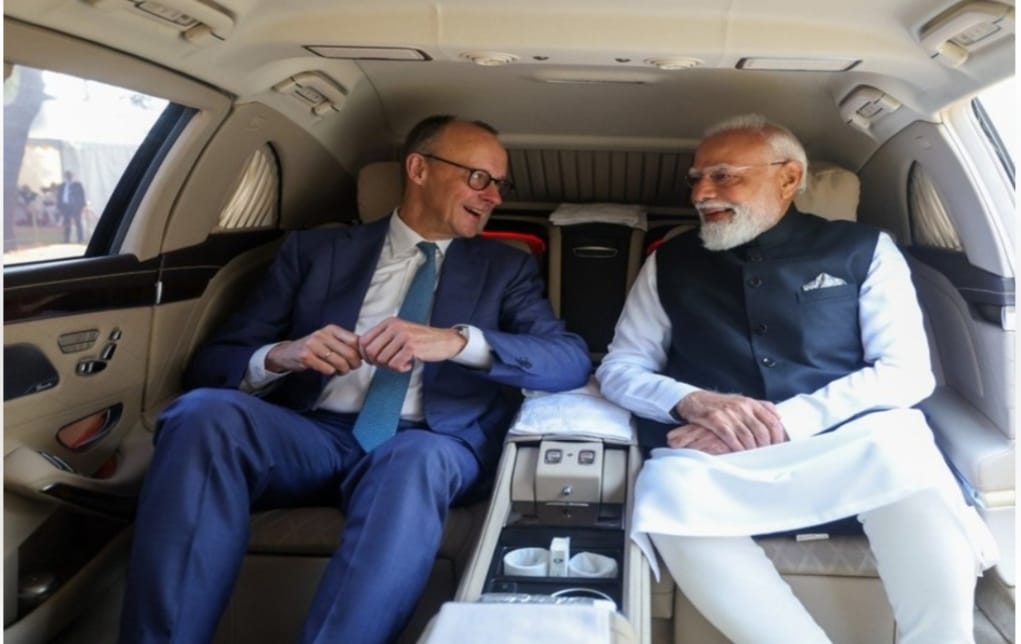
India and Germany on Monday signed several key Memorandums of Understanding (MoUs), giving fresh momentum to their strategic partnership, as Prime Minister Narendra Modi and German Chancellor Friedrich Merz held wide-ranging talks during the German leader’s first official visit to India in Gandhinagar.Addressing a joint press conference, Prime Minister Modi said bilateral trade between the two countries has crossed the $50 billion mark, the highest level achieved so far. He said the milestone reflects growing economic engagement and mutual confidence between the two sides.“More than two thousand German companies have a long-standing presence in India. This reflects their unwavering faith in India and the immense opportunities here,” the Prime Minister said.
#WATCH | Gandhinagar, Gujarat: Prime Minister Narendra Modi says, "Our bilateral trade has reached its highest level ever, surpassing the 50 billion dollar mark. More than 2,000 German companies have a long-standing presence in India. This reflects their unwavering confidence in… pic.twitter.com/iwx4gkCz6H
— ANI (@ANI) January 12, 2026
Prime Minister Modi noted that technology cooperation between India and Germany has steadily expanded over the years and is now visible through joint projects and investments. He said both countries share common priorities in renewable energy and climate action, which have emerged as key pillars of the partnership.To further deepen cooperation in these areas, India and Germany have decided to set up an India-Germany Centre of Excellence. The centre will act as a platform for sharing knowledge, technology and innovation, with joint work already underway in areas such as climate action, energy transition, urban development and urban mobility. Modi said a new mega green hydrogen project involving companies from both countries could prove to be a “game changer” for the future of energy.The Prime Minister also highlighted cooperation in building secure and trusted supply chains, adding that the two leaders agreed to strengthen collaboration in sports and education. He invited German universities to open their campuses in India and announced a comprehensive roadmap on higher education to deepen academic ties.
German Chancellor Friedrich Merz, in his remarks, warned of a “renaissance of protectionism,” saying it harms both Germany and India. He underlined the need for open markets and closer economic cooperation to unlock the full potential of bilateral ties. Merz also stressed the importance of concluding a free trade agreement between India and the European Union, saying such a deal would significantly boost India-Germany economic relations.
#WATCH | Gandhinagar, Gujarat | German Chancellor Friedrich Merz says,"...To tap into the full potential of India-Germany economic relations, we need to conclude the negotiations on a free trade agreement between India and European Union...."
— ANI (@ANI) January 12, 2026
(Source: ANI/DD News) pic.twitter.com/09Vmce7YpC
Highlighting the strategic dimension of the partnership, Merz emphasised the need for closer security cooperation, stating that deeper collaboration would help India become less reliant on Russia. Defence ties were reinforced during the visit, with Prime Minister Modi thanking the German side for simplifying defence trade processes and announcing a roadmap to enhance co-development and co-production opportunities between the defence industries of the two countries.On global issues, the two leaders stressed the need to reform international institutions to better reflect contemporary realities. “Our joint effort through the G4 for reform of the UN Security Council is a testament to this thinking,” Modi said. They also discussed regional and global crises, including the situations in Ukraine and Gaza, and reiterated their shared commitment to combating terrorism.“We are unanimous that terrorism is a serious threat to all of humanity. India and Germany will continue to fight it together with full determination,” the Prime Minister said.Modi also highlighted the deep historical and cultural links between India and Germany, recalling the contributions of Rabindranath Tagore, Swami Vivekananda and Madam Cama in strengthening intellectual and cultural exchanges between the two nations.
(State Correspondent)
Related Items
India’s semiconductor market set to reach $200 Billion by 2035
Asian Games: India opens medal account with silver
India sends fresh tranche of relief material to Nepal