 Uday Kumar Varma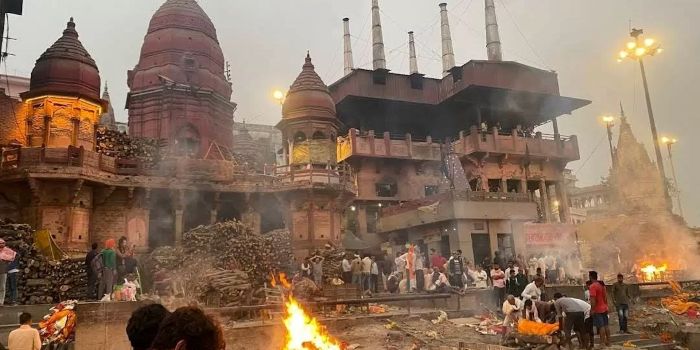
I arrived at Manikarnika as the sun was preparing to leave the sky. The evening light had begun to soften the hard outlines of Varanasi. As I walked through the city's labyrinthine lanes, Kashi displayed all its familiar contradictions at once—pilgrims and shopkeepers, temple bells and motorcycle horns, saffron-clad ascetics and foreign visitors, all sharing the same ancient and crowded stage.
Yet as I drew nearer to Manikarnika, another presence began to announce itself.
A faint veil of smoke hovered above the rooftops. Men carrying bamboo biers emerged from narrow alleys and disappeared again into the human tide. Their chant—"Ram naam satya hai"—rose and faded in the evening air like a reminder from another realm. Long before I saw the ghat itself, I sensed that I was approaching a place unlike any other. The first glimpse was unexpected.
Part of the ghat was under renovation. Scaffolding clung to old structures. Piles of stone and construction material lay scattered about. The occasional metallic clang of machinery mingled with the chants accompanying the dead. At first the scene appeared almost incongruous. Here was one of the world's oldest cremation grounds caught in the midst of modern reconstruction.
Yet the incongruity lasted only a moment.
Beyond the scaffolding, beyond the dust and noise of temporary works, the ancient reality of Manikarnika remained unchanged. The fires burned as they always had. Smoke rose steadily into the gathering dusk. Funeral pyres glowed against the darkening sky. Beside them flowed the Ganga, serene and unhurried, as though she had witnessed this spectacle for so long that astonishment itself had become impossible.
Standing there, I realised that while human beings may alter the appearance of Manikarnika, its essential purpose belongs to a dimension beyond renovation.
Some things belong not to history but to eternity.
There are places in the world one visits with curiosity. Others one approaches with reverence. But there are a rare few before which language itself seems inadequate, where one arrives not merely as a traveller but as a mortal.
Manikarnika is such a place.
No monument stands there. No emperor built it. No marble dome rises above its steps. Yet few places on earth possess such terrible grandeur. For centuries beyond counting, perhaps millennia, its fires have burned without interruption, consuming kings and mendicants, saints and merchants, scholars and labourers alike, reducing every distinction carefully cultivated by life into the same drifting ash.
One does not merely see Manikarnika. One undergoes it.
The cremation ground unfolds in tiers of stone descending towards the river. Stacks of wood rise like miniature fortresses. Smoke curls endlessly upward. The air carries the scent of burning timber, incense, clarified butter, and mortality itself. Priests recite mantras. Relatives stand silently beside the pyres. Tourists in boats pause midstream to watch the flames flickering along the shore. Above, kites circle lazily in the smoky sky.
Death is everywhere present, yet strangely absent of drama.
There is grief, certainly. There are tears and farewells. But there is no rebellion against the inevitable. Death here is neither hidden nor sanitised. It is accepted as part of the natural order of things, as visible and ordinary as sunrise or rain.
The modern world has become adept at concealing mortality. Hospitals, funeral homes, and crematoria have removed death from everyday sight. We spend our lives constructing elaborate distractions against the awareness of our finitude.
Manikarnika permits no such evasion.
Here death burns openly beneath the sky. And yet the dominant emotion is not fear. It is wonder.
For this is no ordinary cremation ground. It occupies a place in the spiritual imagination of India unlike any other.
According to tradition, this is the spot where Shiva and Parvati witnessed the cosmic drama of creation. One legend tells of the goddess's jewelled earring—her manikarnika—falling to earth here, giving the place its name. Nearby lies the sacred Manikarnika Kund, whose antiquity disappears into the mist of faith and memory.
Another belief, cherished by generations of pilgrims, holds that Shiva himself whispers the taraka mantra into the ears of those who die in Kashi, granting liberation from the endless cycle of birth and rebirth.
Whether one accepts these beliefs literally is, in a sense, beside the point. What matters is the extraordinary spiritual significance they have bestowed upon this place. For countless generations, men and women from every corner of India have dreamed of spending their final days in Kashi, believing that death here is not an ending but a homecoming.
Perhaps that is why Manikarnika feels different from every other place associated with death. It does not feel merely funereal. It feels cosmic.
As darkness gathered over the river, I watched a funeral procession arrive at the ghat. The body, wrapped in cloth and flowers, was carried carefully down the steps. Family members surrounded it. Prayers were offered. Rituals were performed. Then the fire was lit.
For a brief time, the body remained recognisably someone—a father, a mother, a friend, a beloved companion. Then gradually the flames began their ancient work. Form dissolved. Identity faded. Individuality itself seemed to loosen its hold.
One could not witness the scene without reflecting on the ambitions, anxieties, triumphs, disappointments, and attachments that had once animated that now silent frame. An entire universe of memories and experiences had culminated in this final encounter with fire.
And then a curious thing happened.
The experience ceased to be about the dead and became about the living.
Standing beside those eternal pyres, many of the concerns that ordinarily dominate our lives appeared strangely diminished. The pursuit of status, the accumulation of possessions, the endless cultivation of self- importance—all seemed faintly absurd before flames that had consumed generations before us and would continue long after our own departure.
The lesson was not despair. Nor was it indifference. It was perspective.
The fire appeared to strip existence down to essentials. Everything superfluous burned away first.
The remarkable thing about Manikarnika is that it does not preach. No one there delivers philosophical lectures. No signboards proclaim spiritual truths. The ghat simply exists, and in existing poses questions that cannot easily be ignored.
What truly endures?
What deserves our devotion?
What remains when titles, achievements, wealth, and reputation have all been surrendered?
The flames offer no verbal answers. Yet they compel reflection.
As I watched the river flowing beside the cremation ground, I was reminded of one of the deepest insights of Indian civilisation: that life is not possession but participation. We belong to something larger than ourselves. We arise briefly from an immense cosmic continuity and eventually return to it.
The Upanishadic sages expressed this insight through philosophy. The poets expressed it through metaphor. Manikarnika expresses it through fire.
Here the individual self appears less like a permanent entity than a wave rising momentarily from the ocean before subsiding once more into the whole.
Strangely, this realisation does not diminish life. It enriches it.
For if life is transient, every moment acquires greater value. Every friendship becomes more precious. Every act of kindness gains significance. Mortality does not rob existence of meaning; it confers meaning upon it.
By now the sun had disappeared completely. The western horizon retained only a fading trace of gold. The pyres glowed more brightly against the darkness. Smoke drifted upward in ghostly columns. Somewhere nearby a temple bell began to ring.
The sound seemed to unite everything—the living and the dead, the river and the flames, the city and the sky.
Kashi appeared less like a geographical location than a vast spiritual theatre in which humanity has contemplated the mystery of existence for thousands of years.
Eventually I turned to leave.
As I climbed back through the narrow lanes, the smoke remained visible behind me. Another funeral procession was descending towards the river. Shops were still open. Customers bargained. Merchants attended to their trade. Pilgrims moved towards the evening aarti. Life, seemingly indifferent to death, continued exactly as before.
Yet something within me had shifted.
I had arrived at Manikarnika as a visitor to one of the world's most famous cremation grounds. I left with the feeling that I had encountered not merely a place but a question—one so ancient and so fundamental that every civilisation, every religion, and every human life must eventually confront it.
What does it mean to live meaningfully when death is certain?
The fires of Manikarnika offered no spoken reply. They simply continued to burn against the night sky, as they have for centuries.
But in the days that followed, long after the smoke had vanished from sight, I found myself returning again and again to that question.
The visit had ended. The meditation had only begun.
(Uday Kumar Varma is an IAS officer. Retired as Secretary, Ministry of Information & Broadcasting)

Related Posts
Guterres calls for global unity, peace ahead of ‘last UNGA’ as S.G.
Peace on border essential for business ties: Modi tells Xi In bilateral
Russia backs India's call for peace in Ukraine:Peskov