 Newsinc24 Team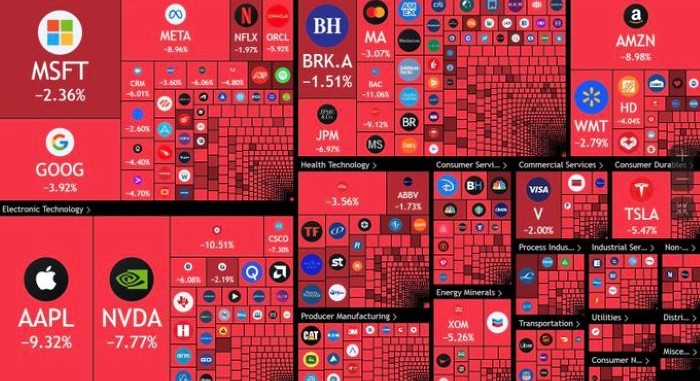
Trump’s tariffs announcement has shaken the global financial markets. As Wall Street's rebellion against Donald Trump's tariff war intensifies, traders are rushing into fixed-income havens. Wall Street faced its sharpest downturn since the height of the Covid-19 crisis on Friday. The S&P 500 plunged 6% after China retaliated against President Donald Trump’s tariff hike, stoking fears of a trade war spiralling into a global recession. It was the S&P 500's worst week since March 2020, when the pandemic severely impacted the economy. The Dow Jones dropped 2,231 points (5.5%), while the Nasdaq tumbled 5.8%, falling over 20% from its December high.
The Nasdaq composite was also down 5.8 percent, as China matched Trump’s big raise in tariffs in an escalating trade war. The selloff continued even after a better-than-expected report on the US job market.The Dow Jones Industrial Average declined 2,231.07 points to 38,314.86, marking a correction from its December 4 record closing high of 45,014.04. Meanwhile, the S&P 500 slid 322.44 points to 5,074.08, its lowest close in 11 months, according to Reuters.Global stock markets also continued their downward spiral, driven by growing investor fears that Trump’s reciprocal tariff strategy could fuel inflation and potentially tip the global economy into a recession. The uncertainty has amplified concerns across financial markets worldwide. “The world has changed, and the economic conditions have changed,” AP quoted Rick Rieder, chief investment officer of global fixed income at BlackRock, as saying.
Bitcoin 'decouples' from economy — analyst Cory Bates
— RT (@RT_com) April 5, 2025
Safe haven from tariffs? pic.twitter.com/R6POKrhAZv
Fed Chair Jerome Powell said Friday that tariffs could also drive up expectations for inflation. That could prove more damaging than high inflation itself, because it can drive a vicious cycle of behaviour that only worsens inflation. “Our obligation is to keep longer-term inflation expectations well anchored and to make certain that a one-time increase in the price level does not become an ongoing inflation problem,” Powell said.
Trump has said Americans may feel “some pain” because of tariffs, but he has also said the long-term goals, including getting more manufacturing jobs back to the United States, are worth it. On Thursday, he likened the situation to a medical operation, where the U.S. economy is the patient.Trump also criticised China’s retaliation, saying on his Truth Social platform that “CHINA PLAYED IT WRONG, THEY PANICKED - THE ONE THING THEY CANNOT AFFORD TO DO!”
Economists say the near-term result of his measures will likely be higher US prices and slower growth, or perhaps even a recession. "If these tariffs stick, the economy is going to slow down," said Mary Ann Bartels at Sanctuary Wealth. "Whether it's a recession or not, it's clear that the economy is headed for a slowdown in the US and around the world. There's no place to hide, but the fixed-income markets." Trump's trade war is likely to reinforce the underperformance of US equities, as tariffs crimp earnings for Corporate America, according to global strategists at HSBC including Alastair Pinder.
Related Posts
Nifty above 22,700, Sensex rallies 685 pts amid positive global cues
Market falls for 4th day,Sensex ends 571 pts down, Nifty at 22,422
Market: Sensex drops 1124 pts, Nifty below 22,800