 Krishan Gopal Sharma
Why the US–Iran Deal May Fail Not Because Peace Is Impossible, but Because Conflict Remains Too Useful
Trigger
“Peace threatens those whose power depends upon the expectation of war.”
When the United States and Iran moved towards a peace framework in June 2026, much of the world welcomed it as a rare triumph of diplomacy. After months of missile exchanges, military brinkmanship and fears of a wider regional war, the prospect of de-escalation offered a desperately needed moment of relief.
Yet before the celebrations had ended, resistance had already begun to organise itself. Critics questioned the concessions. Regional actors voiced alarm. Familiar warnings returned to the headlines. The reaction revealed a deeper truth: in modern geopolitics, peace often faces more organised opposition than war.
The question is no longer whether peace is desirable. Almost everyone claims to support it. The more important question is whether the political, economic and strategic systems built around conflict can afford to let it succeed.
The Business of Perpetual Tension
Civilisations celebrate peace rhetorically but invest in war materially. Schools compete for funding, hospitals struggle for resources and infrastructure projects face endless scrutiny. Yet military expenditure often passes through political systems with remarkable ease.
The explanation is always security. And to a degree, that argument is valid. The world is not free of threats, and every nation possesses a legitimate right to defend itself.
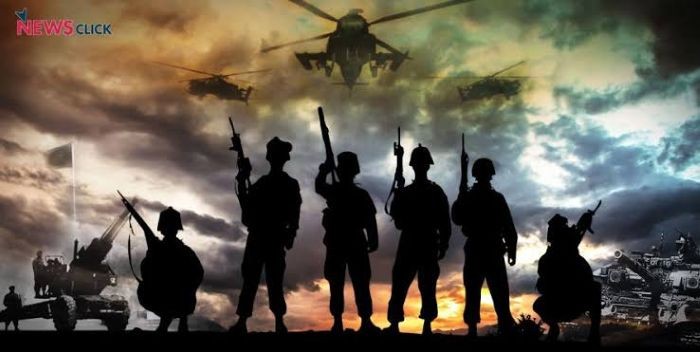
The problem begins when preparation for conflict evolves into a permanent organising principle of society. Defence ceases to be a necessity and becomes an industry. Strategic rivalry becomes a business model. Fear becomes an asset.
More than sixty years ago, former US President Dwight Eisenhower warned against the growing influence of the military-industrial complex. His concern was not the existence of armed forces but the possibility that institutions created to respond to threats might eventually require threats to justify their continued expansion.
That warning feels remarkably contemporary. Around the world, vast ecosystems of defence contractors, strategic consultants, intelligence agencies, lobbyists, media networks and political actors derive relevance, influence or profit from sustained insecurity. No conspiracy is required. Incentives alone are often sufficient.
In such a system, peace becomes disruptive.
A Deal Nobody Fully Loves
The significance of the US–Iran agreement lies not in what it has solved but in what it threatens to change.
For more than four decades, hostility between Washington and Tehran has shaped regional alliances, military deployments, sanctions regimes and strategic calculations across West Asia. Entire political narratives have been constructed around that antagonism.
A genuine thaw would alter those assumptions. It would challenge established security doctrines, reduce the usefulness of old fears and force regional actors to rethink long-standing strategies.
Perhaps the strongest indication that a diplomatic breakthrough may be meaningful is that neither side appears entirely satisfied.
Real diplomacy rarely produces winners and losers. It produces compromises that leave everyone uncomfortable but willing to continue talking. The Good Friday Agreement in Northern Ireland, the Camp David Accords and even periods of Cold War détente succeeded not because trust suddenly emerged but because perpetual confrontation had become more costly than compromise.
Peace does not begin when enemies become friends. It begins when enemies discover that endless hostility serves neither side.
Israel's Strategic Dilemma
No discussion of the agreement can ignore Israel's concerns. For decades, Israeli security doctrine has regarded Iran as its principal long-term strategic challenge. Concerns regarding Iran's nuclear ambitions, support for proxy groups and regional influence are neither imagined nor trivial.
Any serious analysis must acknowledge these realities.
Yet there is a difference between scepticism and obstruction. The challenge arises when every diplomatic opening is viewed through the assumption that engagement itself constitutes a strategic defeat.
Some political factions in Israel fear that any rapprochement between Washington and Tehran could weaken Israel's regional position or grant Iran greater room for manoeuvre. Such anxieties are understandable. However, history offers a sobering lesson: negotiations often fail not because adversaries refuse to talk, but because third parties fear what successful talks might mean for established power arrangements.
The Oslo process, despite its flaws, demonstrated how fragile peace becomes when extremists and spoilers are determined to undermine it. Agreements can survive distrust. They rarely survive systematic sabotage.
The danger today is not that diplomacy is naïve. The danger is that diplomacy may never be given the opportunity to prove itself.
The Forgotten Stakeholders
Lost amid strategic calculations are those who possess the greatest stake in peace and the least influence over it.
Ordinary people.
The shopkeeper in Tehran watching inflation erode years of savings. The family in Tel Aviv exhausted by sirens and uncertainty. The Lebanese farmer wondering whether another regional confrontation will destroy a season's labour. The Iraqi trader whose livelihood depends on stable borders and functioning commerce.
For them, peace is not an abstract geopolitical concept. It is affordable food, reliable electricity, secure employment and the confidence to plan for the future.
Political leaders discuss spheres of influence. Ordinary citizens discuss the next generation.
One conversation dominates headlines. The other determines whether societies flourish.
Fear: The Most Valuable Political Commodity
Fear has always been one of the most useful political resources available to those who wield power. It unifies populations, discourages dissent and simplifies complex realities into convenient narratives.
Most importantly, fear redirects public attention.
A society focused on external threats is less likely to scrutinise internal shortcomings. Economic stagnation becomes secondary. Governance failures become tolerable. Social divisions become easier to manage.
The external adversary becomes politically indispensable.
This phenomenon transcends ideology, geography and political systems. Democracies, monarchies and authoritarian states have all discovered the utility of fear.
As the Roman historian Tacitus observed nearly two millennia ago:
“The desire for safety stands against every great and noble enterprise.”
Today, one might add that the pursuit of political advantage often stands against peace itself.
The Media and the Marketplace of Conflict
Modern media ecosystems unintentionally reinforce these dynamics.
War provides spectacle. Peace produces paperwork.
A missile strike generates dramatic imagery and instant headlines. A confidence-building measure or a successful negotiation generates little excitement. Conflict is visual, emotional and immediate. Diplomacy is slow, technical and often tedious.
As a result, the public frequently receives a distorted picture of reality. Conflict appears dynamic and inevitable. Peace appears fragile and unrealistic.
Yet history suggests the opposite.
War is often the easier choice. It requires anger, fear and mobilisation.
Peace requires patience, imagination and political courage.
That is precisely why it remains so difficult.
The Real Meaning of Strength
One of the great misconceptions of modern geopolitics is the belief that strength and peace occupy opposite ends of the spectrum.
They do not.
Weak states often stumble into conflicts they cannot control. Strong states possess the confidence to negotiate.
The true test of power is not the ability to destroy an adversary. It is the ability to coexist with one.
Military victories can impose silence. Only diplomacy can create stability.
Weapons may deter enemies for a time. They cannot build trust, prosperity or legitimacy. Those achievements require political vision rather than military hardware.
The challenge facing the Middle East today is not a shortage of strength. It is a shortage of confidence in peace.
India's Opportunity: Building Bridges in a Fractured Region
For India, the emerging US–Iran understanding presents both an opportunity and a responsibility. Few major powers today maintain working relationships with Washington, Tehran, Tel Aviv and the Arab Gulf states simultaneously. That diplomatic reach gives New Delhi a unique vantage point.
India's interests in regional stability are neither abstract nor ideological. West Asia remains critical to India's energy security, trade routes, investment flows and the welfare of millions of Indians living and working across the region. Every military escalation eventually finds its way into oil prices, shipping costs and household budgets.
This places India in a potentially constructive role. Without seeking to mediate every dispute, New Delhi can continue to advocate dialogue, strategic restraint and respect for sovereign interests. In an era increasingly defined by rival blocs and hardened positions, India's greatest diplomatic asset may be its ability to maintain channels of communication across competing camps.
The challenge of the twenty-first century is not merely building power. It is preserving spaces where adversaries can still talk. In that endeavour, India has both credibility and experience.
Conclusion: Peace's Most Dangerous Enemy
The greatest threat to the emerging US–Iran agreement may not be Iran. It may not be the United States. It may not even be Israel alone.
Its greatest adversary may be the vast ecosystem—political, economic, institutional and psychological—that has adapted itself to permanent confrontation.
For decades, the region has been organised around assumptions of perpetual hostility. Entire industries, alliances, careers and narratives have grown from that foundation. Peace threatens all of them.
That is why history's most important agreements rarely fail because enemies refuse to talk. They fail because too many others benefit from ensuring that the talking never succeeds.
The world today faces a simple but profound choice. It can continue investing in the management of conflict, or it can begin investing in the architecture of peace.
One path is familiar. The other requires courage.
And courage, unlike weaponry, cannot be purchased.
The real question is not whether America and Iran can make peace. The real question is whether a region conditioned for conflict will allow peace to survive. Wars often begin with a single shot. Peace, by contrast, must survive a thousand objections.
History seldom remembers those who profited from fear. It remembers those who found the wisdom to rise above it.
The agreement may have been signed on paper. Its true test begins now—in the willingness of nations, institutions and leaders to accept a possibility that has become strangely radical in our age: that peace is not a pause between wars, but the purpose of politics itself.
Author's Note
The views expressed are personal. The article examines the structural incentives that often perpetuate conflict and complicate efforts towards reconciliation. It does not diminish the legitimate security concerns of any nation, including Israel, Iran or the United States. Rather, it argues that lasting peace requires political courage, strategic restraint and a willingness to challenge systems that have become accustomed to living with permanent instability.
(kgsharma1@gmail.com; Mobile: 9811340809: The writer is a retired officer of the Indian Information Service and a former Editor-in-Charge of India’s national broadcasters. Also worked as an international media consultant with UNICEF Nigeria and contributes regularly to various publications.)

Related Posts
Terrorism a deadly threat to peace, says Jaishankar; flags ‘4Fs’ crisis
Iran plots to assassinate US officials in Middle East and beyond: Report
Trump warns Iran of potential strike if deal not reached