 Newsinc24 Team
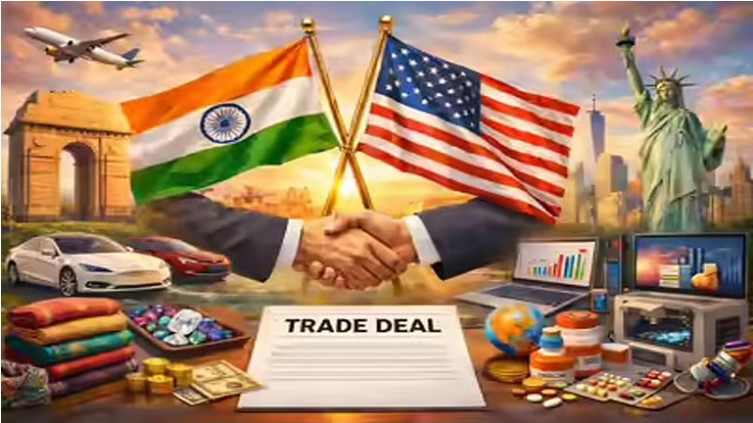
The India-US economic relationship appears to be entering a crucial phase, with both sides moving toward the “final touches” on an interim trade agreement after months of difficult negotiations. The recent meeting between US President Donald Trump and Prime Minister Narendra Modi at the G7 Summit, followed by US Trade Representative Jamieson Greer’s visit to New Delhi, has revived momentum toward a possible breakthrough.The trade discussions come after a year marked by tariff disputes, geopolitical challenges and questions over the future direction of one of Washington and New Delhi’s most important partnerships.
Akshay Mathur, Delhi Senior Director at the Asia Society Policy Institute, noted that the India-US relationship witnessed both optimism and uncertainty after President Donald Trump began his second term. He noted that there was initial hope in New Delhi and Washington that the personal rapport between President Trump and Prime Minister Modi would help deepen strategic and economic cooperation.
However, that optimism was soon tested by a series of tariff measures, including the “Liberation Day” tariffs, sector-specific duties on steel and aluminium, and additional penalties linked to Russian oil purchases.According to Mathur, these developments created fresh challenges for a relationship that had witnessed growing economic engagement in recent years. He also pointed to geopolitical issues, including Washington’s engagement with Pakistan after the India-Pakistan military conflict and the killing of three Indian sailors in a US missile strike near Oman, as factors that added complexity to bilateral ties.Despite these challenges, Mathur noted that the Modi-Trump meeting at the G7 Summit sent a positive signal. President Trump described Prime Minister Modi as a long-time friend and praised him as a “tough negotiator”, indicating a willingness on both sides to move forward.
“Following the G7 bilateral, U.S. Trade Representative Jamieson Greer travelled to India to meet his counterpart, Piyush Goyal, in an effort to put a ‘final touch’ on the trade negotiations,” Mathur said.While Greer’s visit ended without a formal announcement of the deal, Mathur highlighted that both sides acknowledged significant progress and expressed confidence in continuing negotiations.He further emphasised that the trade agreement is not only about tariffs but also about expanding cooperation in strategic sectors such as artificial intelligence, semiconductors, critical minerals, energy security and supply-chain resilience.
India-US Trade Talks: A Test of Economic Confidence
The recent developments indicate that both countries are trying to rebuild confidence after months of uncertainty. When President Trump returned to office, there was optimism that his relationship with Prime Minister Modi would accelerate economic and strategic ties.However, tariff disputes raised concerns in New Delhi about their impact on India’s manufacturing ambitions and its growing role in global supply chains.
Agriculture remains one of the most sensitive issues in negotiations. India has sought to protect its farming sector from increased competition from subsidised foreign agricultural products, while also pushing for greater market access and balanced rules on digital trade, standards and licensing.Prime Minister Modi’s efforts to diversify India’s trade partnerships through agreements with the UK, European Union, EFTA and other regions have also strengthened India’s position in negotiations.
India’s approach to the trade negotiations also reflects a broader shift in its economic strategy. While New Delhi remains committed to strengthening ties with Washington, it is simultaneously expanding engagement with other global trade partners to reduce exposure to external shocks. The ongoing negotiations underline the need for a balanced framework that protects India’s interests while creating greater market opportunities.The evolving US trade policy landscape has further accelerated this approach, encouraging India to diversify its trade portfolio and build resilience across multiple markets. A wider network of trade partnerships gives New Delhi greater flexibility while negotiating agreements and reduces vulnerabilities arising from dependence on any single economic partner.
The larger opportunity extends beyond the immediate trade agreement. Recent global disruptions have highlighted the importance of cooperation between India and the US in energy security, critical minerals, advanced manufacturing and technology.The partnership could also benefit from deeper cooperation through platforms such as the Quad, where both countries are working with partners to strengthen supply chains and technology networks across the Indo-Pacific.The upcoming G20 Summit in Miami later this year could provide another opportunity for President Trump and Prime Minister Modi to discuss global economic priorities, including artificial intelligence, energy security and trade governance.The India-US trade agreement, therefore, represents more than a tariff arrangement. It reflects a broader effort to strengthen economic confidence, deepen strategic alignment and build resilience between two major democracies.


Related Posts
France to preserve India’s manuscript heritage
India must lead in creating future technologies, says PM Modi
India pushes for BIOFIN, tech transfer & global cooperation