 Newsinc24 Team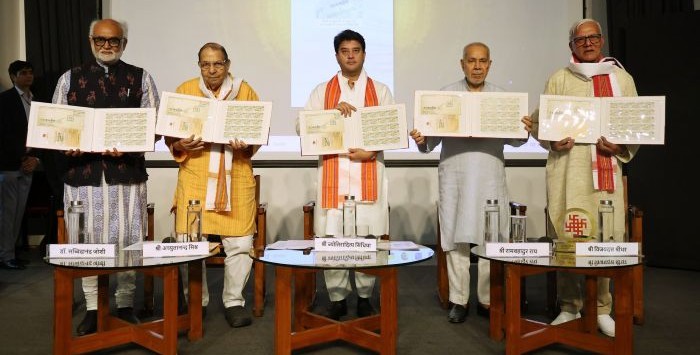
Union Minister for Communications Jyotiraditya Scindia on Saturday said that while journalism in the colonial era grappled with censorship and limited resources, the profession today faces a different set of challenges driven by artificial intelligence, deepfake technology and misinformation, with the "biggest crisis" being one of credibility.Speaking at an event marking 200 years of Hindi journalism, Scindia underscored the evolving role of the media in an age of rapid technological transformation and information overload.
A two-day seminar, beginning May 30, was organised by the Indira Gandhi National Centre for the Arts and the Madhavrao Sapre Memorial Newspaper Museum and Research Institute to commemorate the bicentenary of 'Udanta Martand', India's first Hindi weekly newspaper, which was published on May 30, 1826.
STORY | In era of AI, deepfake, credibility crisis looms largest: Scindia on challenges for journalism
— Press Trust of India (@PTI_News) May 30, 2026
Union Minister Jyotiraditya Scindia on Saturday said press faced censorship and scarce resources during the colonial era, but challenges for journalism are different in today's… pic.twitter.com/ctslCcnVQW
Addressing the gathering as the chief guest, Scindia released a commemorative stamp and a special volume marking 200 years of Hindi journalism.Reflecting on the changing landscape of journalism, he said, "In that era, challenges were different. Censorship was a challenge. A complete programme was in place to restrict freedom of expression. Resources were scarce.""But today, 200 years later, the challenges are different," he said."An information explosion has already taken place. The era of artificial intelligence has arrived. And, if I may say so, the biggest crisis in this era, is of credibility. And this credibility crisis has arisen because of fake narratives, deepfake technology and misinformation, manipulation of videos.""Back then, it was said that what one saw with one's eyes, was the truth. Today, truth has to be found between newspapers and information systems," he added.
#WATCH | Delhi: Union Minister Jyotiraditya Scindia participated in the 'Hindi Journalism Bicentennial Festival.'
— ANI (@ANI) May 30, 2026
He says, "On the occasion of Hindi Journalism Day, I congratulate all of you. Hindi journalism has made a significant contribution in our country... Today, on this… pic.twitter.com/VkzyzQCSKM
The minister noted that while technology is often used to gain likes and views, the same tools can also be harnessed to educate readers and foster greater awareness.In an environment flooded with information, journalism must move beyond merely reporting events and focus on providing context and deeper analysis, he said. Such an approach, according to Scindia, can help enhance readers' intellectual capacity and strengthen public discourse."There should not be just reportage, but a deeper analysis with that reportage, which can also enhance intellectual capacity of readers," he said.
Emphasising the larger responsibility of the media, Scindia remarked, "Because journalism is not only data. Journalism is about preserving the human conscience. And that responsibility is in your hands."During his address, the minister also highlighted the contribution of the erstwhile Gwalior state and the Scindia family to the development of journalism."My great-grandfather... (Jiwajirao Madhorao Scindia), started 'Jayaji Pratap' in the Gwalior state.. to raise awareness. We had a printing press in Gwalior's yard, which I'm now trying to transform into an old, industrial museum. I'll also keep the old press there," he said."And then, her daughter-in-law.. the former Rajmata Sahib, started 'Swadesh' on the Gwalior Palace campus. So, our family may not have same intellectual rigour as you all (veteran journalists) have, but I assure you, it is definitely connected to you in a close way," the Union minister added.
Scindia's remarks come at a time when concerns over misinformation, manipulated content and the growing influence of AI-generated media are reshaping discussions around the future of journalism. His address highlighted the need for credible, responsible and analytical journalism to safeguard public trust in an increasingly complex information ecosystem.









Related Items
Sitharaman invites global CEOs to invest in India
NSE gets SEBI nod for Rs 30,000-Cr IPO, India's largest public issue
India, Vietnam reaffirm commitment to regional stability and peace