 Newsinc24 Team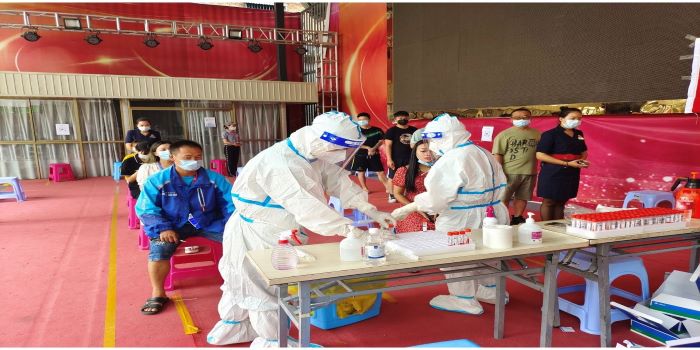
China reported two COVID-19 cases of highly transmissible Omicron variant this week after a sub-strain of the Delta variant triggered a new cluster of cases in eastern China’s industrial powerhouse province of Zhejiang, causing lockdown, travel restrictions, and shutting down factories. State media reported that the first case was detected in Tianjin, 100 km away from the capital Beijing, and second case on Tuesday in Guangzhou, Guangdong province. Both were imported cases, it said. Zhejiang Province registered 138 locally-transmitted confirmed cases stated to be that of new Delta strain "sub-lineage AY.4", prompting authorities to bar millions of people in the eastern province from travelling. This is the first time China has reported the new strain of the Delta variant of the coronavirus.
The whole-genome sequencing and analysis found that the cases in the three cities were caused by the Delta strain sub-lineage AY.4, which is stated to be more transmissible and carries a higher viral load than the original novel coronavirus, the report quoted an official with the Zhejiang provincial centre for disease control and prevention as saying. Over the past few months, Chinese authorities have resorted to increasingly stringent measures to curb local outbreaks often at great economic cost and disruption to daily lives. But infections have continued to flare up, breaking through its ambitious ‘Zero-COVID policy’. China has not released studies on how much its domestic vaccines protect against Omicron, though experts and state media have voiced confidence in curbing the new variant Omicron. China has administered more than 2.61 billion Covid-19 vaccine doses so far. But efficacy of Chinese vaccines has been found to be lower than the mRNA shots, and studies suggest the immunity provided by the Chinese vaccines wanes rapidly.
Chinese vaccine manufacturers are sprinting for breakthroughs in research for Omicron based on traditional inactivated virus techniques, Chinese experts have called for more cooperation with their Western counterparts on the development of mRNA vaccines. On Saturday, Zhong Nanshan, China’s top respiratory disease expert and government adviser, urged China to increase exchanges and cooperation in vaccine development with other countries. While Chinese regulators held off approval for the BioNTech mRNA vaccine, domestic companies were given the green light to forge ahead with developing their own mRNA vaccines. Chinese mRNA vaccine, ARCoVax, has been jointly developed by Yunnan Walvax Biotechnology, Suzhou Abogen Biosciences, and the Academy of Military Medical Sciences, a Chinese military research institute. It’s under clinical trial as a booster dose. Several other Chinese companies, including state-owned giant Sinopharm, are also developing mRNA vaccines. Experts say, China may not allow any foreign mRNA vaccine to enter Chinese markets before approving homegrown mRNA vaccines. According to media reports, more than a dozen Chinese-listed companies said they had suspended production in coronavirus-hit parts of Zhejiang province in response to the local government’s tightened Covid-19 curbs, causing their share prices to plunge












Related Items
Nepal: Death toll reaches 781, China: 261 foreign nationals missing
China expels PLA commander who led troops against India in Doklam, Galwan
Typhoon Saudel makes double landfall on China’s eastern coast