 Newsinc24 Team
 .jpg)
The White House has released a fact sheet detailing the outcomes of President Donald Trump’s recent high-stakes visit to China. The document highlights significant breakthroughs on trade, investment, and Middle East security—but notably omits any mention of Taiwan, despite the self-governed island reportedly dominating discussions between Trump and Chinese President Xi Jinping.The fact sheet announced the creation of two new institutional platforms: the “US-China Board of Trade” and the “US-China Board of Investment.” These bodies are designed to systematically manage and streamline bilateral economic and investment issues.
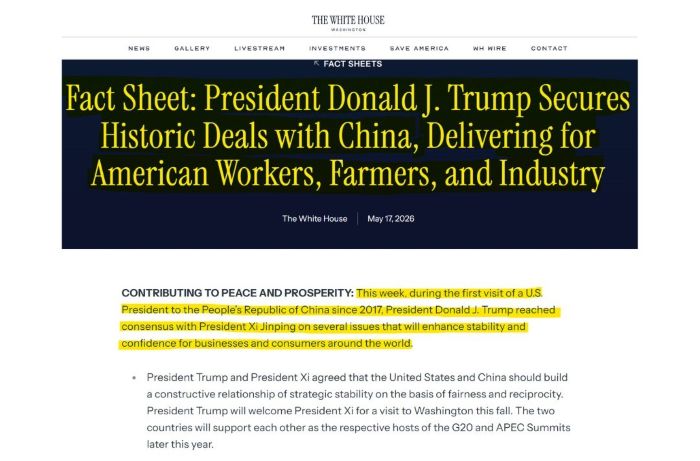
On international security, the two leaders found common ground on tensions in the Middle East, agreeing that Iran “cannot have a nuclear weapon.” They also called for the reopening of the Strait of Hormuz and affirmed that no country or organization should be allowed to charge tolls on the vital shipping lane.
Further boosting diplomatic engagement, the White House said Trump will host Xi in Washington later this year. Both administrations pledged mutual support as hosts for upcoming G20 and APEC summits.
The fact sheet also addressed U.S. concerns about supply chain vulnerabilities. Beijing committed to tackling shortages of critical materials, including yttrium, scandium, neodymium, and indium.
In a major win for the American aviation industry, China has cleared the purchase of 200 Boeing planes for domestic airlines—the first major U.S. plane sale since 2017. The agreement also includes a minimum $17 billion annual purchase of American agricultural goods from 2026 to 2028, building on prior soybean commitments from 2025.
Trade restrictions were eased as well. China restored market access for over 400 U.S. beef facilities and lifted bans on poultry shipments from states that have passed bird flu safety checks.
While the fact sheet emphasizes “strategic stability” and deep economic cooperation, the absence of Taiwan was striking. The White House said both nations aim to cultivate a “constructive relationship of strategic stability” based on fairness and reciprocity.
Chinese officials hailed the agreements as a groundbreaking framework for managing relations between the world’s two largest economies over the next three years, prioritizing cooperation while systematically addressing underlying tensions.
















Related Items
Satwiksairaj-Chirag clinch maiden China Masters title
Mudslide kills 1, leaves 11 missing in China after heavy rain
US sanctions Turkish bank to cut Iran's financial lifelines