 Newsinc24 Team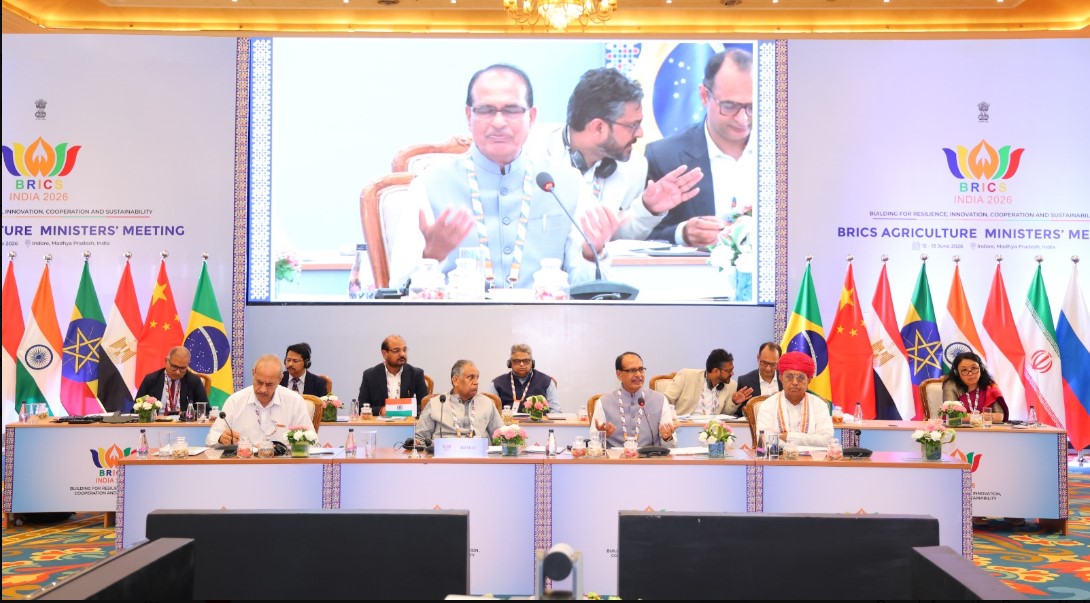
BRICS nations on Saturday adopted the Indore Declaration, a farmer focused roadmap aimed at strengthening food security, promoting sustainable agriculture and expanding cooperation in technology, trade and innovation, marking a significant outcome of the Agriculture Ministers' Meeting held under India's presidency in Indore.The declaration was adopted after five days of discussions involving senior officials and agriculture ministers from BRICS member and partner countries.
Pleased to share that under India's presidency, the 16th #BRICS Agriculture Ministers' Meeting in Indore adopted the Indore Declaration, reaffirming our shared commitment to strengthening agriculture, food security and nutrition.
— Shivraj Singh Chouhan (@ChouhanShivraj) June 13, 2026
To translate this collective resolve into action,… pic.twitter.com/WYYrODXF1T
Announcing the outcome, Union Agriculture and Farmers Welfare Minister Shivraj Singh Chouhan said the declaration reflects a shared commitment to place farmers at the centre of agricultural policymaking while addressing challenges ranging from climate change and food security to technology access and rural livelihoods.Nearly 100 delegates participated in the deliberations, including around 60 foreign representatives from BRICS countries and partner nations.
Chouhan said BRICS countries account for nearly half of the world's population, possess about 42 per cent of global agricultural land and contribute around 42 per cent of global foodgrain production. In that context, he said, the collective decisions taken by the grouping carry substantial weight in shaping future global agricultural priorities.The discussions revolved around four broad themes.Food and nutritional security. Agricultural trade and cooperation. Climate resilient and regenerative farming. Innovation, technology and partnerships in food systems.A dedicated session focused on small and marginal farmers, often referred to as family farmers in several countries, examining issues related to access to credit, agricultural inputs, markets and remunerative prices.
"The declaration places farmers at its core and records the shared commitment of BRICS countries to advance food security, nutrition, livelihoods, agricultural trade, innovation, investment and sustainable agricultural development," said Chouhan.The most significant outcome was the launch of four new institutional platforms designed to deepen cooperation among member nations.
According to agency reports,the first initiative is the BRICS Network of Centres of Excellence on Agro Ecology and Regenerative Agriculture. The platform will promote joint research, capacity building and exchange of best practices related to natural, organic and regenerative farming systems. India will be represented through the Indian Institute of Farming Systems Research at Modipuram.The second initiative is the BRICS Network on Digital Agriculture.The platform will focus on artificial intelligence, geospatial technologies, digital public infrastructure and data driven agricultural solutions. IIT Delhi will coordinate the initiative, which aims to connect emerging technologies with practical farming applications.
BRICS countries also agreed to establish a Global Forum on Farmers' Rights in Seed Systems. The forum will work towards protecting farmers' rights, preserving indigenous seed varieties and safeguarding traditional agricultural knowledge, an issue that gained prominence amid concerns over biodiversity loss and climate risks.The fourth initiative, BRICS AgriN, will function as a network for cooperation on agro inputs, genetic resources and agricultural information. The platform is expected to facilitate exchange of knowledge, improved crop varieties and technical expertise among member countries.
Chouhan said member nations also agreed to strengthen the existing BRICS Agricultural Research Platform and convert it into a more effective "Knowledge to Action Hub" to ensure that scientific innovations move quickly from laboratories to farms.Agricultural trade featured prominently in the discussions. Member countries reiterated support for a fair, transparent and inclusive multilateral trading system, while conversations on proposals such as a BRICS Grain Exchange received fresh momentum during the Indore meetings.
Delegates held discussions the impact of climate change, extreme weather events and El Niño related risks on agriculture. Chouhan said countries exchanged views on collaborative mechanisms for information sharing, climate adaptation and promotion of sustainable farming practices that reduce environmental pressures while maintaining productivity.The minister also highlighted efforts to reduce post harvest losses and food wastage, issues increasingly linked to food security and carbon emissions.
Addressing concerns over rising fertilizer costs due to geopolitical tensions and higher raw material prices, Chouhan said the Government of India would continue supplying urea and DAP at subsidised rates, with the Centre absorbing the additional financial burden. He also advocated balanced fertilizer use and greater adoption of natural and organic farming methods.Technology access for smallholders was another focus area. Chouhan said Custom Hiring Centres and group based models are helping farmers access drones and modern farm machinery without having to bear the full cost of ownership.
The minister said greater participation of women farmers, agri entrepreneurs and young innovators had been explicitly incorporated into the Indore Declaration. He noted that startups and technology driven enterprises are increasingly attracting young people towards agriculture and can play a key role in improving productivity and sustainability.
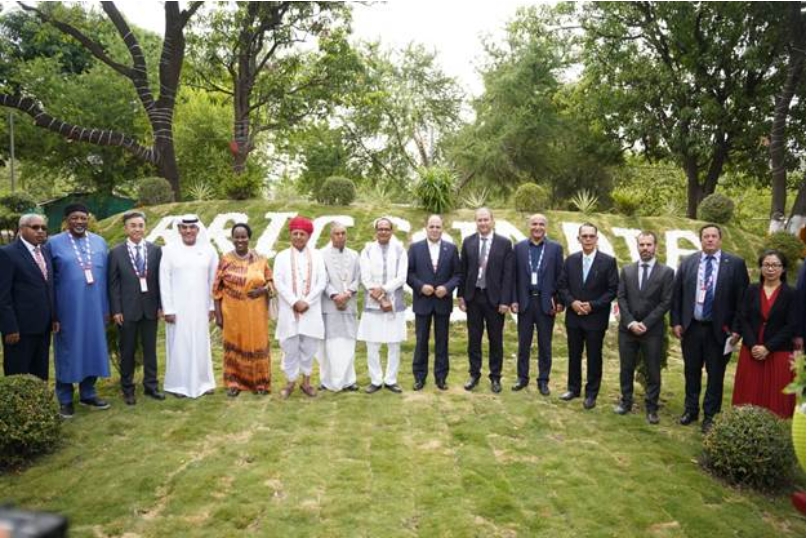
VIDEO | Indore, Madhya Pradesh: On the second day of BRICS Agriculture Ministers' meeting, foreign delegates plant saplings at Meghdoot Udhyan BRICS garden.
— Press Trust of India (@PTI_News) June 13, 2026
Agriculture Minister Shivraj Singh Chouhan says, "Today, the Agriculture Ministers and other delegation members of BRICS… pic.twitter.com/KoUd5WVFll
The meeting concluded with delegates participating in a plantation drive under the "Ek Ped Maa Ke Naam" campaign and establishing a "BRICS Vatika" in Indore, a symbolic gesture reflecting the group's emphasis on sustainable development and environmental stewardship.









Related Items
Apple Foldable iPhone Duo to hit Indian market from Oct 23
Gujarat Assembly monsoon session begins, 9 bills on agenda
PM Modi flags off freight, passenger train services in Gujarat