 Krishan Gopal Sharma
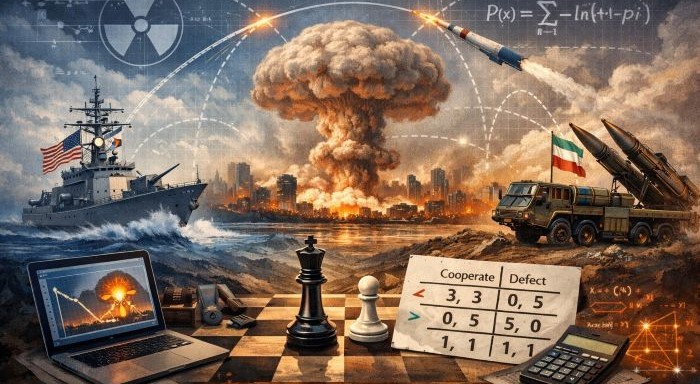
As the standoff between the United States and Iran sharpens and the last guardrails of strategic restraint erode with the end of the New START, the world drifts into a landscape where miscalculation could prove terminal. In this charged vacuum, power is no longer measured only in missiles or sanctions, but in the ability to anticipate consequence. Mathematical models — from nuclear winter simulations to game-theoretic analyses of brinkmanship — now offer a colder, clearer verdict than rhetoric ever can: escalation in a tightly coupled system does not produce victory, it produces collapse. The question is no longer whether leaders possess force, but whether they possess the discipline to heed the mathematics of survival.
The Moscow Realisation and the Climate Verdict
The intellectual architecture of this argument was not born in diplomatic chambers but in scientific institutes. During the late Cold War, researchers within the Soviet Academy of Sciences began confronting an uncomfortable truth: traditional military models measured damage, not survivability. Among the most influential figures was Nikita N. Moiseyev, whose systems analysis helped validate the nuclear winter hypothesis.
Using early but rigorous atmospheric simulations, Soviet and Western scientists demonstrated that even a limited nuclear exchange would inject vast quantities of soot into the upper atmosphere, blocking sunlight and collapsing global temperatures. Agricultural systems would fail. Supply chains would disintegrate. Famine would follow. Nuclear war, in other words, was not a contest with a winner; it was a systemic climatic event with planetary consequences.
This was a conceptual rupture. The science of deterrence had to confront the science of extinction. The battlefield was no longer territorial — it was atmospheric.
The Algorithm of Accord: Game Theory’s Discipline
If mathematics could model destruction, could it also model restraint? This question propelled the evolution of modern game theory in international relations. By abstracting states into rational actors operating within defined incentives, game theory stripped strategic rivalry of its emotional and ideological overlays.
In repeated strategic games resembling the Prisoner’s Dilemma, the logic was sobering. When actors pursued unilateral advantage under conditions of mistrust, the system converged towards mutually harmful outcomes. Arms races and escalation spirals were not aberrations; they were predictable equilibria of competitive insecurity.
Yet the same analytical tools revealed another possibility. Under transparency, verification and credible commitment, stable cooperative equilibria could emerge — arrangements in which no actor gained by unilateral defection. Arms control treaties, inspection regimes and confidence-building measures were not sentimental gestures. They were mathematically defensible stabilisers within an unstable system.
The erosion of formal constraints today therefore represents not merely a political setback, but the weakening of systemic guardrails.
Validation and the Age of Systems Thinking
Contemporary climate science, powered by vastly more sophisticated computational models than those available in the 1980s, has only deepened the warning. Even a regional nuclear exchange involving a small fraction of global arsenals could trigger worldwide agricultural collapse. The threshold for catastrophe is lower than strategic rhetoric implies.
Beyond nuclear risk, systems modelling now shapes global governance across domains. Climate negotiations under the Paris Agreement rely on integrated assessment models to balance economic growth with emissions reduction. Financial regulators use systemic risk models to prevent cascading collapses. Pandemic preparedness depends on epidemiological simulations that map exponential spread.
In each case, mathematics performs the same function: it exposes interdependence. It reveals how tightly coupled systems amplify shocks. It replaces assumption with quantification.
The Present Reckoning
In the current US–Iran standoff, signalling, sanctions and proxy manoeuvres are often described as calibrated instruments of leverage. Yet calibration in a complex system is inherently fragile. Feedback loops, misperceptions and unintended escalations can transform tactical gestures into strategic crises.
Mathematical modelling does not predict the exact spark of conflict. What it demonstrates, relentlessly, is the scale of consequence once ignition occurs. It strips brinkmanship of its theatrical appeal and reduces it to variables and outcomes.
The uncomfortable truth is that in a hyper-connected world, escalation is rarely contained. Economic shock reverberates globally. Military confrontation reshapes alliances. Environmental consequences disregard borders. The system does not respect intention.
The Necessary Evolution of Conscience
Science has done its work. It has mapped the pathways to ruin and illuminated the architectures of restraint. The equations are clear: competitive escalation in a nuclearised, climate-stressed and economically interlinked world produces systemic collapse. Cooperative security produces survivable equilibrium.
What remains unresolved is not a technical question but a moral one. Mathematical models are indifferent to pride, prestige or political theatre. They register only inputs and consequences.
The arithmetic of survival is unforgiving. It offers clarity without comfort. In an era marked by treaty erosion and strategic drift, the decisive variable is whether leadership will internalise what the models already show — that in the final calculation, restraint is not weakness but the only rational form of strength.
(The writer is a retired officer of the IIS and a former Editor-in-Charge of DD News and AIR News , India’s national broadcasters, as well as Media-link Information Officer of PIB attached to various ministries. He has also worked as an international media consultant with UNICEF Nigeria and contributes regularly to various publications in India and abroad)



Related Posts
Iran plots to assassinate US officials in Middle East and beyond: Report
Trump warns Iran of potential strike if deal not reached
Iran rejects US response to conditions set to reopen Strait of Hormuz