 Ira Singh

India’s rural policy architecture is undergoing one of its most consequential transitions in over a decade. With the replacement of the Mahatma Gandhi National Rural Employment Guarantee Act by the Viksit Bharat – Guarantee for Rozgar and Ajeevika Mission (Gramin), and renewed capital push for housing, roads, livelihoods, and land reforms, the Union Budget 2026–27 signals a structural shift rather than incremental tinkering.But as allocations expand and schemes are rebranded or restructured, a deeper question emerges: will institutional capacity, implementation discipline, and state-level execution keep pace with ambition?
A ₹1.97 Lakh Crore Blueprint for Rural India
The Ministry of Rural Development has been allocated ₹1,97,023 crore for 2026–27 — a 4% increase over the revised estimates of the previous year. Of this:
•₹1,94,369 crore goes to the Department of Rural Development.
•₹2,654 crore is earmarked for the Department of Land Resources — a sharp 51% rise.
The bulk of the allocation remains concentrated in a few flagship schemes, underlining the government’s preference for scale-driven delivery.
From MGNREGS to VB-G RAM G: A Structural Pivot
The most significant reform is the replacement of Mahatma Gandhi National Rural Employment Guarantee Act with the Viksit Bharat – Guarantee for Rozgar and Ajeevika Mission (Gramin) Act.
What’s Changed?
•Employment guarantee increased from 100 to 125 days per household.
•Scheme converted into a Centrally Sponsored Scheme.
•Centre–State cost sharing revised to 60:40 (90:10 for NE and Himalayan states).
•State-wise normative allocations to be determined by the Centre.
The new scheme has been allocated ₹95,692 crore. In contrast, the allocation for the residual MGNREGS component stands at ₹30,000 crore — a 66% reduction from last year’s revised estimates.
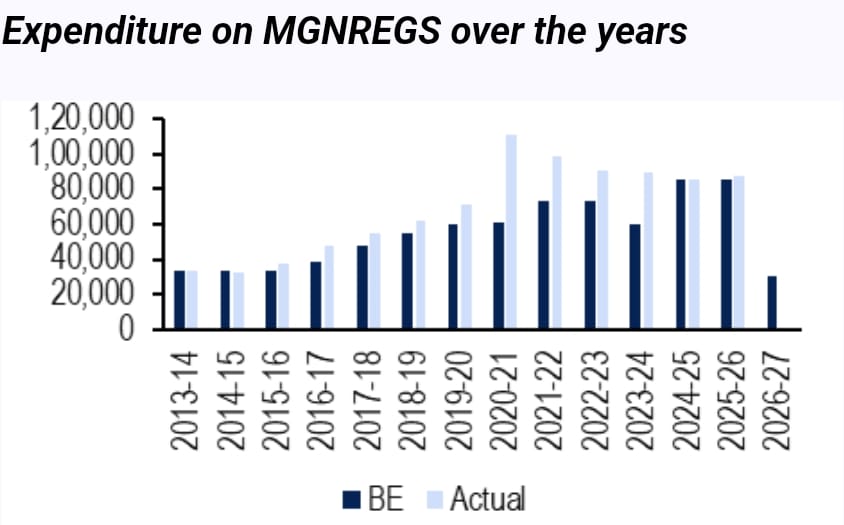
The Reality Check
•Despite statutory guarantees, the past decade shows:
•Average employment generated: 48 days per household per year
•Less than 10% of households completed 100 days
•Wage payments constituted nearly 70% of total expenditure
The expansion to 125 days is ambitious. But unless actual demand is matched by fiscal space and state capacity, the headline figure may remain aspirational.
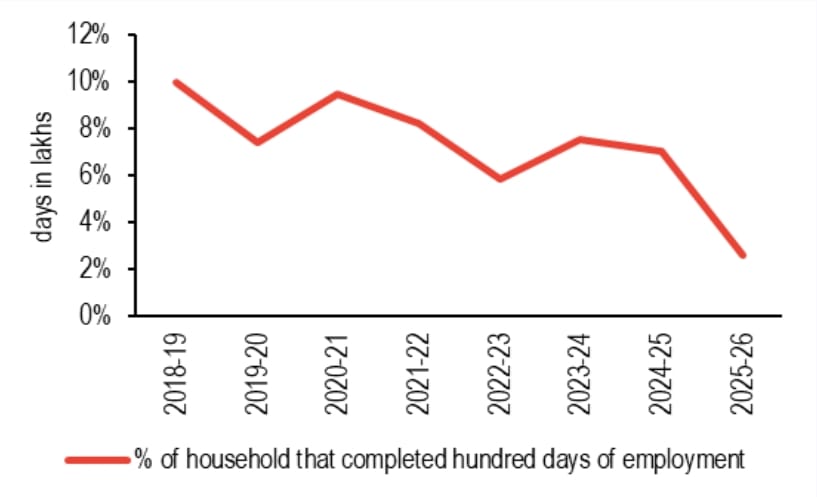
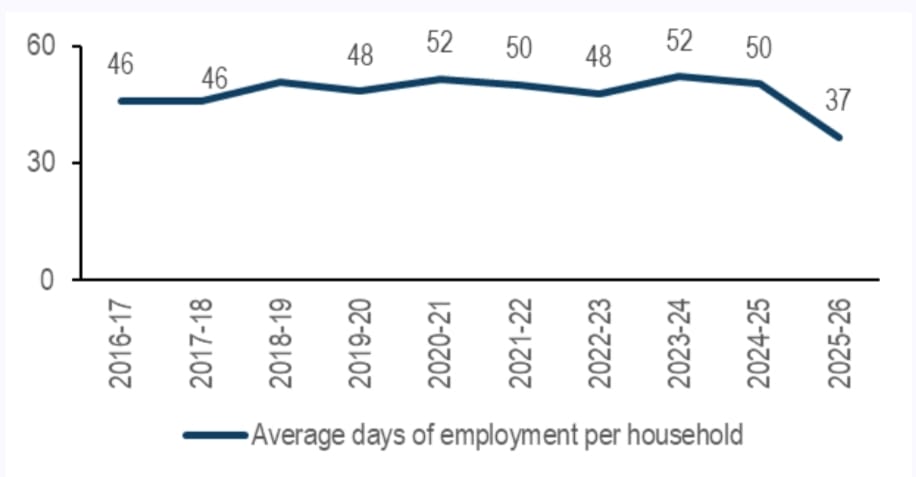
Wage Gaps and Unemployment Allowances: Persistent Frictions
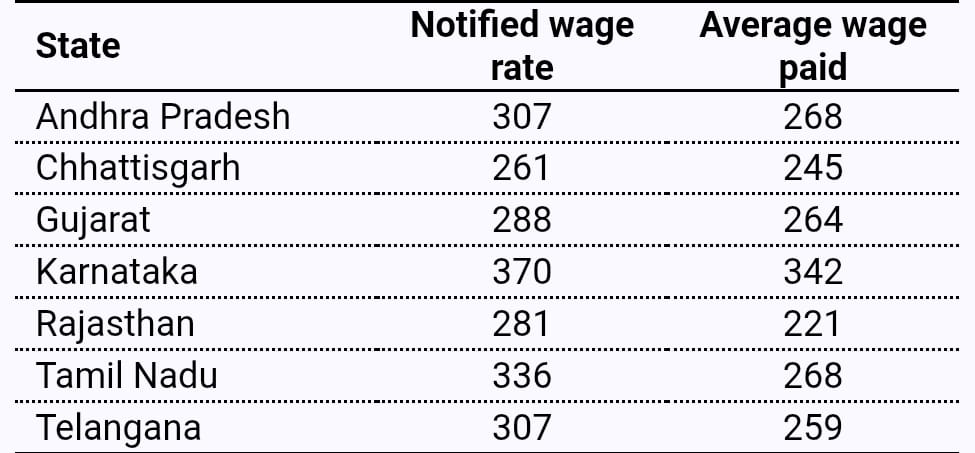
Under the earlier framework, wages were indexed to the Consumer Price Index for Agricultural Labourers (CPI-AL). Yet in 20 out of 31 states and UTs in 2025–26, workers received wages below notified rates.
More troubling is the issue of unemployment allowance:
Between 2019–25, only about 8% of due allowances were paid.
In 2025–26 (till February), only 2% of due allowance had been disbursed.
These gaps point to a systemic issue — legal guarantees without administrative enforcement.
PMAY-G: Housing Push, Execution Pause
The Pradhan Mantri Awaas Yojana – Gramin has been allocated ₹54,917 crore in 2026–27 — a 69% increase. Yet, fund utilisation has weakened:
•Only 70% of the cumulative 4.15 crore houses targeted have been completed.
In 2025–26, expenditure was 41% below budget estimates.
•Average completion time: 297 days.
•Several North-Eastern and hilly states exceed one year in completion timelines.
Persistent constraints include land unavailability for beneficiaries, migration, and succession disputes. Parliamentary committees have recommended raising unit assistance from ₹1.2–1.3 lakh to ₹4 lakh to offset inflationary pressures.
The funding increase signals intent. The implementation backlog suggests caution.
PMGSY: Near Saturation, Quality Concerns
The Pradhan Mantri Gram Sadak Yojana receives ₹19,000 crore in 2026–27 — a 73% rise.
As of December 2025:
•94% of sanctioned roads (8.36 lakh km) are completed.
•Completion rates remain slower in Left Wing Extremism and tribal areas.
However, inspection data reveals a maintenance challenge:
•24% of roads inspected by National Quality Monitors were unsatisfactory for maintenance.
•16% flagged by State Quality Monitors.
The next phase, PMGSY-IV, aims to connect 25,000 habitations by 2028–29. But sustaining asset quality may prove harder than building new ones.
NRLM: The SHG Revolution Deepens
The Deendayal Antyodaya Yojana – National Rural Livelihood Mission has been allocated ₹19,200 crore — a 20% increase.
Key highlights:
•92 lakh Self-Help Groups promoted cumulatively.
•Over 10 crore households covered.
•₹1.2 lakh crore in loans disbursed in 2025–26.
•Loan repayment rate: ~98%.
The SHG architecture remains one of rural India’s most stable institutional platforms. However, regional credit disparities persist, and access to higher-value enterprise financing remains uneven.
NSAP: Social Security Under Strain
The National Social Assistance Programme allocation stands at ₹9,671 crore — just 5% higher than last year.
Yet:
•Old age pension remains ₹200 per month (₹500 above age 80).
•Several states delay disbursement by months.
•Pension payments are irregular in many regions.
While states top up the central assistance, disparities across regions widen the social security gap.
Land Reforms: Ambition vs Utilisation
The Department of Land Resources sees a 51% allocation increase.
PMKSY–Watershed Development
The Pradhan Mantri Krishi Sinchai Yojana – Watershed Development Component allocation rises to ₹2,500 crore.
However:
In 2025–26, utilisation was just 40% of budget estimates.
Key components such as water harvesting renovation achieved only 11% of targets.
DILRMP: Digitising Land, Slowly
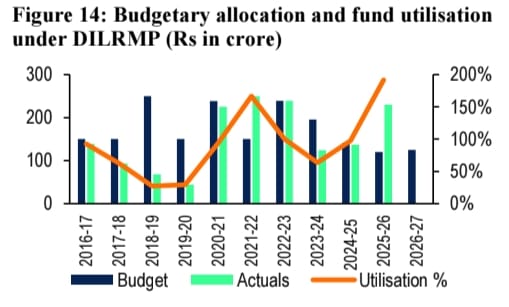
The Digital India Land Records Modernisation Programme receives ₹125 crore — 46% lower than last year’s revised estimate.While computerisation of records of rights and sub-registrar offices has reached 100%, digitisation of cadastral maps and GIS integration remain works in progress — often delayed by manpower shortages and state-level execution gaps.
The Capacity Question
Repeated parliamentary observations highlight one recurring constraint: institutional capacity.
•One Panchayat Secretary manages 17 Gram Panchayats on average.
•Only 63% of Gram Panchayats conducted at least one social audit in 2025–26.
•Maintenance funding for rural roads varies widely across states.
•Land record updates lag behind ground realities.
•Budgetary expansion without administrative strengthening risks diminishing returns.
A Rural Crossroads
Budget 2026–27 for Rural Development is not about austerity — it is about recalibration. The shift from MGNREGS to VB-G RAM G, the housing push, the infrastructure consolidation, and the digital land reform agenda collectively indicate a governance pivot.
Yet, three structural challenges remain:
•Demand vs capacity mismatch
•Allocation vs utilisation gaps
•Legal entitlement vs administrative enforcement
If the coming years see improvements in planning, state-level capacity, digital integration, and accountability, the current allocation surge could mark a transformative phase.
If not, the numbers may remain impressive — but outcomes uneven.Rural India stands at a policy inflection point. The 2026–27 grants suggest intent. The real test lies in delivery.
(Business Correspondent)


Related Posts
Gujarat: National unity rally with 150 motorcycles flagged off in Surat
US National appears before Delhi NIA court in Myanmar arms training case
National Unity Day to mark end of Naxalism, promote drug-free India