 Nisha Singh
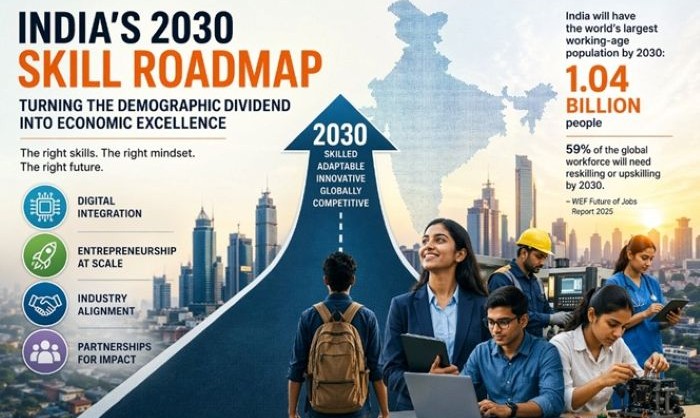
"India stands at a decisive inflection point. How it navigates the next five years will determine whether its demographic dividend becomes an economic asset or a missed opportunity." By 2030, India is projected to have the world’s largest working-age population, with nearly 1.04 billion people. But this advantage is not automatic. According to the World Economic Forum’s Future of Jobs Report 2025, about 59% of the global workforce will require reskilling or upskilling by 2030 as technological, economic and green transitions reshape job roles. The question is not whether India must transform its skilling ecosystem but how quickly and effectively it can do so.
From Scale to Outcomes
Over the past decade, initiatives under the Skill India Mission and the National Policy for Skill Development and Entrepreneurship have laid a strong foundation. Programmes such as Pradhan Mantri Kaushal Vikas Yojana (PMKVY), Skill India Digital Hub (SIDH), and World Bank-supported SANKALP and STRIVE have shifted the focus from training volumes to outcome-driven, demand-aligned skilling.
The next phase must go further, aligning competencies with real-time market needs, ensuring global benchmarking of certifications, and embedding entrepreneurship within the skilling ecosystem.
The Horizontal Imperative
While sector-specific skilling has expanded in manufacturing, IT and healthcare, a critical gap remains in horizontal capabilities, management, communication, financial literacy and leadership.
These are no longer optional. As organisations flatten hierarchies and digital systems decentralise decision-making, such skills are becoming essential at every level.
Entrepreneurship, too, must be redefined. It extends beyond starting new ventures to include intrapreneurship, innovation, and problem-solving mindsets within organisations and communities.
Sector Skill Councils (SSCs), which define National Occupational Standards and Qualification Packs, play a key role in embedding these cross-cutting skills into India’s workforce.
Digitisation as the Core Enabler
India’s skilling future will be digital-first. Technology is transforming not just jobs, but how skills are acquired, assessed and certified.
Digital platforms, AI-enabled learning, and online certification systems are enabling scale, transparency and accessibility, particularly beyond urban centres. More importantly, they are making lifelong learning a practical necessity rather than an aspiration.
Strengthening the Skilling Ecosystem
Management and Entrepreneurship and Professional Skills Council (MEPSC) highlight the importance of cross-sectoral skilling frameworks. By focusing on management, entrepreneurship and professional skills, such models support workforce mobility across industries and career stages.
Increasingly, skilling ecosystems are also integrating academic partnerships, global exposure and industry collaboration, blurring the lines between education, training and employment.
The Perception Challenge
Despite progress, vocational skilling continues to face a perception challenge in India, often viewed as secondary to traditional academic pathways.
Changing this narrative is critical. Skilling must be positioned not as an alternative, but as a primary pathway to economic mobility and career growth.
The Road to 2030: Four Priorities
To fully leverage its demographic advantage, India must focus on four priorities:
1. Deepen Digital Integration: Embed digital literacy, data skills and AI capabilities across all training frameworks.
2. Build Entrepreneurial Pipelines: Shift from job seekers to job creators through incubation, mentorship and access to finance.
3. Strengthen Industry Alignment: Ensure continuous collaboration with industry to keep training relevant and demand-driven.
4. Scale Through Partnerships: Drive impact through stronger collaboration across government, industry, academia and skilling institutions.
India’s demographic dividend presents a once-in-a-generation opportunity. But its success will depend on building a workforce that is not just skilled, but adaptable, entrepreneurial and digitally fluent.
The shift from “Skill India” to a truly “Skilled India” will require systemic transformation, where policy, technology and institutions work in alignment.
(Nisha Singh,GM-Brand & Corporate Commumnication, MEPSC, New Delhi)



Related Posts
India must lead in creating future technologies, says PM Modi
India pushes for BIOFIN, tech transfer & global cooperation
India-EU investment protection agreement under discussion: Goyal