 B I Saini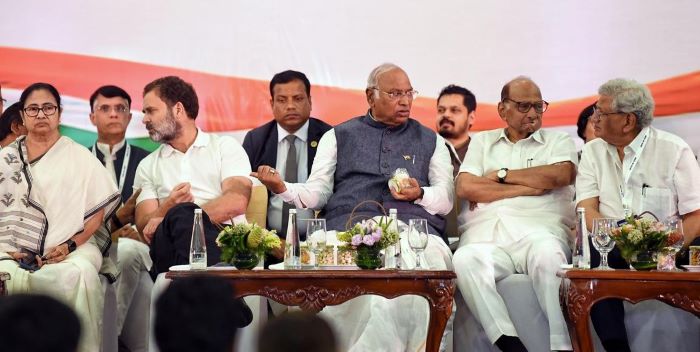
With the opposition parties coming together in Mumbai, their third conclave in the last four months, circumstances are building up for a tough electoral contest in the Lok Sabha elections due by May next year.
The meeting held in Mumbai last week is remarkable in terms of the resolve expressed by most participating political parties to work together to defeat the incumbent government at the Centre headed by Prime Minister Narendra Modi. The parties unanimously set up a 14 member coordinating committee to take further steps to put up a united challenge to the National Democratic Alliance, NDA, led by the BJP. A significant move was to lose no time in taking the next step, that is the seat sharing at the state level. An encouraging feature was the recognition by major opposition parties that they must put up a common fight to save democracy and democratic institutions in the country. All of them were in agreement that the Narendra Modi led ruling dispensation posed a serious threat to the continuance of democratic functioning in the country. All of them were critical of what they called the misuse of supposedly independent agencies and the media to harass the opposition parties and their leaders.
That their fight is not going to be easy became clear on the last day of the opposition conclave, that is September 1, with the report from national capital that the government is considering steps to go in for One Nation One Poll, where elections to both the Lok Sabha, the lower house of parliament, and the State Assemblies are held at the same time or simultaneously. This was accompanied by the announcement that a special session of parliament would be held later this month. As no agenda for the special session was announced, it led to speculation that the session might be used to get parliamentary approval for holding simultaneous elections to the Lok Sabha and State Assemblies.
The government later announced the setting up of a committee headed by former President Ram Nath Kovind to go into the issue of One Nation One Poll. As the details of the specific agenda of the committee has not been made public, it is not clear what time frame will be there to carry out the recommendations of the panel. This leaves the field open for the government to adopt whatever course of action it may find to be in the interest of the ruling party.
A tough challenge lies ahead for the opposition parties in the so-called INDIA alliance to work out seat sharing for the national elections. It may be easy in some states like Bihar, Maharashtra and Tamil Nadu, where the contours of the seat sharing are almost drawn already. But it will be a tough and tricky course in states like West Bengal, Uttar Pradesh and Punjab and NCT Delhi, where the opposition alliance partners are in direct fights with each other. How do Mamata Banerjee’s Trinamul Congress compromise with the Congress and the Left parties in West Bengal? A similar conundrum is in Punjab and Delhi where Arvind Kejriwal’s Aam Aadmi Party and the Congress are in direct opposition.
There are some other issues which will take some intense efforts to resolve. For example, the issue of who will be Prime Minister if the combine is victorious. There are any number of Prime Ministerial aspirants in the opposition alliance. The best course of action, of course, is to postpone the decision to the post-election stage. But some elements in the body politic, including a section of the media is playing up the issue, which can derail the opposition alliance even before it takes off.
The opposition alliance also needs to devise an effective response to the government charge accusing the opposition of being a combine of the corrupt and dynastic elements.
The coming national election will witness a tough fight, which is clear from the steps being taken by the ruling dispensation to gear up and to take the fight to the opposition camp. An interesting time ahead.
(The writer is a Political Analyst with decades of journalistic experience. Retired as DG, News, AIR)




Related Items
India Passes BRICS Baton to China, PM Modi seeks timely action on Declaration
India, Russia agree to advance bilateral investment treaty talks
India's electoral process among most transparent in world: CEC