Atrocities Committed on the Hindus during Muslim Rule
Will Durant, famous American historian and philosopher, in his eleven-volume magnum opus ‘The Story of Civilization’, makes a very insightful observation: “The Mohammedan conquest of India is probably the bloodiest story in history. The Left-Liberal cabal has been trying to defend the atrocities committed by the Muslim invaders upon the Hindus essentially in the name of religion, by arguing that murder, plunder, rape and rapine was the norm for the victors in that era and hence there was nothing unnatural or abnormal in the behaviour of the Muslim invaders. This is not just outrageous but a despicable lie.
Historically, most of the victorious armies have been committing various degrees of atrocities upon the vanquished. However, committing atrocity in the frenzy of fighting or as a result of anger over the losses sustained in the battle is materially different from ‘calculated atrocities’ committed in the name of religion. The ferocity and single-minded devotion with which the Muslim invaders carried out their saga of murder, plunder, rape and rapine, as if it was the sole object of military conquest, would make even the most depraved of the world blush. Only the Mongol hordes could match them in bestiality and they, incidentally, happened to be ancestors of the Mughals.
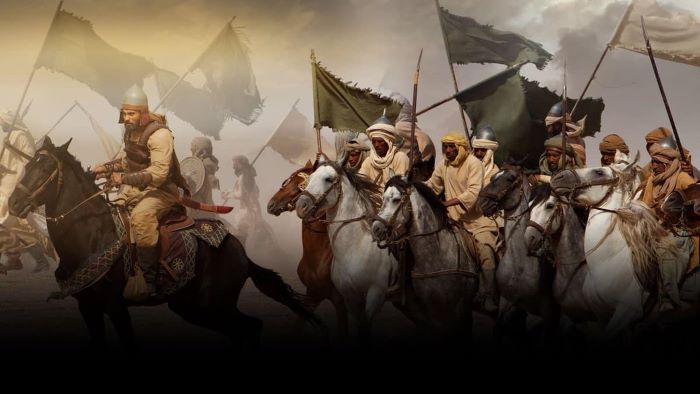
Photo credit: Wikimedia Commons
Before the Muslim armies set foot on India, this land was invaded in the past by people of various races, such as the Hunas; Alexander the Macedonian Greek; the Bactrian Greeks; the Shakas; Parthians; Kushanas; and after the Muslims, the British, French and Portuguese. None of them was as barbaric and as savage as the Muslim invaders. None of them went after destroying the Hindu religion and hurting Hindus’ religious sentiments as methodically and as their sole obsession as the Muslim invaders. The sheer savagery of the Muslim invasions has left an indelible imprint on the collective psyche of the Hindus which has shown absolutely no sign of fading away in spite of over 13 centuries of ‘forced coexistence’ of the two communities since 712 AD.
On the contrary, Menander (later named Milind) embraced Buddhism under the Buddhist monk Nagarjuna. A Greek ambassador, Heliodorus, became Vaishnavite and erected ‘Garuda Pillar’ at Besnagar, Vidisha. The Shaka Maha-kshtrapa Rudradaman I issued the first ever long inscription in chaste Sanskrit. The Kushan king Kanishka embraced Buddhism but his coins exhibit images of not only Buddha but also of Greek and Hindu gods, clearly implying his toleration. He was a great patron of arts and Sanskrit—blossoming in the Gandhara and Mathura schools of art. He also patronised the great Ayurveda physician Charak who is now synonymous with the science of Ayurveda. The last Kushan ruler Vasudev worshipped Bhagwan Shiv. As for the Europeans, suffices it to say that, for many of us, our very introduction to our cultural heritage came through the translations done by them and archaeological discoveries made by them.
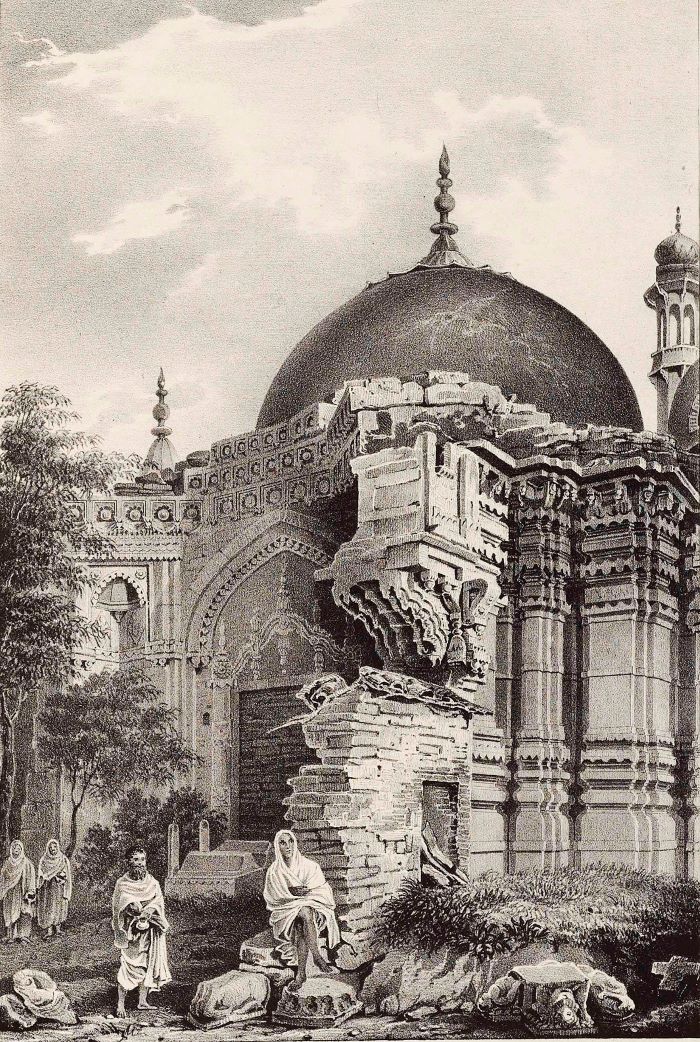
The Gyanvapi masjid as depicted in the sketch made by James Prinsep in 1831 for his book 'Benares Illustrated'. The sketch clearly shows the remnants of the Kashi Vishwanath temple that stood there. Diana Eck has pointed out in her book 'Benares: The City of Light' that it also shows two Muslim graves that were obviously made there with the intention of defiling even the remnants of the temple, there being no shortage of graveyards in Benares.
photo credit: Christie.com
It is not that only the Hindus were the unfortunate victims of Muslim invaders’ fiendishness. Little more than a century after the Prophet (PBUH), the swords of the Islamic armies rapidly swept over the Ancient World. The Left-Liberal cabal describes the Crusades as a clash of the European Dark Age with the Muslim Golden Age and an attempt by the Christians to retake the Holy Land and Jerusalem. It is not so. As historian John J. O’Neill has shown, before the advent of Islam, Christians had no concept of ‘Holy War’ at all, and that it was from the Muslims themselves that Europeans took this idea. The Crusades, were therefore part of a rear-guard action aimed at stemming the Muslim advance which, by the beginning of the 11th century, was threatening like never before to overwhelm the whole of Europe. In fact, the Muslim armies were so relentless in their pursuit of murder, plunder, rape and rapine that the most popular image of the Turks in the Western minds became that ‘Terrible Turk’ and ‘Lustful Turk’.
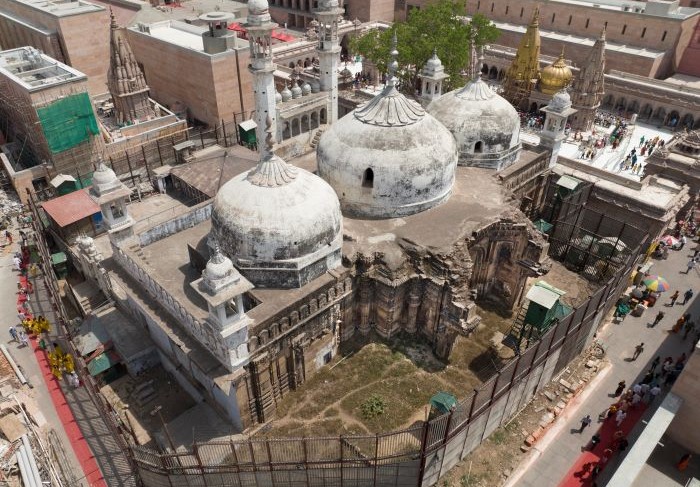
The Gyanvapi masjid as it stands today. The western wall of the masjid can be clearly seen in this photo, which obviously belonged to the erstwhile Kashi Vishwanath temple.
Photo credit: Author Dr. N. C. Asthana
There may be some dispute over the estimate of Hindu population having declined by 60 to 80 million during 1000 to 1525 AD, as estimated by the Dr. K. S. Lal, historian and professor at several universities, in his book ‘Growth of Muslim Population in Medieval India (1000-1800)’. A similar remark has been made by the famous Belgian Indologist and scholar of Hindu nationalism Dr. Koenraad Elst in his article ‘Was There an Islamic Genocide of Hindus?’ He comments: “There is no official estimate of the total death toll of Hindus at the hands of Islam. A first glance at important testimonies by Muslim chroniclers suggests that, over 13 centuries and a territory as vast as the Subcontinent, Muslim Holy Warriors easily killed more Hindus than the 6 million of the Holocaust. Ferishta, the famous Persian historian who settled in India, lists several occasions when the Bahmani sultans in central India (1347–1528) killed a hundred thousand Hindus, which they set as a minimum goal whenever they felt like punishing the Hindus; and they were only a third-rank provincial dynasty.” Francois Gautier, author on history and Indology, also opines that, “The massacres perpetuated by Muslims in India are unparalleled in history, bigger than the Holocaust of the Jews by the Nazis; or the massacre of the Armenians by the Turks; more extensive even than the slaughter of the South American native populations by the invading Spanish and Portuguese.”
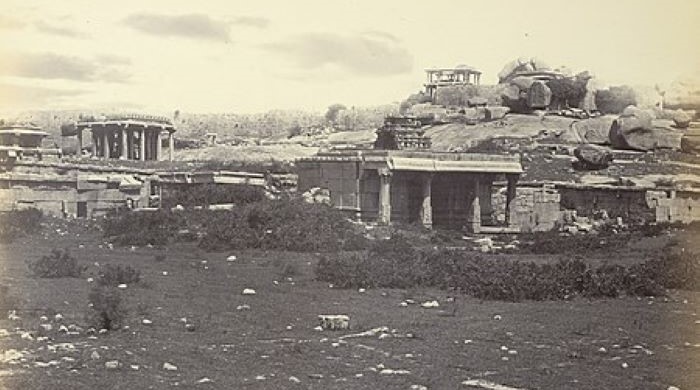
Ruins of the Vijayanagar empire destroyed by the Muslims. (Photo credit: Photographer: Lyon, Edmund David (1868). Now at the British Library.)
One may argue over these estimates and is free to disagree with them. However, the fact that massacres of Hindus did take place is not questionable because contemporary Muslim chroniclers themselves confirm it. Now, to argue that they wrote lies to please their masters is plainly stupid. The real issue is not that exactly how many Hindus were killed or how many Hindu women were raped? The real issue is that these crimes had indeed taken place.
If today’s Muslims are found ‘relishing the relics of a brutal past’, such as their purposefully offering namaz in those old, dilapidated mosques also, which scream to have been built after demolishing revered temples and using the same material so as to hurt the Hindus all the more, is resented deeply by the Hindus and is one of the major stumbling blocks in ‘Historical Closure’, or a ‘reset’ of the relationship between the two communities.
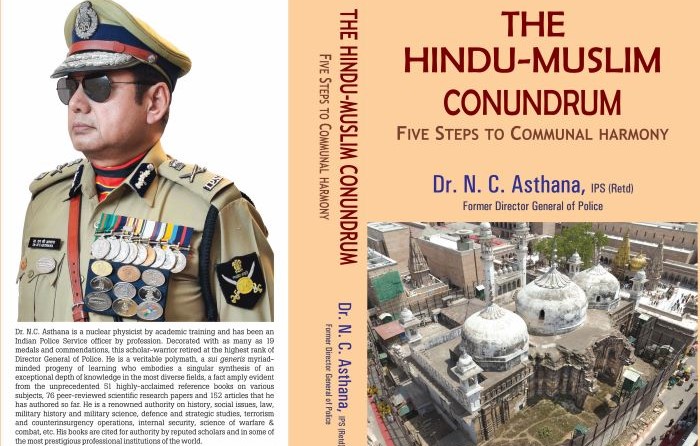
[Publisher: Sannidhya Books (9810101036), Delhi.]
(Writer is an IPS (Retd), former DGP, Kerala and the author of 51 books and 246 research papers/articles)
Related Posts
NIA Court awards life sentences to 4 PFI cadres for Hindu Munnai leader murder case
Cong opposes Vande Mataram for Muslim appeasement: MP CM
Iran’s leader urges Muslim rulers to confront their true enemy