 Newsinc24 Team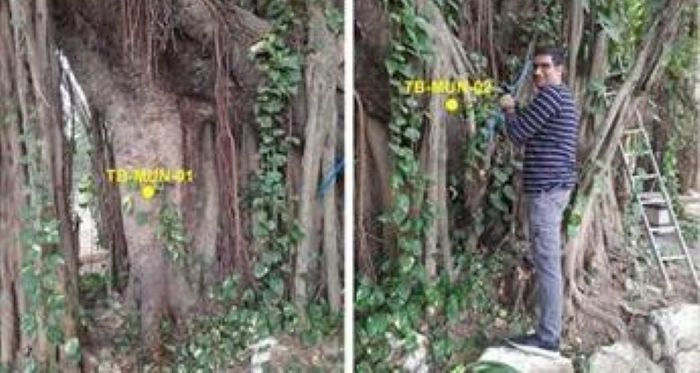
A monumental banyan tree (Ficus benghalensis) located on the Indian Tobacco Company (ITC) campus in Bihar's Munger has been identified as one of the world’s oldest scientifically dated living trees with its age estimated at around 700 years through radiocarbon dating. The discovery followed a survey conducted by the Bihar Biodiversity Board in 2022, which examined 32 ancient trees across the state. Three trees from Munger, including the banyan, were selected for detailed study. Researchers from the Birbal Sahni Institute of Palaeosciences(BSIP), Lucknow, including Trina Bose, Mayank Shekhar, Akhilesh Kumar Yadav and Avneesh Mishra, collected samples from the trunk and dried aerial roots for analysis. The radiocarbon dating established the tree’s age at nearly seven centuries.
They collected samples from the trunk and dried aerial roots for analysis. The radiocarbon dating established the tree’s age at nearly seven centuries. The extracted cellulose samples were subjected to high-precision radiocarbon dating using Accelerator Mass Spectrometry (AMS), followed by calibration against the latest IntCal20 calibration curve and OxCal software, enabling the team to establish a robust, reliable estimate of the tree's age.
This finding refutes earlier assumptions that the Munger Banyan was planted in front of the historic 'Burra Bunglow', which, based on architectural style, dates to the late Mughal-Early British period (~300 to 350 years old), as a venue for dialogue between rulers and common citizens, village assemblies, religious ceremonies, and cultural exchanges. It establishes that the approximately 700-year-old tree is likely a surviving remnant of a natural forest that once existed in the region, and that it witnessed the construction of the building. Hence, this analysis redefines the order of historical events in this region.This research represents a major breakthrough in the scientific dating of ancient trees in tropical regions, especially those of cultural significance, such as the Banyan, and will not only help determine the age of such trees more accurately but also support efforts to preserve natural, historical, and cultural heritage throughout South Asia and beyond.
Banyan trees, with their intricate root and branch networks, provide habitats for a variety of wildlife, including birds and insects. They have also played a significant role in Indian social and cultural life for centuries. Traditionally, estimating their age relied on folklore, local stories or historical records, which were often inaccurate. These living representations of history were not scientifically dated previously due to a lack of a clear protocol. Field sampling and laboratory analyses revealed that the absence of distinct annual growth rings in most tropical broadleaf trees limited the application of conventional dendrochronological techniques, emphasising the need for alternative high-precision dating methods, including radiocarbon dating.
The study, published in the journal Quaternary Research, establishes the age of the Ficus benghalensis tree through scientific evidence rather than relying on folklore, historical records or local traditions that have long been used to estimate the ages of such ancient trees. Spread across about 100 square metres and standing nearly 60 feet tall, the banyan has developed hundreds of aerial roots that have grown into supporting trunks over the centuries. It has also survived major events, including the 1934 earthquake.

















Related Items
At least 55 killed in Nepal flash flood, Bihar, UP borders on alert
Bihar: Rising Ganga triggers erosion in Danapur
Centre approves 11.19 lakh pucca houses for Bihar