 Newsinc24 Team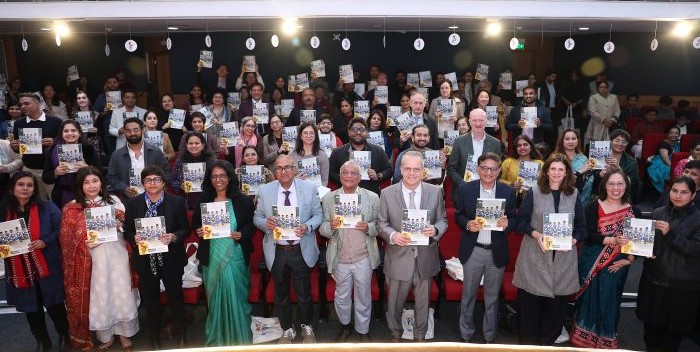
UNESCO has launched the seventh edition of its annual flagship report, “Bhasha Matters”, the 2025 State of the Education Report for India, focusing on Mother Tongue and Multilingual Education. This year’s report explores the critical role that language plays in education. In a country like India, home to 1,369 languages, integrating multilingualism becomes essential to ensure inclusive and equitable quality education so that every child can learn in a language they understand.
The report examines the implementation of multilingual education across India’s diverse educational landscape, presenting evidence from classrooms, teacher-education initiatives, digital innovations, and community-led programmes. Case studies from tribal and rural contexts demonstrate that when schools embrace learners’ home languages, measurable improvements emerge in reading comprehension, classroom participation, conceptual understanding, and in building stronger foundations for lifelong learning
The report aligns closely with India’s National Education Policy (NEP) 2020 and the National Curriculum Frameworks for the Foundational Stage (2022) and School Education (2023). To address gaps in multilingual planning, including teacher preparation, language policy and learning resources, the report proposes ten recommendations to accelerate progress:
• Adopt and operationalize clear state-level language-in-education policies grounded in Mother Tongue and Multilingual Education;
• Strengthen teacher recruitment, deployment and professional standards for multilingual competence;
• Reform pre-service and in-service teacher education to embed multilingual pedagogy at all stages;
• Institutionalize community participation and Indigenous knowledge in school practice;
• Develop and distribute high-quality multilingual learning materials and assessments across grades;
• Integrate a gender-responsive mother tongue-based multilingual education (MTBMLE) framework across middle, secondary and alternative schooling;
• Leverage digital public infrastructure for inclusive, multilingual teacher support and learning resources;
• Invest in inclusive language technologies and bridge the digital divide;
• Ensure sustainable, equitable and inclusive financing for MTB-MLE and languageresponsive technologies; and
• Establish a national mission for MTB-MLE and strengthen institutional coordination.
Dr. Minati Panda, Professor and Director, National Multilingual Education Resource Consortium, Jawaharlal Nehru University – with research support from Rahul Pachori, Linguist, Indira Gandhi National Centre for the Arts has authored the report. The report is developed in partnership with and funding support from the British Council India and UNICEF India.












Related Items
Iranian President Pezeshkian submits resignation: Report
CBI arrests ex-judge Giribala Singh, Twisha Sharma's mother-in-law
Iran-US agreement could be canceled:Report