 Newsinc24 Team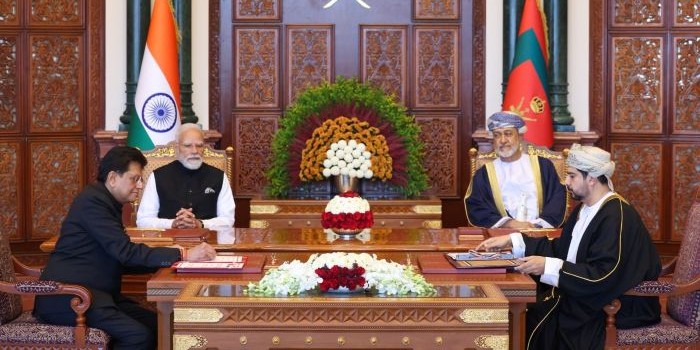
India and Oman have taken a significant step in building a stronger economic partnership with the signing of Comprehensive Economic Partnership Agreement(CEPA).Commerce and Industry Minister Piyush Goyal and Oman’s Minister of Commerce, Industry & Investment Promotion Qais bin Mohammed Al Yousef signed the agreement. The agreement was signed in the presence of Prime Minister Narendra Modi and Sultan Haitham bin Tarik.
This Comprehensive Economic Partnership Agreement (CEPA) marks an important milestone in India’s engagement with the Gulf region and reflects the shared commitment to deepen bilateral economic integration. Oman is an important strategic partner in the region and is a key gateway for Indian goods and services to the wider Middle East and Africa. Nearly 7 lakh Indian nationals reside in Oman, including Indian merchant families with a presence of over 200–300 years, contributing significantly to Oman’s economy and society. Indian enterprises have built a strong presence in Oman, with over 6,000 Indian establishments operating across sectors. Annual remittances of around USD 2 billion further reflect the depth of economic engagement. Bilateral trade between India and Oman stands at over USD 10 billion, with strong potential for expansion under the CEPA framework.
The pact was inked by Union Commerce and Industry Minister Piyush Goyal and Oman’s Minister of Commerce, Industry and Investment Promotion Qais bin Mohammed Al Yousef, reflecting the shared vision of both nations to deepen economic integration and unlock new growth opportunities.
Described as a significant step in India’s engagement with the Gulf region, the CEPA provides unprecedented market access for Indian goods and services. Under the agreement, Oman has offered zero-duty access on 98.08 per cent of its tariff lines, covering 99.38 per cent of India’s exports by value. Immediate tariff elimination will apply to nearly 98 per cent of these lines, benefiting key labour-intensive sectors such as textiles, leather, footwear, gems and jewellery, engineering goods, plastics, furniture, agricultural products, pharmaceuticals, medical devices and automobiles. The move is expected to boost exports, generate employment and support artisans, MSMEs and women-led enterprises.
India, in turn, has offered tariff liberalisation on about 78 per cent of its tariff lines, covering nearly 95 per cent of imports from Oman by value, while protecting sensitive sectors such as agriculture, dairy, tea, coffee, precious metals and select labour-intensive products through exclusions and tariff-rate quotas. The agreement also marks a breakthrough in services trade. For the first time, Oman has made ambitious commitments across 127 services sub-sectors, including computer-related services, business and professional services, audio-visual services, research and development, education and health. These commitments are expected to unlock high-value opportunities for Indian service providers and drive skilled job creation.
This is the 2nd Free Trade Agreement signed in the last 6 months after United Kingdom and is a part of strategy to sign trade agreements with developed economies that are not competing with our labour-intensive interests and provide opportunities for Indian businesses.
Related Posts
India defend Asian Games hockey gold, book Olympic berth
Asian Games:India beat Pakistan by 19 runs to clinch gold
India targets 600 MT steel capacity by 2047: Secretary