 Ira Singh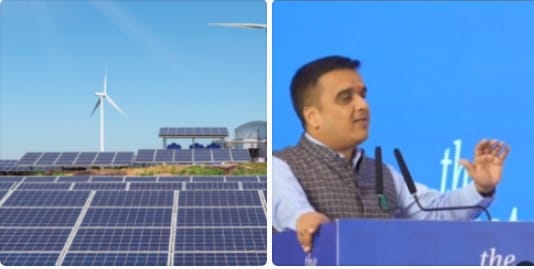
Gujarat has emerged as the country’s largest contributor to renewable energy capacity, accounting for 16.50 per cent of India’s total installations, with cumulative capacity reaching 42.583 GW as of December 31, 2025. The milestone places the state at the forefront of India’s clean energy transition, aligned with the national goal of achieving net-zero emissions by 2070 and sourcing half of electricity generation from renewables by 2030.Under the leadership of Chief Minister Bhupendra Patel, Gujarat has set new benchmarks across renewable energy segments. The state ranks first nationally in total installed renewable energy capacity and wind power installations, and second in solar power capacity. Its renewable energy mix includes 14,820.94 MW of wind power and 25,529.40 MW of solar power, reflecting a diversified and resilient clean energy portfolio.
Reinforcing the state’s leadership, Gujarat Deputy Chief Minister Harsh Sanghavi said the state tops the country in renewable energy, describing it not only as a present strength but also a long-term mission.He also expressed confidence that the India-EU trade deal will open new avenues for the state's industries. Speaking at a renewable energy conference, Sanghavi recalled that Prime Minister Narendra Modi had articulated Gujarat’s clean energy vision as early as 2000–2002, when renewable power was still seen as experimental. “What was once considered a joke has today become Gujarat’s strength. We faced challenges, but the government never backed down from its promise,” he said. He added that Gujarat was the first state to take strong initiatives in renewable energy and therefore ranks number one nationwide.According to a state government statement, Gujarat contributes 27.2 per cent of India’s total wind energy generation, while more than 64 per cent of the state’s power consumption now comes from renewable sources. Over 7.5 lakh households have installed rooftop solar panels, accounting for more than 30 per cent of India’s total rooftop solar capacity. The state has also developed a robust ecosystem for renewable energy manufacturing, installation and research.Sanghavi also highlighted the state’s industrial resilience, citing the rapid growth of Kutch after the 2001 earthquake as an example of Gujarat’s economic strength. “Investments in Gujarat are safe and deliver the best returns. Industries here have shown unmatched growth compared to other states,” he said. He expressed confidence that the proposed India–EU trade deal would open new avenues for Gujarat’s industries, particularly in clean energy manufacturing and allied sectors.
Gujarat has also taken a clear lead in rooftop solar adoption, with more than 11 lakh installations generating 6,412.80 MW across residential, commercial and industrial consumers. The state accounts for over a quarter of India’s total rooftop solar capacity, supported by sustained incentives since 2016 and continued momentum under the PM Surya Ghar scheme. The widespread adoption of rooftop solar has strengthened distributed generation and reduced dependence on conventional power sources.Solar energy remains a major growth driver for the state. Of the total installed solar capacity, over 17.77 GW comes from ground-mounted projects, while rooftop systems contribute more than 6.4 GW. Hybrid solar projects account for over 1.17 GW, and off-grid systems, including those under PM KUSUM, add another 173 MW. Large-scale solar parks such as Charanka, Radhanesda and Dholera continue to anchor capacity growth, while the Khavda Renewable Energy Park in Kutch—planned for 37.35 GW—has already achieved 11.33 GW, making it the world’s largest renewable energy park under development.
Wind energy has long been a strength for Gujarat, which pioneered India’s first wind power policy. Installed wind capacity stands at 14,820.94 MW, with Kutch alone contributing nearly half of this total. Other districts such as Jamnagar, Devbhumi Dwarka, Amreli, Rajkot and Bhavnagar also play a significant role. The state has additionally commissioned nearly 2.4 GW of wind-solar hybrid projects under successive renewable energy policies, supported by strong transmission infrastructure and government-allotted land.
The rapid expansion of renewable energy has had a tangible economic impact. Based on installed capacities across sectors, Gujarat’s clean energy growth is estimated to have generated around 2.37 lakh direct and indirect jobs, spanning project development, manufacturing, operations and maintenance.Ease of doing business has been another key enabler. The state has introduced a streamlined process for grid connectivity through the Akshay Urja Setu online portal, facilitating faster approvals and project execution. Net metering regulations have further supported rooftop solar growth, helping Gujarat become a national leader in distributed renewable energy.
Gujarat’s progress has been backed by a strong and evolving policy framework. Starting with its first wind power policy in 1993, the state has introduced a series of solar, hybrid, waste-to-energy and small hydel policies over the years. The Gujarat Integrated Renewable Energy Policy-2025, effective until 2030, provides a unified framework covering solar, wind, hybrid and distributed projects, battery energy storage systems, and emerging technologies. The policy removes capacity caps, enables flexible commissioning timelines, promotes repowering of old wind projects, and encourages private sector participation, innovation and green skill development.
Looking ahead, Gujarat’s renewable energy pipeline remains robust. As of December 2025, more than 5,200 projects are under implementation, representing a combined capacity of 68.37 GW across solar, wind and hybrid segments. The state has set a target of achieving 105 GW of renewable energy capacity by 2030, aiming to contribute 20 per cent of India’s 500 GW non-fossil energy goal.
(State Correspondent)



_(5).jpg)








Related Items
Amreli hosts Gujarat’s Grand 80th I-Day state level celebration
India's Ethanol Story: From Sugarcane to Energy Security
Nearly 25 children dead in Gujarat as Chandipura virus returns