 Ira Singh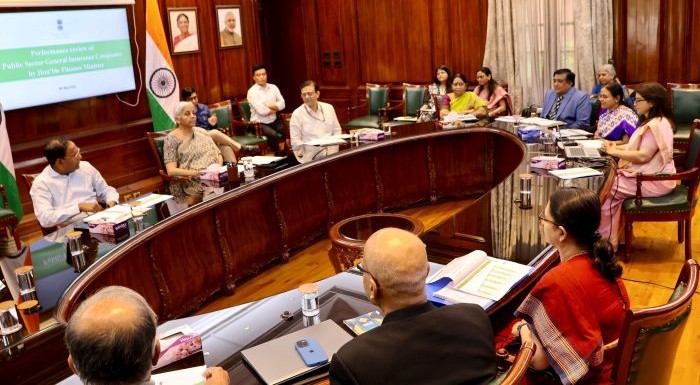
Union Finance Minister Nirmala Sitharaman on Wednesday urged public sector general insurance companies (PSGICs) to reach more people and help increase the use of insurance in the country. She said this is important to give more people financial protection through insurance. During a comprehensive review of PSGICs’ performance, Sitharaman examined key indicators such as premium collection, penetration, insurance density, and incurred claims ratios. According to official data, the total premium collected by PSGICs has grown significantly—from approximately Rs80,000 crore in 2019 to nearly Rs1.06 lakh crore projected for 2025. The overall general insurance sector also showed robust growth, with total premium collections touching Rs3.07 trillion in FY 2024–25.
Despite this progress, India’s general insurance penetration remains low at just 1% of GDP, far behind the global average of 4.2% in 2023. Insurance density, however, has improved from $9 in 2019 to $25 in 2023. The finance minister reiterated the need for PSGICs to aggressively work toward narrowing this gap. According to information, the meeting included a five-year performance analysis of the health insurance segment. It revealed consistent premium growth across public and private insurers. Incurred claims ratios, which spiked during the COVID-19 pandemic in FY21—reaching 126% for PSGICs and 105% for private insurers—have since moderated. By FY24, these ratios dropped to 103% for PSGICs, 89% for private insurers, and 65% for standalone health insurers.
PSGICs have staged a financial turnaround, with all four firms reporting profits again. Oriental Insurance Company Ltd. (OICL) and National Insurance Company Ltd. (NICL) returned to profitability in Q4 and Q2 of FY 2024–25, respectively. United India Insurance Company Ltd. (UIICL) posted its first profit in seven years in Q3 of FY 2024–25, while New India Assurance Company Ltd. (NIACL) continues to lead the market and post steady profits.
Sitharaman stressed the importance of adopting AI-powered claim settlement mechanisms, especially for motor and health products, to accelerate and enhance the accuracy of claim processing. She also called for strengthening underwriting practices and optimizing insurance portfolios to align combined ratios with global benchmarks—an essential step toward ensuring financial stability.
Customer-centric service delivery was underlined as a strategic priority. The finance minister advised PSGICs to enhance grievance redressal systems, build robust social media engagement, and integrate seamlessly with the account aggregator ecosystem. This includes implementing fully digital know-your-customer (KYC) systems to simplify onboarding and improve the overall customer experience.
To broaden insurance accessibility, PSGICs were encouraged to forge strategic partnerships with intermediaries, fintech companies, and insurtech startups. These collaborations are expected to expand the insurers’ reach across underserved and digitally connected populations. Furthermore, Sitharaman underscored the significence of advanced data analytics and artificial intelligence in driving innovation in pricing and claims modeling. These tools, she noted, are vital for accurate risk assessment and the long-term sustainability of the insurance business.
(Business Correspondent)















Related Items
India well-placed to leverage AI, digital infrastructure: RBI Governor
Parliament passes bill to recognise digital banking records as evidenc
CBI chargesheets Bank official, firm owner in digital arrest scam