 Newsinc24 Team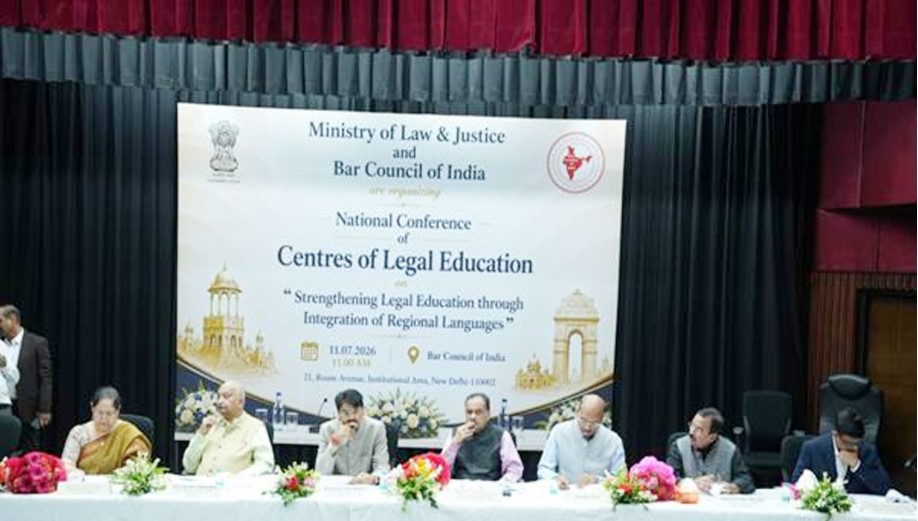
The Department of Legal Affairs under the Ministry of Law and Justice, in partnership with the Bar Council of India (BCI), on Saturday launched the process of preparing a 10-year roadmap to expand the use of Hindi and other Indian languages in legal education while retaining English as an important language for legal learning and practice.
According to reports,the initiative was discussed during a national conference titled "Strengthening Legal Education through Integration of Regional Languages", which brought together senior government officials, members of the judiciary, legal experts, academicians, representatives of the Bar and vice-chancellors of prominent law universities.The conference focused on preparing a Ten-Year Perspective Action Plan to make legal education more inclusive by gradually introducing Indian languages into law courses through a structured and phased approach.
STORY | Experts discuss ways to integrate Indian languages in legal education
— Press Trust of India (@PTI_News) July 11, 2026
Seeking to make the judicial ecosystem more inclusive, top government officials and legal experts on Saturday deliberated on a framework to integrate Indian languages into legal education while… pic.twitter.com/HvEAEQdsy9
Among those present were Justice Rajendra Menon, Chairperson of the Armed Forces Tribunal and Co-Chairperson of the Standing Committee on Legal Education of the Bar Council of India, Rajya Sabha MP and BCI Chairman Manan Kumar Mishra, Secretary in the Department of Legal Affairs Dr. Rajiv Mani, and several senior legal and academic representatives.
During the discussions, participants underlined the need for a balanced multilingual framework that would preserve academic standards while widening access to legal education. They agreed that English would continue to play a vital role as a national and international language for legal studies, but greater use of Indian languages could improve understanding of legal concepts and make the justice system more accessible.The proposed roadmap seeks to enable students, particularly those planning to practise in district and subordinate courts, to pursue legal education in Indian languages. It is also expected to strengthen legal aid services and clinical legal education by making legal knowledge easier to understand for a broader section of society.
The role of technology featured prominently during the conference. Participants discussed the use of Artificial Intelligence-based translation tools, digital legal repositories, standardised legal glossaries and terminology databases to support multilingual legal education. At the same time, they stressed that legal translations and terminology must be thoroughly verified by legal and language experts to maintain precision and consistency.The conference also identified key steps for the coming years. These include preparing a National Declaration on Indian Languages in Legal Education, finalising the broad framework of the Ten-Year Perspective Action Plan, and establishing a National Steering Committee jointly led by the Department of Legal Affairs and the Bar Council of India.
The proposed steering committee will oversee the implementation of the reforms, monitor progress and provide guidance for the phased integration of Indian languages into legal education across the country.The conference concluded with a shared commitment from the Centre, the Bar Council of India and other stakeholders to build a more inclusive, accessible and high-quality legal education system. The initiative is expected to improve access to justice while supporting the country's long-term vision of becoming a developed nation by 2047.














Related Items
FIR against Mamata over violation of HC order on TMC students' rally
Karnataka forms panel on student issues, education reforms
Agri education system should cater to farmers' needs: Shivraj Singh