 Nisha Singh
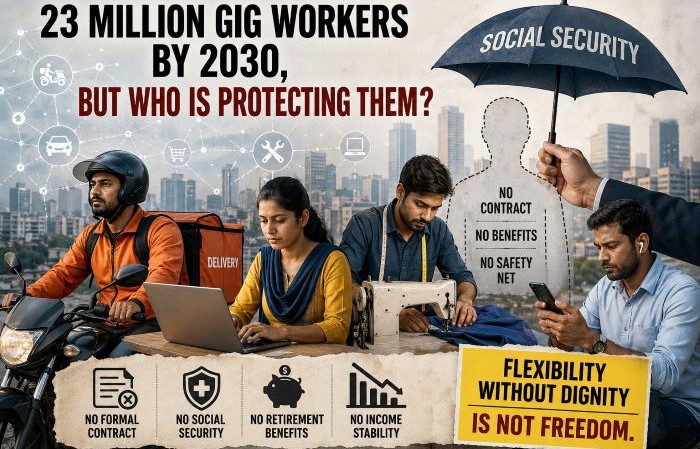
By 2030, India will have over 23 million gig workers. Most of them will have no formal contract, no social security and no guaranteed income. This is not a future risk. It is already the reality.
India is in the middle of a structural shift in how work is defined and delivered. From delivery riders and app-based drivers to freelance designers and home tutors, millions are earning through platforms without a fixed employer or long-term security. According to NITI Aayog, the gig workforce is projected to grow from 7.7 million in 2020-21 to 23.5 million by 2029-30. This is no longer a marginal trend; it is the backbone of India’s labour market. Yet, the systems meant to prepare and protect workers remain rooted in a bygone era of permanent employment.
Millions now work without contracts, benefits, or safety nets.
The question is no longer whether the gig economy is here; it is whether we are ready for it.
For years, gig work was seen as an urban, millennial phenomenon, an extension of convenience culture in big cities. That perception no longer holds. Platforms have penetrated deep into India’s non-metro landscape. Electricians in Patna, tailors in Surat and tutors in Indore are now part of this distributed workforce. The gig economy has undeniably expanded access to income, especially for first-generation earners and returning migrants. But this access comes at a cost: the erosion of wage security, healthcare benefits and retirement protections that traditional employment once guaranteed.
The pandemic exposed these vulnerabilities with brutal clarity. Workers who kept cities running during lockdowns often did so without insurance, income stability, or institutional support. Yet, the policy response since then has been incremental rather than transformative.
India cannot build a $5 trillion economy on a workforce without a safety net
India’s education and skilling systems are also misaligned with this new reality. Each year, the country produces over a million graduates, many of whom are trained for structured, long-term employment. But gig work demands a different toolkit: digital literacy, financial management, client handling and the ability to navigate uncertain income streams. The system continues to produce job seekers in an economy that increasingly rewards independent earners.
Policy has begun to respond, but not fast enough. The Code on Social Security, 2020, marked the first formal recognition of gig and platform workers in Indian law. Rajasthan’s platform-based gig workers legislation went a step further by proposing welfare mechanisms. These are important milestones. However, implementation remains uneven, awareness among workers is limited and platforms largely continue to classify workers as independent contractors, effectively bypassing deeper obligations.
What India lacks is not intent, but integration. Social security, skilling and platform regulation are still being addressed in silos. A fragmented approach cannot solve a systemic shift.
If the gig economy is here to stay, five priorities demand urgent attention. First, education must move beyond degrees to capability-building, embedding financial literacy, digital skills and entrepreneurship into mainstream curricula. Second, skilling institutions need to co-create programmes with platforms to reflect real market conditions rather than outdated job roles. Third, social protection must become portable, allowing workers to accumulate benefits across multiple platforms into a single account covering health, accident and retirement. Fourth, platforms should be mandated to share anonymised data with policymakers to enable evidence-based regulation. Finally, gig worker collectives, many of which are already organising informally, must be given legal recognition and a voice in shaping policy.
The gender dimension cuts across all of these priorities. The gig economy has opened new pathways for women, particularly those constrained by mobility or caregiving responsibilities. Yet barriers persist from limited digital access in rural areas to safety concerns and algorithmic biases. A gender-neutral approach will not suffice; policy must be intentionally designed to close these gaps.
India’s demographic dividend is often described as its greatest economic advantage. But a dividend is not automatic; it must be earned. A workforce that lacks stability, protection and upward mobility cannot sustain long-term growth.
A delivery rider in Lucknow earning ₹20,000 a month, a freelance designer in Bhubaneswar working with global clients, these stories reflect aspiration and resilience. But participation without protection is not progress.
Flexibility without dignity is not freedom. The gig economy did not wait for policy approval to arrive.The question now is whether policy can catch up before opportunity hardens into inequality.
(Nisha Singh is a policy analyst and General Manager – Brand & Corporate Communication at Management & Entrepreneurship and Professional Skills Council (MEPSC), working at the intersection of skilling, employability, and workforce development. Views expressed are her own.)



Related Posts
India must lead in creating future technologies, says PM Modi
India pushes for BIOFIN, tech transfer & global cooperation
India-EU investment protection agreement under discussion: Goyal