
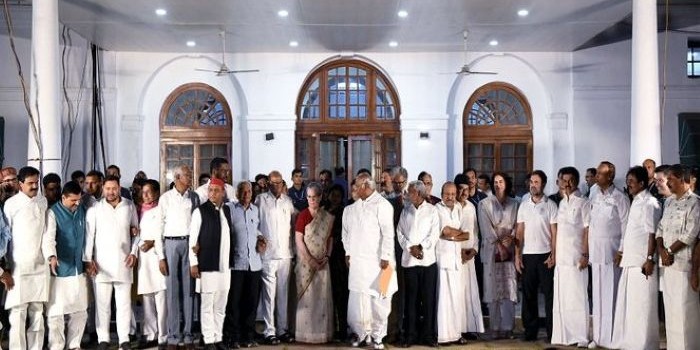
Congress party seems to be in utter confusion at all level. Despite marathon CWC meeting in New Delhi, the party failed to select a new non-Gandhi chief and ultimately gave responsibility to Sonia Gandhi as interim president for a few months. But political observers say that is far from reality. The party's future is totally dependent on the outcome of Assembly elections of three states due later this year.
Mrs Gandhi faced personality charges
Congress, the Grand Old Party, saw first major split in 1969 when the then party president S. Nijalingappa expelled Prime Minister Indira Gandhi on November 12. Mrs Gandhi was accused of "encouraging a cult of personality". She countered saying senior members have formed a "Syndicate". The Indian National Congress (Organisation) or Congress (O) was a political party in India formed when the Congress party split following the expulsion of Indira Gandhi. The break was complete when V V Giri, an independent candidate, was elected president and Dr N. Sanjeev Reddy lost the election despite he was the official candidate of the Congress. After that the Party split into Congress(R) and Congress (O).
When Right & Left developed within the Congress
As per available information, conflict between the right and the left developed within the Congress party - the right advocated greater party discipline and reigning in of the Young Turks and other leftists. The left, on the other hand, openly attacked Morarji Desai as the representative of big business. Initially, with a view to avoid organizational and ideological polarisation and a split in the party, Indira Gandhi adopted a cautious, non-partisan attitude in the heated debate between the right and the left in the party. The political tension inside Congress over the unsettled question of relations between its ministerial and organization wings became more pronounced.
New headache of Congress
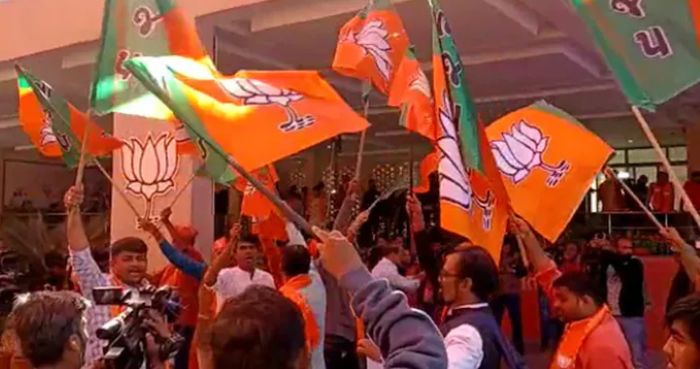
Congress party's new headache is lack of coordination among leaders on political and sensitive subjects. Such dilemma has forced many leaders to desert from Congress. Sanjay Singh and Bhuvneshwar Kalita are prominent leaders who said goodbye to Congress and joined the BJP. Some party leaders are giving conflicting statements about new J&K status after removal of Article 370. Complete divide could be seen within the party on the Kashmir issue. Veteran leaders like Dr Karan Singh, son of Late Raja Hari Singh of Kashmir, Janardan Dwivedi, young leader Jyotiraditya Scindia and some other openly supported the government's move on J&K. But on the other hand senior leader Ghulam Nabi Azad, P Chidambaram, Anad Sharma and others criticised it. Even party's resolution on J&K issue is not giving any clear message to its cadres.
The party cadres are scared
Experts says that now the party cadres are scared. Party leaders - senior and junior - have no trust and both want supremacy. That is the reason why present leadership does not want to give the baton to young turk. Party leaders' self confidence has completely shaken are afraid of holding elections for any posts and that is the reason office bearers are being nominated for the last three decades. Hard and devoted workers never get their dues. It is also true that the party got height during Gandhis' tenure - Indira and Sonia. But this is also true that the deterioration of Congress started during Rahul Gandhi's tenure as the president. Weak opposition parties are not a good sign for the healthy democracy. But the problem is most opposition parties have become a family party. Congress is also suffering from this syndrome. And voters have started rejecting such family parties. On top of this, the Congress lacks dynamic leadership. In such a situation even political pundits are not denying the possibility of a split in the party under Gandhis.



Related Items
Punjab Congress: Rift widens despite Baghel's mediation
Why every Indian family is paying the Aspiration tax
TMC rebels remove Mamata Banerjee as the party chairperson