 Ira Singh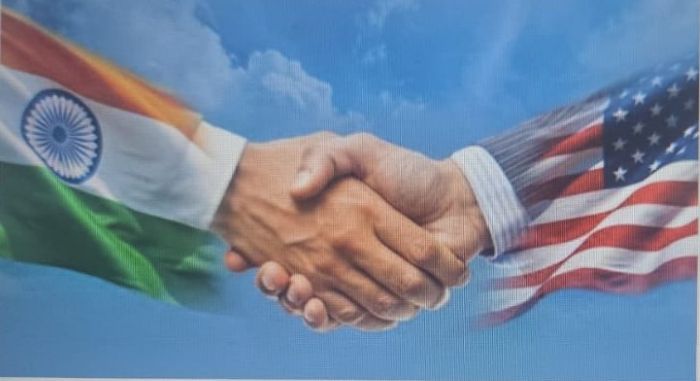
In a significant yet geopolitically charged move, the United States has sharply reduced import tariffs on a wide range of Indian labour-intensive goods, offering immediate relief to exporters even as it places India at the centre of a delicate strategic balancing act.Under an executive order effective February 7, 2026, Washington has slashed punitive tariffs on Indian exports such as textiles, leather, footwear and plastics from a steep 50 per cent to 18 per cent. The rollback, described by US officials as an interim trade framework towards a broader Bilateral Trade Agreement (BTA), comes with a clear condition: India’s stance on Russian oil imports.
Relief for exporters, pressure on policy
For India’s export ecosystem, the tariff cut removes a major overhang that had threatened growth, jobs and investor confidence. The 50 per cent tariff regime—imposed through successive escalations since mid-2025—had severely eroded India’s competitiveness in the US market, putting nearly $50 billion worth of trade at risk and raising fears of layoffs across labour-intensive sectors.Industry bodies have welcomed the move, calling it a “much-needed reset” that restores parity with Asian peers such as Vietnam, Bangladesh and Indonesia, where tariffs range between 19 and 30 per cent. The revised 18 per cent rate is expected to boost order flows, revive stalled manufacturing lines and improve capacity utilisation, particularly in textiles, apparel, leather goods, carpets and plastics.Textiles and apparel exports to the US alone stood at around $11 billion in FY25, with the American market accounting for 59 per cent of India’s carpet exports and nearly half of home textiles. In leather and footwear—where India currently holds just a 2.9 per cent share of the $43 billion US import market—the tariff relief could be a game-changer.
The geopolitical trade-off
Yet, behind the economic relief lies a clear geopolitical bargain. The US has explicitly linked the tariff rollback to India’s commitment to reduce or halt purchases of Russian oil, arguing that continued imports indirectly fund Moscow’s war effort.While Washington has projected the move as a diplomatic success, India has been far more cautious in its public messaging. The Ministry of External Affairs has reiterated that energy security for a country of 1.4 billion people cannot be compromised, stressing diversification and market-based sourcing rather than abrupt supplier shifts.This divergence underscores the core tension in the deal: India’s strategic autonomy and energy pragmatism versus US foreign policy priorities.As part of the interim framework, India has also committed to purchase over $500 billion worth of US goods including energy products, aircraft, defence platforms and technology over the next five years, alongside reducing duties on select American industrial and agricultural items.
Diplomatic navigation under pressure
The tariff rollback comes after a turbulent phase in India-US trade ties. In August last year, US President Donald Trump imposed an initial 25 per cent tariff on Indian goods, followed by another 25 per cent “secondary tariff” to penalise India’s continued trade with Russia. From August 27, Indian exports faced a combined 50 per cent levy, dealing a blow to India’s growth narrative even as it sought to sustain GDP expansion above 7 per cent.At the same time, New Delhi was navigating a complex geopolitical environment—managing an assertive China, an economically weakened but strategically important Russia, and an increasingly transactional United States.According to N.K. Tripathi, a senior IPS officer (retd.) and academician, India’s handling of the crisis reflects “quiet but effective diplomacy.”“India was facing pressure from both China and the US, while Russia—its long-standing partner—was itself under strain,” Tripathi said, sharing his assessment. “Sustained back-channel engagement with senior US officials helped defuse a situation that could have seriously damaged India’s manufacturing base and investor confidence.”Tripathi noted that while India-US relations have strengthened over the past two decades, Washington’s recent unpredictability coupled with renewed US engagement with Pakistan had unsettled India. “This deal gives a new direction to ties. The US also understands that it cannot ignore India’s role in the Indo-Pacific,” he added.
What remains unchanged
Despite the relief, the agreement is far from comprehensive. Tariffs on steel and aluminium (50 per cent), auto components (25 per cent), and certain strategic items remain untouched, having been imposed on national security grounds. Pharmaceuticals and select electronic components continue to enjoy zero-duty access.Crucially, agriculture and dairy sectors India considers politically and socially sensitive have been kept out of the framework, a red line India has consistently defended in all trade negotiations.“Trade deals are never one-sided,” Tripathi said. “India has protected its agricultural sector, which supports nearly 45 per cent of the population. This was non-negotiable, and the US has accepted that reality.”
Fragile gains, uncertain future
Analysts note that the biggest risk lies in the conditional nature of the tariff cuts. Washington has reserved the right to reimpose duties if it believes India has deviated from commitments related to Russian oil, giving the US significant leverage over India’s energy choices.Unlike the recently concluded EU-India free trade agreement—which offers near-universal tariff elimination and long-term certainty—the US arrangement remains an interim framework, with details still under negotiation and signatures yet to be finalised.Even so, markets have reacted positively. The Sensex rose on hopes of export revival, while exporters anticipate double-digit growth in shipments to the US over the next year.For now, the deal offers India breathing room at a critical moment. But its durability will depend on how deftly India balances economic imperatives, energy security and geopolitical expectations in an increasingly fragmented global order.
(Business Correspondent)








Related Items
India, Russia agree to advance bilateral investment treaty talks
Russia eyes Indian pharma, electronics, fruits to narrow trade gap
India's electoral process among most transparent in world: CEC