 Krishan Gopal Sharma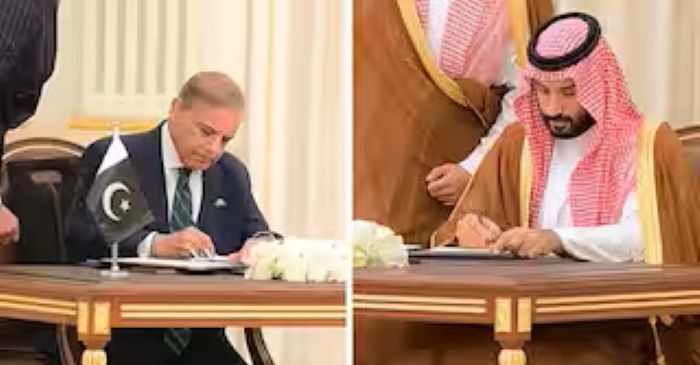
In the ever-evolving geopolitical landscape of South Asia and the Gulf, the recent Strategic Mutual Defence Agreement between Saudi Arabia and Pakistan signals a monumental shift in regional security dynamics. The pact, which declares that “any aggression against either country shall be considered an aggression against both,” formalises a NATO-style mutual defense arrangement between two historically aligned yet diplomatically cautious nations. It is the first of its kind between an Arab Gulf state and a nuclear-armed power, and its repercussions are vast, complex, and fraught with implications that could reshape the regional order.
A Nuclear Dimension: Implied or Real?
At the heart of the Saudi-Pakistan agreement lies its implicit nuclear dimension. Pakistan’s Defence Minister, Khawaja Asif, has openly stated that Pakistan’s nuclear capabilities "will be made available" to Saudi Arabia. While there is no indication of a physical transfer of nuclear technology, this public declaration is significant. It marks the first explicit recognition that Pakistan is extending its nuclear umbrella to its Gulf partner. This arrangement leverages Pakistan’s non-signatory status to the Nuclear Non-Proliferation Treaty (NPT) and its rejection of a no-first-use policy, granting it the flexibility to offer nuclear deterrence without violating international norms.
Yet, this nuclear bargain is not without its contradictions. Pakistan’s nuclear doctrine has historically been focused on India, with its military maintaining strict control over nuclear assets. The notion that Islamabad would subordinate its nuclear deterrence to Saudi Arabia’s strategic needs raises questions among analysts. Some believe the agreement is symbolic— a political signal of solidarity rather than a firm military commitment. The ambiguity surrounding the pact’s comprehensive defense scope, particularly in relation to Saudi Arabia’s regional ambitions, only heightens concerns about its true nature.
Geopolitical Reactions: A Delicate Balance
The absence of a U.S. response to Pakistan’s nuclear offer is telling. While Washington has not formally commented, its approval of $6 billion in new arms sales to Israel raises questions about its broader Middle East strategy. Is the U.S. silently endorsing Pakistan’s rise in Gulf security to counterbalance China’s growing influence in the region? And in its pursuit of strategic leverage, is the U.S. prepared to overlook Pakistan’s past as a state accused of sponsoring terrorism?
For India, the Saudi-Pakistan pact represents a growing challenge to its regional interests. The agreement strengthens the China-Pakistan axis, potentially undermining India’s security in South Asia. Chinese support for Pakistan’s diplomatic and intelligence efforts could elevate Islamabad’s position in regional affairs, while Saudi investments—reportedly $15 billion in Pakistan’s defense-industrial complex—could empower Islamabad’s military ambitions. This further complicates India’s efforts to integrate Saudi Arabia into its strategic plans, including the India-Middle East-Europe Economic Corridor (IMEC). While bilateral trade between Saudi Arabia and India reached $41.88 billion in FY 2024-25, India remains cautious about the optics of the pact and its potential to dilute international pressure on Pakistan through platforms like the Financial Action Task Force (FATF).
The Price of Militarisation: A Global Trend
The implications of the Saudi-Pakistan defense pact extend beyond South Asia and the Middle East. As global power structures shift and smaller nations are increasingly drawn into military alliances, the diversion of resources from development to defense has become a pressing issue. Military partnerships, rather than humanitarian aid, have become the currency of international diplomacy. The prioritisation of defense spending over education, healthcare, and infrastructure risks deepening global inequalities and further exacerbating poverty.
This trend becomes even more concerning when rogue or authoritarian states are rewarded with defense deals and strategic alliances. When military power is the determinant of international relevance, regimes with a history of human rights violations may be emboldened. If nuclear deterrence becomes a tradable commodity, the risks of nuclear proliferation and regional conflict escalation grow exponentially.
The role of the United Nations in this changing landscape seems increasingly diminished. The UN’s failure to check the actions of veto-wielding powers and its reduction to a forum for power politics rather than a platform for justice underscore the erosion of global norms. Once-isolated rogue states are now courted as strategic partners, further deepening the divide between military might and moral authority.
A World of Nuclear Umbrellas and Strategic Alliances
The Saudi-Pakistan defense pact represents more than just a bilateral agreement—it symbolizes a broader shift in global order. As military power increasingly trumps diplomatic engagement, nuclear umbrellas replace peace treaties, and strategic alliances with authoritarian regimes become the cornerstone of international diplomacy. This trajectory risks normalising the militarisation of global politics and leaving international norms in the dust. If this trend continues, rogue states may no longer be isolated—they may become the kingmakers in regional politics.
The question now is not whether this new world is possible, but whether the global community is ready to confront it. If not, the consequences could be irreversible. As Kofi Annan once said, “We may have different religions, different languages, different colored skin, but we all belong to one human race.” The time to act on that truth is now—before the race to arm eclipses the race to uplift.
<><><>
(Krishan Gopal Sharma; kgsharma1@gmail.com: Freelance journalist, retired from Indian Information Services. Former senior editor with DD News, AIR News, and PIB. Consultant with UNICEF Nigeria. Covered BRICS, ASEAN, Metropolis summits and contributed to national and international media.)











Related Items
Saudi's dilemma: Pakistan steps Back, US says no strikes on Houthis
India beat Pakistan 19-0 to reach Junior Women’s Asia Cup semi-finals
73 injured as Houthis attack four Saudi cities, Airports