 Commander Raghvendra Chaturvedi
Modern warfare has changed and armed forces are fast adapting to this change, both in terms of strategy and equipment. The US Department of Defense in its National Defense Strategy, released in
year 2018, acknowledges this change and talks about preparing for an “irregular war”. The US Marine Corps in its 10- year transformation plans to eliminate its tank force and cutting down on
their aircraft in favour of standoff missiles and unmanned aircraft. They are now moving away from large traditional amphibious ships and redistributing their elements in smaller groups in order to
remain relevant and effective. India has been fighting an unconventional (irregular) war in Kashmir for decades and faces a similar situation in eastern Ladakh against China, but there is no sign that it
is either ready to accept or prepare for it. The country still continues to plan and equip itself with equipment of yesteryears, especially the Indian Navy, with its continued ingenuous obsession with
an unending desire for more aircraft carriers.
The basis of aircraft carrier’s rise to glory and it turning into an object of desire for most Navies, lies in the crafty marketing and narrative building skills of the US Navy. Post Second World War, Carrier
Battle Group (CBG) became the center stage of US Naval Strategy. Backed by a robust military industrial and innovation base and supplemented by an unlimited financial resources, the CBGs were
deployed across the world oceans and soon became the symbol of US national reach and power.What the CBGs achieved strategically and operationally might not have been of much significance,
but what matters is that every navy worth its salt, wanted to own an aircraft carrier to showcase its intention of “having reached there”. Many including India failed to notice that the carriers have
never been tested in any high pitched battle against any credible enemy after the Second World War. Even the US Navy has used its CBG, only against extremely weak adversary, whose armed forces, especially the Navy were either non-existent or depleted.
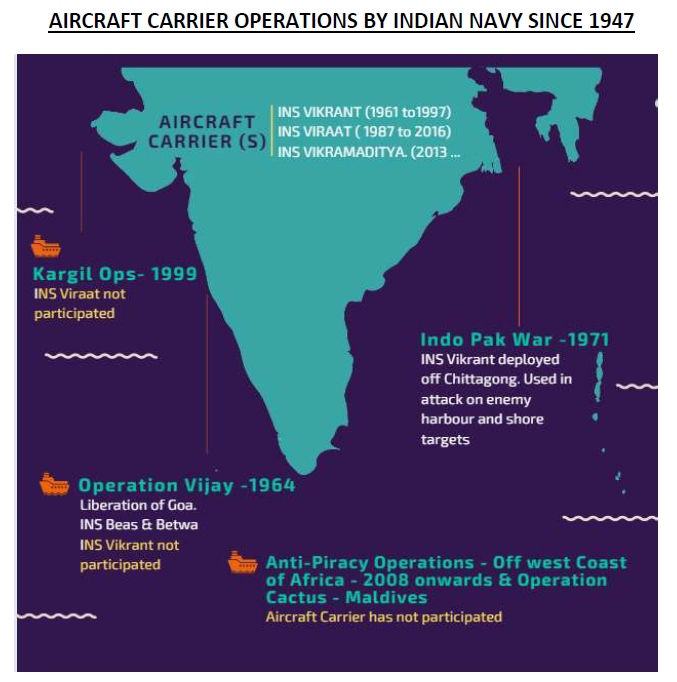
Indian Navy itself used its aircraft carrier INS Vikrant, only in 1971, after establishing sea control against an extremely inferior East Pakistan Navy that too, when it had established almost total air
space and sea control.Owning an aircraft carriers is extravagant hobby. They are expensive to construct/buy, maintain, equip and operate. In addition to being expensive, the most critical part is that they are highly vulnerable. Vulnerable against enemy air, surface and underwater attack. Therefore, an aircraft carrier has to be protected at all times by a protection force (escorts) comprising several destroyers, frigates, submarines, which in turn, are needed to be supported by a supply ship.Vulnerability of an aircraft carrier coupled with hefty price and most importantly its symbolism of
being a center point of national power and prestige, makes it a prime target of each and every enemy gun, missile and torpedo; akin to duck in duck hunting season. It’s thus, no surprise that in
the 1971 war with Pakistan, the sole aim of PNS Ghazi was to sink India’s only aircraft carrier INS Vikrant, knowledge of which kept Indian Naval war room at tenterhooks and only when news of
sinking of PNS Ghazi was received, INS Vikrant was moved closer to the coast for deployment of its aircrafts against enemy ships. While the proponents of aircraft carrier for the Indian Navy talk about -power projection, sea control, blue water navy etc. very few have dwelled on the ‘How?’ element; the deployment, operation and most crucial its effectiveness in a conflict – a basic quantitative analysis. India has what is called a “small-deck” carrier, defined on basis of its size (<50,000 tons), number of aircraft it can carry on-board (24 to 26) and propulsion type (conventional). To put this in perspective, US Navy operates “large-deck” carriers which are greater than 90,000 tons, have an aircraft complement of about 90 aircrafts and are nuclear propelled. While the Indian Maritime Security Strategy 2015 talks of sea control as one of the major role, for ease of understanding let us split the war time role of the carrier into two parts – Offensive and Defensive. Offensive against enemy ships, aircrafts and shore installations and defensive to protect itself. In any conflict, the commander of the CBG has to protect the carrier for reasons mentioned earlier in the article. A task which is performed by the escorts and aircrafts on-board the carrier. The Queen needs to be protected at all times.INS Vikramaditya, Indian Navy’s sole aircraft carrier, can carry a complement of maximum 26 Mig 29K (source: Wikipedia). Factoring a serviceability rate of 75% (a generous assumption, considering
Controller Auditor General of India report of 2016 which stated that the serviceability MiG-29K was low, ranging from 15.93 per cent to 37.63 per cent and that of MiG-29KUB ranging from 21.30 per
cent to 47.14 per cent); out of 26 Mig’s only 20 are available for deployment at any given time. While operating within the attack radius of enemy aircraft (shore based) or probable surface threat, a CBG deploys a Combat Air Patrol (CAP). CAP is a permanent air cover comprising two or more fighter aircraft which protect the CBG against enemy surface and air attack.
Taking a CAP of two Mig 29K (bare minimum) for one day, each with patrol time of 3 hrs (very high), makes it 8 patrol per day. Assuming that same aircraft is used only once in a day, 16 Mig 29 K would be deployed for CAP duties per day. Disregarding downtime/serviceability calculations in continuous intensive air operations (which can be as high as factor of 1/3) and the fact that the “ski-jump” design of Indian carriers (a ramp on the flight deck which allows aircrafts to launch) restricting the number of aircrafts that can be operated at any time and also putting limit on the payload the
aircrafts can carry; in the best case scenario described above, only 3 to 4 Mig 29 k will be available per day to the CBG commander, to carry out offensive operations. It’s thus no surprise that during the Falkland war, wherein the Royal Navy had deployed two aircraft carriers, 1100 CAP missions were flown against only 90 offensive missions.So, it’s an irony that a $3 Billion offensive platform is utilising 90% of its force to protect itself. Other than the air and surface threat, it is the underwater threat that actually is the Achilles heel of an aircraft carrier. One of the biggest nightmare for any carrier commanding officer is the presence of an enemy submarine in the vicinity. The threat is so real that the CBG deploys departure and exit screens (a protective layer of ships) while leaving and entering harbour respectively and while at sea.It also uses an advanced screen of sonar equipped ships and ASW helicopters, in conjunction with nuclear attack submarine (SSN), to sanitize the area it will pass through, of any underwater threats.
The submarine threat, therefore is extremely credible in case the submarine is conventional (Pakistan) and potent in case it is nuclear powered (China); compounded by the fact that both can
launch long range homing torpedoes and anti-ship missiles without getting detected before launch. Gone are the days, when Navies could hide their aircraft carriers from the prying eyes of enemy.
Advancement in detection technologies, especially satellite based synthetic aperture radars, long range Unmanned Airborne Vehicles (UAVs) and other smart technologies, have made hiding the
carrier a next to impossible task. The moment the carrier leaves the harbour, it is tracked in real time and is always under threat of attack.Thus, having an aircraft carrier might be a relatively easy affair, but keeping it safe and using it to carry battle winning offensive missions is an extremely difficult proposition which requires deep pockets and cutting edge technology base; neither of which Indian Navy may have access to. Indian aircraft carrier at best would be deployed in a supporting role beyond the range of shore based fighter aircrafts, protecting own sea lines of communications (SLOCs) and interdicting enemy shipping, by attacking targets of opportunity. A job which can be done more effectively and efficiently by Long range maritime reconnaissance aircraft like P8i, or BrahMos equipped Su 30 MKI fighter aircraft or by surface attack group comprising of a couple of frigates or destroyers with integral helicopter - all at a fraction of cost of an aircraft carrier.
It is time Indian Navy looks beyond aircraft carrier(s) and commits itself to investing in modern platforms and innovative technologies, which win wars. Rather than spending billions of dollars in acquiring aircraft carrier and thereafter spending much more in equipping and maintaining it for next 50 years, it would be prudent to invest in stealthy submarines, precision strike weapons, remote platforms and multi role surface combatants; platforms which can perform more efficiently and effectively, at fraction of the cost of a carrier. Investing in a new aircraft carrier, is like buying a gold plated land line telephone in the age of smartphones. It may have a snob value and Be a smart display for parties and show, but will achieve little else.
(Writer is an ex Indian Naval officer and is currently pursuing his PHd from IIFT, Delhi in Defense Industrialisation in India)












Related Items
DAC clears Rs 52,000 crore defence acquisitions
Rajnath Singh hails Gujarat’s defence manufacturing potential
Gen Dhiraj Seth takes charge as new Army Chief