 Uday Kumar Varma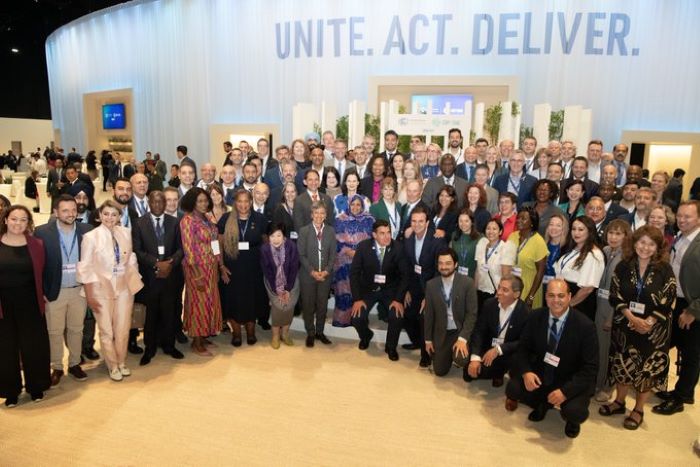
COP 28 began on the 30th November at Dubai. It is a modern City dotted with gleaming Sky Scrapper, built on wealth that fossil fuels have brought to the hosts, the United Arab Emirates. The ‘Economist’ termed the choice of venue ‘controversial’. Over 70,000 climate advocates, diplomats, academicians and NGOs have descended in Dubai. The fact that the world’s most important climate gathering will be hosted by a leading oil producer has sparked outrage among environmentalists, many of whom whisper about a fix on behalf of Big Oil.But there is another dark cloud that hovers over the gathering, the cloud of the bloody conflict in Middle East, and the lingering Russia-Ukraine war. Terrorism in the first case, and unconscionable national ambitions in the latter, have set both the progress and resolution on environmental goals decades back.Terrorism has never been discussed as a factor that affects progress on Global Environmental Goals. Could it be a factor in hampering the understanding on environmental aspirations on which substantial work has been done and several consensuses built?
Although on the very first day of COP 28, a major breakthrough brightened the prospects for a conference that was widely feared to be a wash out, the challenges before it are formidable and intractable. But the fact that the diplomats from nearly 200 countries approved a plan for a loss and damage fund, a demand developing countries have been making for over three decades, lifted the mood and set an upbeat tone. The pledges to this fund, as of now, add up to $549 million, with UAE and Germany contributing 100 million each while UK pledging about $75 million and Japan 10 million. US committed a disappointing $17.5 million that many feel was niggardly from the largest economy and compared to the damage it has caused. The fund will help vulnerable countries hit by climate disasters, which are made worse by pollution spewed by wealthy nations. The adequacy of the funds may be judged by the fact that climate-related damages are expected to cost developing countries between $280 billion and $580 billion per year by 2030.
And still, COP 28 could not be taking place at a more inopportune time. The world’s attention riveted to Middle East in the wake of Hamas-Israel conflict, poised to escalate into a widespread crisis of extraordinary proportions, will likely diminish the attention and intensity of discussions in Dubai. Progress since COP27 in Sharm-El-Shaikh a year ago has been scant, painting a dim and discouraging outlook. With little progress to report since COP27 a year ago, the prognosis is neither bright nor encouraging.
Navigating a Bleak Outlook
In a letter of July 2023, the incoming UAE Presidency outlines four paradigm shifts for COP 28: fast-tracking the energy transition and cutting emissions before 2030, transforming climate finance, prioritizing nature and people in climate action, and aiming for the most inclusive COP ever. However, the first three shifts have seen limited progress, and the fourth remains largely aspirational.
With the global demand for oil and petroleum seeing a resurgence with no possibility of it diminishing in near future, the prospect of Global Carbon Emissions (GCE) hitting further south is eminent. Its time- bound containment so enthusiastically and ceremoniously endorsed during past COPs stands already buried. The phasing out of fossil fuels was in any case a wash out in COP 27. It should be deemed dead for COP 28.
Apart from a resolve operationalise a ‘loss and damage’ fund, the two other worth mentioning outcomes of COP 27 included focusing on post-2025 finance goal, and the so-called mitigation work programme, that would reduce emissions faster, catalyse impactful action, and secure assurances from key countries that they will take immediate action to raise ambition on the path towards 1.5°C. A new term, ‘low emissions energy’ was introduced alongside renewable as the energy source of future. The purpose was to discourage the new fossil fuel development programme undertaken by some countries against the clear guidance of the UN Intergovernmental Panel on Climate Change (IPCC) and the International Energy Agency (IEA).
The most crucial of all issues and the one on which nations stand committed i.e. limiting warming to 1.5 degree, saw no progress even at Sharm El Sheikh. Its declarations even then rang hollow and a reiteration of an impossibility, that everyone acknowledged but ostrich-like refused to accept. The world is destined to heat beyond this limit. Now, even a fresh deadline seems difficult to conceive and utterly intractable even to reiterate.
UNFCCC Reports: Evaluating Global Climate Trajectory
The UNFCCC Secretariat on November 14 has published two synthesis reports of Nationally Determined Contributions (NDCs) under the Paris Agreement on climate change and of long-term low-emission development strategies (LT-LEDS). The two reports will inform the first Global Stocktake (GST) under the Paris Agreement and the deliberations at COP 28 in Dubai, United Arab Emirates (UAE). The findings reveal that despite increased efforts by some countries, much more action is necessary now to bend the global emissions trajectory and avoid the worst impacts of climate change.
The first report titled ‘‘Nationally Determined Contributions Under the Paris Agreement,’ synthesizes information from the 168 latest available NDCs communicated by 195 parties to the Paris Agreement and recorded in the NDC Registry as of 25 September 2023. The report shows that while in 2030, emissions are projected to be 2% below 2019 levels, they are still not showing “the rapid downward trend science says is necessary this decade.” To achieve peaking of emissions before 2030, the report argues, “the conditional elements of the NDCs need to be implemented, which depends mostly on access to enhanced financial resources, technology transfer and technical cooperation, and capacity-building support; as well as the availability of market-based mechanisms.”
Clearly, national climate action plans described in the report “remain insufficient to limit global temperature rise to 1.5°C and meet the goals of the Paris Agreement.”
The second report, on LT-LEDS synthesizes submissions received from 75 parties to the Paris Agreement up until 25 September 2023. According to the report, the LT-LEDS received account for 87% of the world’s gross domestic product (GDP), 68% of global population in 2019, and around 77% of global greenhouse gas (GHG) emissions in 2019. “This is a strong signal that the world is starting to aim for net-zero emissions,” the report underscores. However, “many net-zero targets remain uncertain and postpone into the future critical action that needs to take place now.”
Clearly, the report card of the year following COP 27 does not raise much hope. But more than anything else, the likely failure of this important event this time around must be ascribed to the terrorist attacks perpetrated by organisations credited to have only hatred, violence and reprisal as its only faith and creed, the environmental concerns being farthest thing in their minds.
(To Be Continued….)
(Uday Kumar Varma is an IAS officer. Retired as Secretary, Ministry of Information & Broadcasting)














Related Items
Bihar highlights industrial potential at Dubai investment summit
CM Mohan Yadav pitches Madhya Pradesh as investment hub in Dubai
UN Land Summit begins in Mongolia to strengthen climate resilience