 Farwa Aamer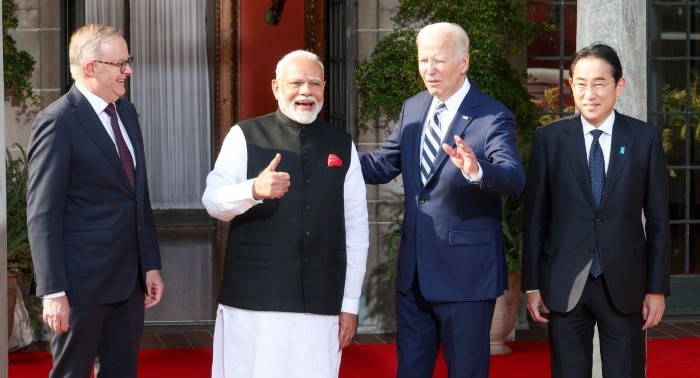
The Quad Summit, as President Biden's last in office, certainly proved to be a pivotal convening with a personal touch conveying the kind of relationship Biden shares with other Quad member country leaders, prominently PM Modi and PM Kishida.
Political transitions have marked this year, with the US and Japan next in line, yet the viability and sustainability of the Quad appear to remain strong in pursuit of its long-sought vision of a rule-based international order, as reaffirmed by the leaders during the summit.
For Quad to endure, the right kind of strategic cooperation in areas beyond security and geopolitics (which will be important binders) will equally become important with time—something that the group seems to understand well. For India and PM Modi, this summit was significant as it marked the Indian premier's first in his third term and as India is set to host the next round. He is in the United States on a broad agenda, including engagement with the large Indian diaspora and addressing the Summit of the Future.
For PM Modi, this was an opportunity to reiterate India's strong willingness to continue working with the United States on areas of mutual interest, including the Indo-Pacific, and to build on the various areas of cooperation the 2 countries have established over the past year.
Despite frictions, the India-US relationship has endured over the Biden administration's tenure. The 2 countries learned to manage differences well and work together where there was a clear alignment, geopolitically and economically, especially in the face of a rising China. Whether a political transition in the United States and any shifts in either country's China policy in the future, would impact this trajectory remains to be seen. Largely, we don't expect major policy pivots from either side.
The announcement of a roadmap for the U.S.-India initiative to build safe and secure global clean energy supply chains, following a bilateral meeting between Biden and Modi, shows a foresight-based cooperative framework in the works where issues (climate change, green tech) not just limited to the 2 countries but with broader benefits for the developing world and the globe are taking precedence.
With India aiming to solidify relationships and ink agreements over issues that are recognized threats to current and future generations, like climate change and green tech innovation, the country is certainly building its case for being the leading voice for the Global South as well.
The summit culminated in a comprehensive statement which not only endorsed the areas of cooperation and alignment that the group has upheld previously but also shared a lot more clearer language on some key global issues: the South China Sea, Ukraine Conflict, and Middle East and Gaza.
Notable was the reiteration of commitment to cooperation in the Indian Ocean region, which goes to say that the region’s security, geopolitical, and strategical significance is well recognised and we will see some more proactive engagement on that front in the near future.
Quad members have signalled the importance they place on the group (& a future pathway for it) by announcing key initiatives such a new regional Maritime Initiative for Training in the Indo-Pacific, joint Coast Guards first-ever Quad-at-Sea Ship Observer Mission in 2025, Quad Cancer Moonshot, & a Quad Indo-Pacific Logistics Network pilot project—showing a multifaceted cooperative framework for these 4 major global players to work on carry forward. Nonetheless, a lot will surely hinge on the success of these initiatives.
Daniel Russel, Vice President for International Security and Diplomacy, ASPI.
Two of the four Quad leaders are stepping down, but this was not a nostalgia summit – they did real work and generated real progress in areas like health, maritime security, and technology that directly benefit communities in Southeast Asia, South Asia, and the Pacific Islands. The Quad is not “the four for the four”—these programs serve the people and interests of the region.
The four leaders allocated an impressive amount of time to their discussions. The bilateral and Quad meetings stretched across an entire day including dinner. There is far more strategic alignment among the four leaders than when they began meeting in 2021. The fact that they now hold real discussions in place of set-piece, scripted interventions is what makes the Quad summit genuinely strategic.
While it is true that Japan and the United States will have new leaders by the time the next Summit is held in India, we can expect continued progress because the Quad today is far more institutionalized and less leader-dependent than in the past.
Dominique Fraser, Research Associate, ASPI Australia.
This year’s Quad leaders meeting comes at a crucial time, as the group may look quite different by the time it meets again next year. This year, the leaders bid farewell to U.S. President Biden and Japanese Prime Minister Kishida, and with elections due before May 2025 in Australia, this might also have been Prime Minister Albanese’s last summit. While the leaders may change, the Quad will likely endure. There are sufficient shared concerns among Quad members about China’s behaviour in the region to gloss over some of the issues that divide them, such as Russia. But the Quad’s impact will really depend on its ability to deliver concrete benefits for the region, especially in areas like maritime security, health, and—eventually—economics. While the joint statement highlights these matters, China would have dominated the agenda behind closed doors.
(Farwa Aamer, Director of South Asia Initiatives, ASPI, New York)








Related Items
India's forex reserves rise $7.26 bn to $674.19 bn: RBI
India, New Zealand target Rs35,000 crore trade by 2030
Operation Amistad concludes, India wraps up humanitarian mission in Venezuela