 Ajay Chaturvedi
In today's world, being connected to the internet has become an essential part of daily life. Online connectivity enables people to access information, receive essential services, work remotely, pursue education, manage financial transactions, and maintain relationships. The Telecom Regulatory Authority of India (TRAI) recognizes that digital inclusion is vital for empowering every citizen. Without timely action, the gap in access to digital services could widen, leaving large sections of society excluded from the benefits of inclusive growth that connectivity offers.
Digital India Programme: Power to Empower
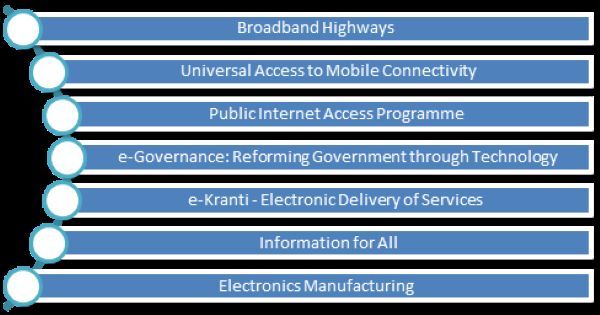
At the forefront of this transformation is the Digital India, a flagship programme with the vision to transform India into a digitally empowered society and knowledge economy. It was launched on July 1, 2015, by Prime Minister Shri Narendra Modi with the vision to transform India into a digitally empowered society and knowledge economy. Digital India has been improving the lives of all citizens through the digital delivery of services, expanding the digital economy and employment opportunities. It is based on the following pillars:
National Broadband Mission (NBM)
The National Broadband Mission was launched in 2019, aiming to provide universal and equitable access to broadband services. Progress under the NBM 1.0 has seen the number of broadband subscribers increase to 94.49 crores, and the Optical Fiber Cable (OFC) length has expanded significantly to 42.13 lakh route km as of March 25, 2025. The NBM 2.0, shall facilitate to tackle challenges of broadband connectivity in remote and difficult areas through several initiatives:Promoting satellite broadband for effective, competitive connectivity in rural and remote areas.
Coordinating with the Ministry of Power to use Optical Ground Wire (OPGW) from the power sector to enhance connectivity in hilly and remote regions.
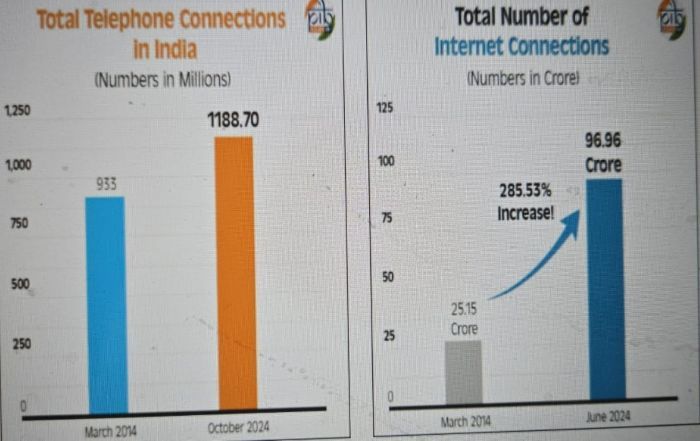
A cornerstone of rural connectivity is BharatNet, being implemented in a phased manner to provide broadband connectivity to all Gram Panchayats (GPs) and villages beyond GPs on demand basis across the country. A cornerstone of rural connectivity is BharatNet, being implemented in a phased manner to provide broadband connectivity to all Gram Panchayats (GPs) and villages beyond GPs on demand basis across the country. Simultaneously, Internet connections jumped from 25.15 crore in March 2014 to 96.96 crore in June 2024, registering a growth of 285.53%. Broadband connections rose from 6.1 crore in March, 2014 to 94.92 crore in August, 2024 growing by 1452%.
Use of Immersive Technologies in the Broadcasting Landscape
Technologies like augmented reality (AR), virtual reality (VR) and mixed reality (MR) can revolutionize content creation and consumption in broadcasting. Experts from broadcasting domain alongside technology innovators presented the use cases to highlight how immersive technologies can enhance viewer engagement, create richer experiences and reshape the future of media content delivery.
The Sanchar Saathi Mobile App is a user-centric platform aimed at enhancing telecom security and empowering citizens. The Sanchar Saathi Mobile App, available on Android and iOS, equips users with essential tools to safeguard their telecom assets and prevent fraud, offering features like reporting suspected fraud communications, managing mobile connections, blocking lost or stolen devices, and verifying handset authenticity. With over 90 crore smartphone users in India, the app ensures easy access to these critical services through a simple, user-friendly interface.
Mahila E-Haat
It is an initiative for meeting aspirations and needs of women entrepreneurs. It is an online marketing platform for women, where participants can display their products. It is an initiative for women across the country as a part of ‘Digital India’ and ‘Stand Up India’ initiatives. The platform has been set up by the Ministry of Women and Child Development, Government of India under Rashtriya Mahila Kosh (RMK).
India's commitment to closing the digital gender gap was strongly reflected during its G20 presidency, where leaders pledged to halve the gap by 2030. With a robust Digital Public Infrastructure (DPI) enabling financial inclusion through Direct Benefit Transfers (DBT) and Government-to-Person (G2P) payments, especially for rural women, India is advancing gender equity in the digital space. As the telecommunications sector evolves, ensuring digital inclusion for women remains essential to achieving gender equality and enabling their full participation in the digital economy. The observance of World Telecommunication and Information Society Day 2025 highlights both the strides made and the ongoing need to build a truly inclusive digital future where women and girls have equal access to opportunities to connect, learn, and succeed.









Related Items
Peace on border essential for business ties: Modi tells Xi In bilateral
India, Russia agree to advance bilateral investment treaty talks
India's electoral process among most transparent in world: CEC