 Ira Singh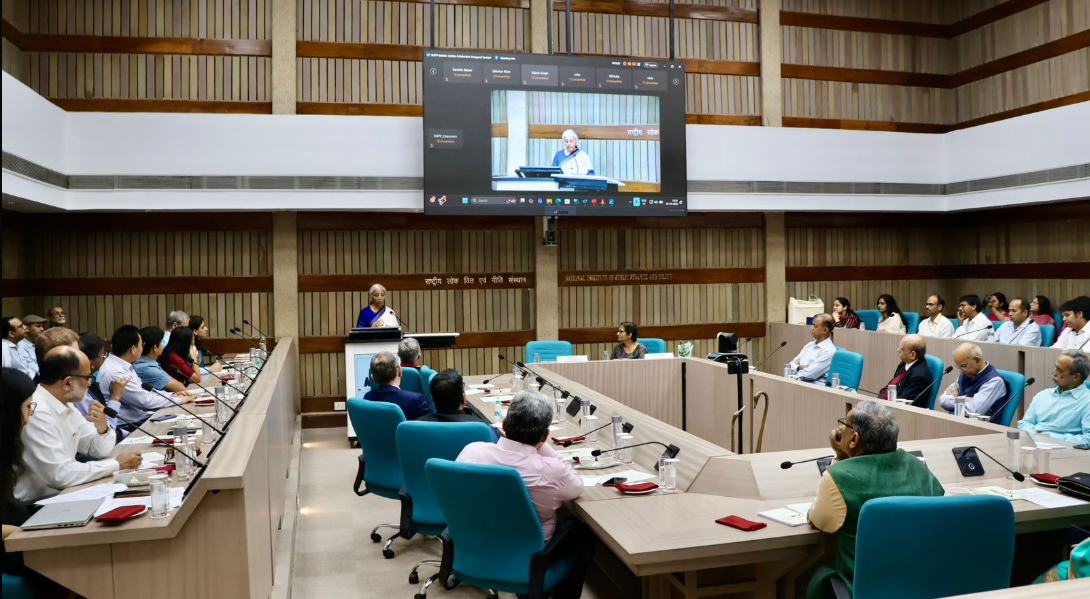
Union Finance Minister Nirmala Sitharaman on Monday expressed concern that the escalating conflict in West Asia is no longer a regional security issue but a systemic shock with far-reaching implications for global energy supply chains and economic stability.Speaking at the golden jubilee celebrations of the National Institute of Public Finance and Policy (NIPFP), Sitharaman said the intensifying geopolitical tensions are “threatening the vital arteries of global energy” while accelerating the emergence of a fragmented, multi-polar world order.Highlighting the evolving global landscape, she noted that the concept of VUCA—coined in the late 1980s—has become increasingly relevant in recent years.
“I wish we could relegate this term to the history books, yet it has become the only honest vocabulary for our present reality. It is what it is: a world of Volatility, Uncertainty, Complexity, and Ambiguity, all at once,” she said.Referring to rising protectionism, including US tariffs and ongoing geopolitical uncertainties, Sitharaman described 2025 as a “monumental year” that reshaped global trade dynamics. She pointed out that trade fragmentation has disrupted supply chains and triggered downward revisions in global growth forecasts, though India emerged relatively resilient.“This current year is even more challenging, as we move from a landscape of ‘shocks’ to one of permanent volatility,” she added.
Despite global headwinds, the Finance Minister underscored India’s comparatively strong fiscal position. She stated that India’s general government debt-to-GDP ratio, including states’ liabilities, stands at around 81%—among the lowest for major economies after Germany—and is projected by the International Monetary Fund (IMF) to decline to 75.8% by 2030.She further highlighted that India’s external debt-to-GDP ratio remains low at 19.1% as of September 2025, while foreign exchange reserves—estimated at over $688 billion as of March 31, 2026—provide an import cover of nearly 11 months.Sitharaman said this strong macroeconomic foundation provides policy flexibility.“India has fiscal space — room to maintain our capex programme, room for the RBI to cut rates, and room to offer targeted support to affected sectors,” she noted, adding that this is the outcome of sustained fiscal discipline over the past decade.
Global public debt has surged to approximately $106 trillion - exceeding 95% of Global GDP.. Many advanced economies that spent decades running expansionary fiscal policies now find themselves with severely constrained policy space precisely when they need it most.
— Nirmala Sitharaman Office (@nsitharamanoffc) April 6, 2026
Meanwhile,… pic.twitter.com/fhWPXu4eIE
In contrast, she flagged rising global debt levels as a key concern. Global public debt has surged to $106 trillion, exceeding 95% of global GDP. According to IMF projections, the United States’ debt-to-GDP ratio is expected to reach 125% in 2025, while Japan’s stands at a steep 235%.“Many advanced economies that pursued expansionary fiscal policies for decades now face constrained policy space precisely when they need it most. Against this backdrop, India continues to stand out,” Sitharaman said.Her remarks come at a time when escalating tensions in West Asia are raising concerns over energy security, inflationary pressures, and the stability of global supply chains, posing fresh challenges for policymakers worldwide.
(Business Correspondent)


_(5).jpg)












Related Items
Agri GVA rises to Rs 52.08 lakh cr as India's farm economy expands
India's retail inflation rises to 4.45% in July on food prices
Karnataka cabinet portfolios out: DKS keeps finance, check full list