 Uday Kumar Varma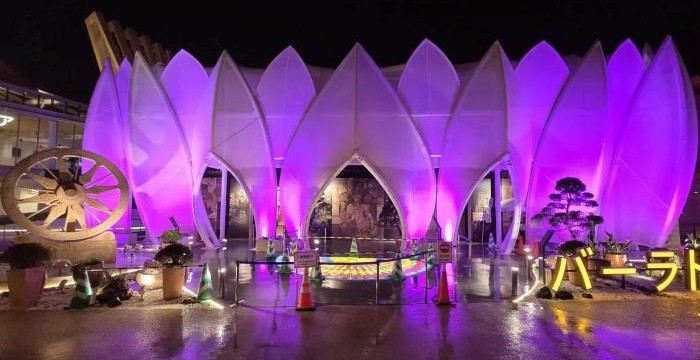
A recent article in The Economist drew attention to a striking contrast between India's pavilion at the Osaka World Expo and its pavilion at this year's Venice Biennale. Both were official representations of India, both came under the Ministry of Culture, and yet the magazine's assessment of the two could hardly have been more different.
Two Ways of Showing India
The Osaka pavilion, it suggested, was late, somewhat chaotic and inclined towards the familiar vocabulary of temples, paintings and official presentations. Venice, by contrast, was presented as a triumph. Imaginatively curated, it brought together five contemporary artists around the idea of home in an India undergoing rapid transformation. Among the works that attracted particular attention was Sumakshi Singh's recreation, in delicate fabric, of her grandparents' demolished Delhi home, and Asim Waqif's vast bamboo installation evoking a country that seems perpetually under construction.
The Economist's verdict is striking, but it is not the only possible reading of Osaka. Other accounts have been considerably more favourable, pointing to the pavilion's popularity with visitors and its attempt to connect India's civilisational heritage with contemporary technology and achievement. That divergence of opinion is itself worth noticing. What one observer sees as unimaginative, another may see as accessible and engaging.
Perhaps that is one of the peculiarities of culture. Its impact cannot always be captured by a single measure, or even by a single judgement.
Yet the contrast between Osaka and Venice does raise a larger question: how should a country as culturally complex as India represent itself to the world?
India is increasingly conscious of culture as an element of its international influence. The Prime Minister has spoken of soft power as one of the dimensions of India's rise. India has for decades used music, dance, cinema, yoga, literature and its civilisational heritage to build bridges with other societies. The Indian Council for Cultural Relations and the Ministry of Culture have an extensive network of programmes, cultural exchanges and Festivals of India abroad.
The India We Choose to Show
The question, therefore, is not whether India has enough culture to show the world. It plainly does.
The more interesting question is: what do we choose to show?
For a long time, the easiest way of presenting India abroad has been through the extraordinary antiquity of Indian civilisation. Temples, classical dance, miniature paintings, handicrafts, yoga, spirituality and traditional music are undeniably part of our inheritance. They are also among the country's most recognisable cultural assets.
But can a civilisation be adequately represented by its inheritance alone?
India is not merely the country that produced Ajanta and the Vedas, Bharatanatyam and the Taj Mahal. It is also a country of restless cities, disappearing neighbourhoods, new architecture, contemporary artists, experimental theatre, independent cinema, literature in many languages, changing food cultures and millions of young people negotiating the relationship between inheritance and modernity.
Perhaps this is what makes the Venice pavilion particularly interesting. It did not attempt to explain India. It allowed artists to make us encounter it.
The recreation of a demolished Delhi home is not a conventional statement about Indian heritage. It evokes a very contemporary Indian experience—the disappearance of familiar spaces beneath the pressure of urban transformation. The bamboo installation similarly speaks of something immediately recognisable in today's India: a country constantly building, rebuilding and changing.
In that sense, the pavilion drew upon tradition without becoming a display of tradition. It found the contemporary in the familiar.
That distinction may be important to the larger question of cultural representation. There is a difference between presenting culture and allowing culture to speak. The first can become a catalogue of achievements: here is our heritage, here are our traditions, here is what India has given the world. The second is less predictable. It permits imagination, experimentation and even ambiguity. It trusts the artist—and, equally, the audience.
This also makes the relationship between the state and culture inherently delicate. Governments have resources, reach and a legitimate interest in representing the country. Artists and cultural institutions possess something different: professional judgement, imagination and the freedom to see the country in ways an official presentation may not always anticipate.
Perhaps the question is not whether one should replace the other, but whether the state can create conditions in which India's many cultural energies—public, private, individual and institutional—can find their own expression.
From Cultural Diplomacy to Soft Power
This matters even more as the language of cultural diplomacy increasingly gives way to that of soft power. The two are related, but they are not quite the same. A government can organise an exhibition, establish a cultural centre or send a performing troupe abroad. It cannot decree that another society will be moved by what it sees.
Influence is ultimately more elusive. It grows from curiosity, admiration, emotional connection and the sense that one is encountering something genuine.
And how do we know when such influence has been achieved? Is it visitor numbers, favourable reviews, social-media attention, international recognition for Indian artists—or something less visible and more enduring, such as a change in how another society begins to see India?
These questions become important if culture is to be regarded not merely as an ornament of diplomacy but as an instrument of soft power.
Perhaps that is why the Osaka–Venice contrast is worth remembering. The issue may not simply be whether India has represented its culture adequately, but whether it has allowed the richness and complexity of contemporary India to find a voice.
And this opens a much larger conversation.
Who should decide what the world sees of India? How much should the state curate, and how much should it enable? Can India's extraordinary heritage become not merely something to preserve and display, but a source of contemporary creativity? And can India move from simply projecting its culture to creating genuine cultural conversations with the societies with which it seeks a deeper relationship?
These are questions that cannot be settled by one pavilion, however successful.
But perhaps the contrast between Osaka and Venice gives us a useful place to begin.
When India speaks to the world, who should speak for India—and what should India say?
The answers may lie not merely in official catalogues, but also—and perhaps more importantly—in the artists, institutions, traditions and experiments through which India is already speaking.

Two Pavilions, Two Ways of Showing India
A recent article in The Economist drew attention to a striking contrast: India's pavilion at the Osaka World Expo and its pavilion at this year's Venice Biennale. Both were official representations of India, both came under the Ministry of Culture, and yet they left remarkably different impressions.
Osaka, the magazine observed, was late, somewhat chaotic and inclined towards the familiar vocabulary of temples, paintings and official presentations. Venice was quite different. Curated by Amin Jaffer, it brought together five contemporary artists around the idea of home in an India undergoing rapid transformation. Among the works that attracted particular attention was Sumakshi Singh's recreation, in delicate fabric, of her grandparents' demolished Delhi home, and Asim Waqif's vast bamboo installation evoking a country that seems perpetually under construction.
The contrast is interesting not simply because one pavilion succeeded and the other did not. It raises a larger question: how should a country as culturally complex as India represent itself to the world?
The Economist attributed much of the difference to the way the two projects were managed. Osaka was essentially top-down, while Venice involved cultural institutions and practitioners with considerable artistic freedom. The government, in the latter case, concentrated more on facilitating the enterprise than directing its artistic content.
There may be other explanations. Great cultural enterprises rarely have a single cause. But the contrast is worth pondering because India is increasingly conscious of culture as an element of its international influence. The Prime Minister has spoken of soft power as one of the dimensions of India's rise. India has for decades used music, dance, cinema, yoga, literature and its civilisational heritage to build bridges with other societies. The Indian Council for Cultural Relations and the Ministry of Culture have an extensive network of programmes, cultural exchanges and Festivals of India abroad.
The question, therefore, is not whether India has enough culture to show the world. It plainly does.
The more interesting question is: what do we choose to show?
For a long time, the easiest way of presenting India abroad has been through the extraordinary antiquity of Indian civilisation. Temples, classical dance, miniature paintings, handicrafts, yoga, spirituality and traditional music are undeniably part of our inheritance. They are also among the country's most recognisable cultural assets.
But can a civilisation be adequately represented by its inheritance alone?
India is not merely the country that produced Ajanta and the Vedas, Bharatanatyam and the Taj Mahal. It is also a country of restless cities, disappearing neighbourhoods, new architecture, contemporary artists, experimental theatre, independent cinema, literature in many languages, changing food cultures and millions of young people negotiating the relationship between inheritance and modernity.
Perhaps this is what makes the Venice pavilion particularly interesting. It did not attempt to explain India. It allowed artists to make us encounter it.
The recreation of a demolished Delhi home is, after all, not a conventional statement about Indian heritage. It is an evocation of a very contemporary Indian experience—the disappearance of familiar spaces beneath the pressure of urban transformation. The bamboo installation similarly speaks of something immediately recognisable in today's India: a country constantly building, rebuilding and changing.
In that sense, the pavilion drew upon tradition without becoming a display of tradition. It found the contemporary in the familiar.
That distinction may be important to the larger question of cultural representation. There is a difference between presenting culture and allowing culture to speak. The first can become a catalogue of achievements: here is our heritage, here are our traditions, here is what India has given the world. The second is less predictable. It permits imagination, experimentation and even ambiguity. It trusts the artist—and, equally, the audience.
This also makes the relationship between the state and culture inherently delicate. Governments have resources, reach and a legitimate interest in representing the country. Artists and cultural institutions possess something different: professional judgement, imagination and the freedom to see the country in ways an official presentation may not always anticipate.
Perhaps the question is not whether one should replace the other, but whether the state can create conditions in which India's many cultural energies—public, private, individual and institutional—can find their own expression.
This matters even more as the language of cultural diplomacy increasingly gives way to that of soft power. The two are related, but they are not quite the same. A government can organise an exhibition, establish a cultural centre or send a performing troupe abroad. It cannot decree that another society will be moved by what it sees.
Influence is ultimately more elusive. It grows from curiosity, admiration, emotional connection and the sense that one is encountering something genuine.
Perhaps that is why the Osaka–Venice contrast is worth remembering. The issue may not simply be whether India has represented its culture adequately, but whether it has allowed the richness and complexity of contemporary India to find a voice.
And this opens a much larger conversation.
Who should decide what the world sees of India? How much should the state curate, and how much should it enable? Can India's extraordinary heritage become not merely something to preserve and display, but a source of contemporary creativity? And can India move from simply projecting its culture to creating genuine cultural conversations with the societies with which it seeks a deeper relationship?
These are questions that cannot be settled by one pavilion, however successful.
But perhaps the contrast between Osaka and Venice gives us a useful place to begin.
When India speaks to the world, who should speak for India—and what should India say?
The answers may lie not in another official catalogue, but in the artists, institutions, traditions and experiments through which India is already speaking.
(Uday Kumar Varma is an IAS officer. Retired as Secretary, Ministry of Information & Broadcasting)

Related Posts
No official US offer to sell F-35 fighters to India, says IAF Chief
India, Africa cannot remain underrepresented in UNSC: Jaishankar
India to reassess US trade deal amid changing circumstances: Goyal