 Uday Kumar Varma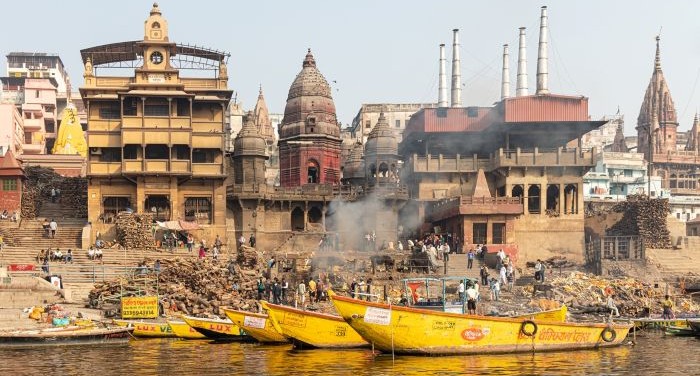
The evening I left Manikarnika, I imagined I was leaving a place. In the days that followed, I realised that I had carried it along with me.
The smells that had assailed me faded quickly. The sounds of Varanasi receded into memory. Yet the questions raised by that ancient cremation ground remained stubbornly alive. They surfaced unexpectedly—in conversations, while watching television, while making plans for the future, and while attending to the countless trivialities that fill our days. Manikarnika had ceased to be a location; it had become an inquiry.
The visit itself had lasted scarcely an hour. The meditation continues still.
The Question That Followed Me Home
What does it mean to live knowing that death is certain?
The question is hardly new. Philosophers, prophets, poets, saints, and ordinary men have wrestled with it across centuries. Yet modern life possesses an extraordinary capacity for postponing the encounter. We live as though mortality were a distant rumour rather than an intimate certainty.
Modern civilisation has become remarkably efficient at shielding us from the awareness of impermanence. Death has largely disappeared from everyday sight, while technology, entertainment, and ambition keep our attention elsewhere. Human beings have never lived longer, yet many have never thought less deeply about death.
India, at its philosophical best, adopted a different approach. Rather than hiding mortality, it invited reflection upon it. The teachings of the Buddha, the songs of Kabir, the wisdom of the Upanishads, and the meditations of countless sages point towards a simple insight: awareness of death is not the enemy of life. It is one of life's greatest teachers.
Manikarnika embodies that wisdom. No sermon is delivered there. No doctrine is imposed. The lesson arises naturally from the spectacle itself.
The Equality of the Pyre
Standing beside those ancient fires, one realises that almost everything to which we attach excessive importance belongs to the realm of the temporary.
The body passes. Beauty fades. Power changes hands. Possessions outlive their owners. Even memory, given sufficient time, yields to oblivion. One body arrives wrapped in costly silk, another in a simple cloth. One funeral is attended by hundreds, another by only a handful. One burns upon sandalwood, another upon ordinary timber. Yet the fire makes no distinction.
What appears unequal in life becomes remarkably equal in death.
Before mortality, wealth, status, rank, and reputation are revealed as temporary arrangements rather than permanent realities. The insight is ancient, yet it remains elusive. If status is transient, perhaps character matters more. If wealth is temporary, perhaps generosity matters more. If fame fades, perhaps service matters more.
Death, paradoxically, helps clarify life.
What Truly Endures?
As I reflected upon that evening beside the Ganga, I found myself returning repeatedly to a question posed, in one form or another, by every spiritual tradition: What truly endures? What remains of us after we depart?
The cremation ground offers no direct answer. Yet it compels the question with unusual force.
Standing there, I realised that much of what occupies us proves surprisingly fragile. Positions are filled by others. Houses acquire new occupants. Wealth changes hands. Even names, given enough time, fade from memory.
Yet not everything vanishes equally.
A kindness offered at the right moment may outlive its giver. A teacher's influence survives in generations of students. A parent's values continue in children and grandchildren. A poem, a book, an act of courage, a scientific discovery, an institution built with care, or simply a life lived with integrity may travel far beyond the span of a single existence.
Perhaps this is what endures—not possession, but contribution; not what we accumulated, but what we gave.
The flames of Manikarnika seem to ask, with relentless simplicity: if all else is destined to pass, what are we leaving behind in the hearts and lives of others?
The Gift of Impermanence
We tend to think of permanence as desirable and impermanence as tragic. Yet some of life's greatest beauties derive their meaning precisely from their transience.
A flower is precious because it blooms briefly. A sunset moves us because it cannot be preserved. Childhood is cherished because it vanishes. Human life itself acquires urgency and significance because it is finite.
Standing beside the Ganga, watching ashes carried away by the current, I found myself thinking of the ancient image of the wave and the ocean. A wave rises, assumes a distinct form for a time, and then subsides. Its individuality disappears, yet nothing is lost. The water remains.
Whether one interprets that metaphor spiritually, philosophically, or poetically matters less than the intuition it conveys: we belong to something infinitely greater than ourselves.
Perhaps our deepest fear is not death itself. Perhaps it is the surrender of separateness.
Living in the Shadow of Eternity
As I think back to that evening, one image returns more vividly than any other.
It is not the sight of a burning pyre, nor the drifting smoke, nor even the funeral processions descending towards the river.
It is the sight of ordinary life continuing a few steps away from the cremation ground.
Shopkeepers attended customers. Pilgrims moved towards temples. A multitude threaded its way through crowded lanes. The city carried on with its endless business, seemingly untroubled by the flames burning beside it.
At first the contrast appeared startling. Later it seemed profoundly wise.
Life and death were not confronting one another as enemies. They were coexisting as companions. The awareness of mortality had not paralysed life; it had become part of life's texture.
Perhaps that is the final lesson of Manikarnika.
We do not honour death by becoming preoccupied with it. We honour it by living more consciously, loving more generously, forgiving more readily, and wasting less time on vanities that cannot survive the fire.
The gift of Manikarnika is not an obsession with mortality.
It is gratitude.
Gratitude for the brief miracle of existence. Gratitude for the companions who share the journey. Gratitude for the opportunity to participate, however fleetingly, in this vast and mysterious universe.
The fires of Manikarnika burn day and night on the banks of the Ganga. Most visitors remember the smoke, the rituals, and the spectacle of mortality.
What remains with me is something quieter: the understanding that death is not life's contradiction but its completion; that awareness of our impermanence can deepen gratitude rather than diminish joy; and that the true purpose of contemplating death is not to prepare for dying, but to learn how to live, and that the surest preparation for death is to live meaningfully.
The flames of Manikarnika continue to burn beside the river.
Their reflection continues to burn within me.
(Uday Kumar Varma is an IAS officer. Retired as Secretary, Ministry of Information & Broadcasting)









Related Items
Atleast 14 infants killed in Islamabad hospital fire
Hawk fire in Nevada destroys atleast 32 homes, leaves 7 injured
Maharashtra: fire at Amravati hospital kills 3 newborns, CM orders probe