 Ira Singh
The evening session of the 101st International Tansen Festival unfolded as a sublime celebration of Brahma Naad, where velvety sarod melodies and refined gharana-style singing came together in a rare confluence of tradition and innovation. Set against the historic backdrop of Gwalior, the festival once again reaffirmed its stature as a living continuum of Indian classical music, where timeless legacies coexist with contemporary musical expression.In keeping with tradition, the evening commenced with an auspicious Dhrupad presentation by students of the Dhrupad Centre, Gwalior. They rendered the bandish “Aisi Chavi Tori Samajhata Nahi” in Raga Puria Dhanashree, set to Teental. Through elaborate, medium, and fast-paced alaps, the performers highlighted the powerful character of the raga while preserving the purity of the Dagarvani tradition. The composition, created by Guru Shri Abhijit Sukhdaane, was elevated by the steady and nuanced pakhawaj accompaniment of Shri Jagat Narayan Sharma.
The stage then welcomed Padma Vibhushan Ustad Amjad Ali Khan, accompanied by his sons, Aman Ali Khan and Ayaan Ali Khan. Representing the illustrious Senia-Bangash gharana, their sarod recital unfolded like an ocean of sound—each layer revealing greater depth and richness.The performance began with Raga Shri, an evening raga of the eastern thaat, known for its spiritual gravitas and contemplative mood. Through expansive alap, the brothers brought out the raga’s dignity and emotional resonance. The slow Jhaptal passage held the audience spellbound, while the concluding jhalla in Teental lifted the performance to a crescendo, drawing warm appreciation from listeners.Ustad Amjad Ali Khan then presented a series of deeply moving compositions. His sarod rendition of Mahatma Gandhi’s favourite bhajan, “Vaishnav Jan To Tene Re Kahiye,” touched the audience profoundly. This was followed by evocative interpretations of “Raghupati Raghav Rajaram” and “Vande Mataram,” filling the atmosphere with spirituality and patriotic fervour. The hall resonated with the hallmark qualities of his style—clarity of tone, gentle phrasing, and perfectly balanced meend and gamak.Tabla accompaniment by Ramendra Solanki and Anubrat Chatterjee added rhythmic strength to the presentation. On the occasion, the academy’s director, Prakash Singh Thakur, and deputy director, Shekhar Karadkar, honoured Ustad Amjad Ali Khan with a commemorative portrait.
Brahma Naad resonated at #TansenMusicfestival as sarod maestro Amjad Ali Khan and gharana stalwarts created an unforgettable evening of classical brilliance in Gwalior. pic.twitter.com/IQShTW66WV
— newsinc24 (@newsinc24) December 17, 2025
The next segment featured noted vocalist Sumitra Guha, who began her recital with Raga Hansadhwani. After a brief alap, she presented the slow bandish “Matang Tanay Madhushalini Bagyeshwari” in Jhaptal, followed by “Laagi Lagan” in Adha Teental. Her fast-paced Teental composition “Kaise Jaun Tumhare Paas” received enthusiastic appreciation from the audience.The vocal segment concluded on an emotive note with her self-composed bandish “Toe Se Nahin Bolun Saiyaan” in Ektaal, followed by Meera’s bhajan “Mere To Giridhar Gopal.” She was ably supported by Shri Suman Chatterjee on tabla, Shri Sumit Mishra on harmonium, and tanpura accompaniment by Smt. Renu Sahu and Shri Saket.The evening session drew to a close with a powerful khayal presentation by renowned vocalists Ritesh–Rajnish Mishra. Torchbearers of the Banaras gharana and sons of the late Pandit Rajan Mishra, the duo presented three bandishes in Raga Nayaki Kanada.The slow Ektaal composition “Banra Mora Pyara Chhail Chhabila” was followed by fast-paced Teental bandishes “Pakherua Re Ai Mai” and “Sajan Bhai Nirash,” rendered with finesse and deep understanding of the raga’s nuances. The recital concluded gracefully with the gharana’s revered bandish “Pratham Jyoti Jwala” in Raga Darbari.Tabla accompaniment by Pradeep Kumar Sarkar and harmonium support from Zakir Dhaulpuri brought rhythmic and melodic completeness to the performance.
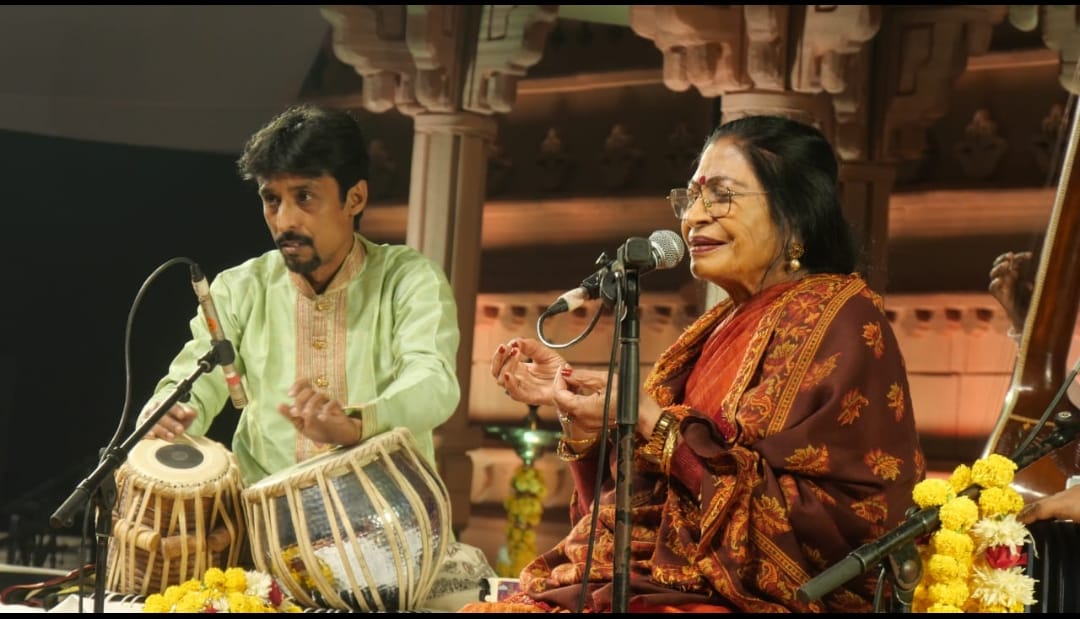
Organised by the Ustad Alauddin Khan Music and Art Academy for the Department of Culture, Government of Madhya Pradesh, in collaboration with the district administration, Gwalior Municipal Corporation, and Madhya Pradesh Tourism, the evening session of the festival’s second day emerged as an unforgettable celebration of Indian classical music—where heritage resonated vividly through sound and soul.
(Asstt.Editor)





Related Items
India hosts 12th BRICS Environment Ministers’ meeting in New Delhi
Trump praises India's voter ID system in bid to pass SAVE America Act
MEA Secretary highlights India's BRICS 2026 priorities at Cairo forum