 Newsinc24 Team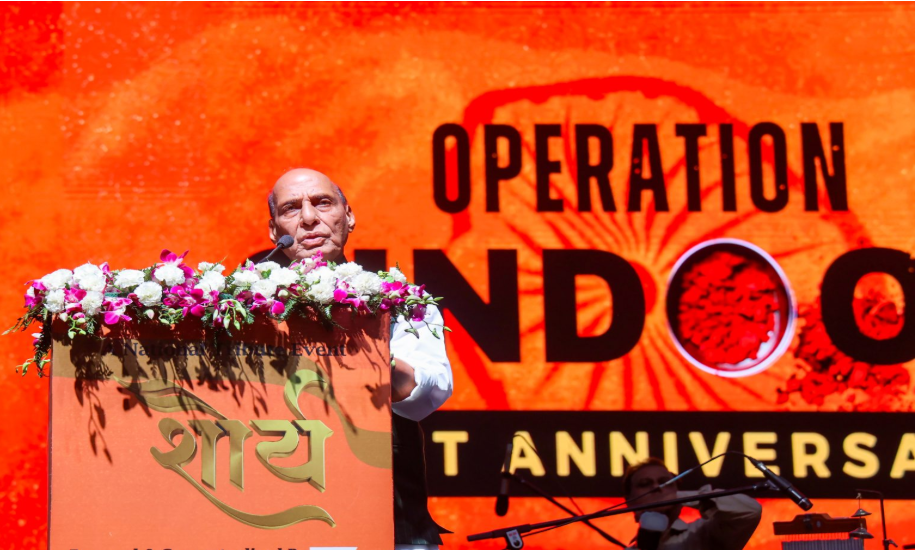
Defence Minister Rajnath Singh on Thursday hailed Operation Sindoor as a symbol of India’s national resolve, military preparedness and growing self-reliance in defence capabilities, while paying tribute to the courage and sacrifices of the armed forces on the anniversary of the operation.In a post on X, Singh said the operation demonstrated the unmatched precision, seamless coordination and deep synergy among the Army, Navy and Air Force in safeguarding the country’s security interests.“On the anniversary of Operation Sindoor, we salute the valour and sacrifices of our armed forces, whose courage and dedication continue to safeguard the nation. Their actions during the operation reflected unmatched precision, seamless jointness and deep synergy across services, setting a benchmark for modern military operations,” the Defence Minister said.
#WATCH | Defence Minister Rajnath Singh tweets, "On the anniversary of Operation Sindoor, we salute the valour and sacrifices of our armed forces, whose courage and dedication continue to safeguard the nation. Their actions during the operation reflected unmatched precision,… pic.twitter.com/PSeySMFKZv
— ANI (@ANI) May 7, 2026
Singh further described Operation Sindoor as a testament to India’s preparedness and decisive military capabilities. “Operation Sindoor stands as a powerful symbol of national resolve and preparedness, showing that our armed forces are always ready to act decisively when it matters most. It also stands testament to India’s steady advance towards achieving Atmanirbharta, enhancing capability while reinforcing resilience,” he added.
Operation Sindoor was launched on May 7, 2025, following the deadly terror attack in Pahalgam that claimed 26 lives. In response, Indian armed forces carried out strikes on terror infrastructure located in Pakistan and Pakistan-occupied Jammu and Kashmir (PoJK).During the operation, India destroyed nine major terror launchpads linked to terror outfits including Lashkar-e-Taiba, Jaish-e-Mohammed and Hizbul Mujahideen. More than 100 terrorists were reportedly killed in the action.
Pakistan subsequently responded with drone attacks and shelling, triggering a four-day military confrontation between the two neighbouring countries. Indian forces retaliated by targeting and destroying radar installations in Lahore and radar facilities near Gujranwala.Following the escalation and damage suffered during the conflict, Pakistan’s Director General of Military Operations (DGMO) contacted the Indian DGMO, after which both sides agreed to a ceasefire on May 10, bringing hostilities to an end.















Related Items
SEMICON 2026: India preparing today for the chips of tomorrow: PM
2 terrorists killed in ongoing Operation in J&K’s Udhampur
PM Modi inaugurates SEMICON India 2026, engages with participants