 Krishan Gopal Sharma
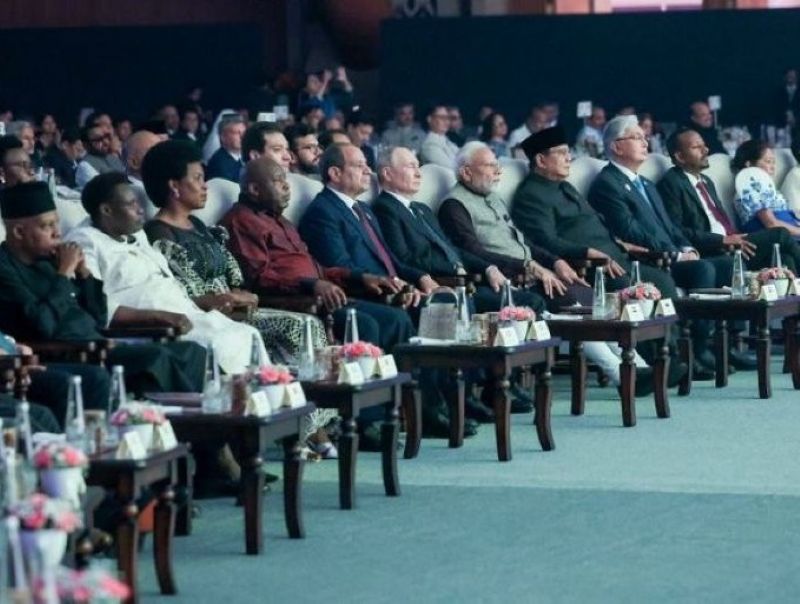
Russian President Vladimir Putin’s visit to India is more than a ceremonial reaffirmation of ties. It is a strategic moment that highlights India’s determination to maintain autonomy in foreign policy while navigating the pressures of an increasingly fractured global order. For Moscow, the trip is a chance to demonstrate resilience against Western isolation and to remind the world that Russia’s reach extends beyond its partnership with Beijing.
At the heart of the visit lies defence. India remains heavily reliant on Russian hardware, and the summit with Prime Minister Narendra Modi is expected to unlock several high-value deals. A $2 billion agreement to lease another nuclear-powered submarine will strengthen India’s underwater deterrence. Negotiations for Su-57 stealth fighters could give the Indian Air Force a qualitative edge, while discussions on the S-500 missile defence system build on the ongoing deployment of S-400 batteries. Civil nuclear cooperation is also on the agenda, with new reactors and technology transfers reinforcing Russia’s role in India’s energy security. These moves are not simply about hardware; they are about ensuring India retains freedom of choice in procurement, avoiding overdependence on Western suppliers who may impose political conditions.
Yet Putin’s presence in New Delhi reverberates far beyond bilateral ties. Western capitals view the visit as undermining sanctions, particularly as India continues importing discounted Russian oil. The timing, against the backdrop of the Ukraine conflict, underscores India’s refusal to isolate Moscow and its insistence on strategic autonomy. Hosting Putin despite his ICC warrant signals India’s prioritisation of national interest over Western narratives, reinforcing its role as a decisive pole in a multi-polar world.
Tightrope Walk
India’s balancing act is fraught with risks. Deepening defence ties with Russia could invite secondary sanctions, disrupt supply chains, and strain relations with Quad allies. Delivery delays caused by sanctions have already raised questions about Russia’s reliability as a supplier. There is also reputational cost: New Delhi’s willingness to host Putin may be seen as defying international norms, potentially complicating its partnerships with the United States and Europe. At the same time, overreliance on Russian systems could limit India’s ability to integrate seamlessly with Western defence platforms, undermining interoperability in the Indo-Pacific.
The rewards, however, are substantial. Access to advanced military technology, enhanced energy security, and greater autonomy in foreign policy strengthen India’s deterrence and global standing. Putin’s visit epitomises India’s tightrope walk—leveraging Russia for hard power while keeping Western partnerships open for technology, trade, and strategic cooperation.
India’s strategy lies in careful sequencing. Russian systems such as submarines and missile defence should be prioritised in the short term, where Moscow has a clear technological edge. Gradually, India must pivot to Western suppliers for fighters, drones, cyber-defence, and space-based surveillance, where Western technology is more advanced and strategically aligned with Indo-Pacific ambitions. Simultaneously, indigenous production under “Make in India” must be accelerated, with Russia supporting missile and tank technologies and Western firms contributing avionics and AI. This layered approach ensures deterrence now, interoperability later, and sustainability in the long run.
Beyond Bilateral Optics
The visit also reshapes the Asia-Pacific security scenario. Russia’s support strengthens India’s deterrence posture against China and Pakistan, complicating Beijing’s calculations along contested borders and in the Indian Ocean. For Washington and its allies, India’s refusal to align fully with the West adds complexity to Indo-Pacific strategies, positioning New Delhi as a swing power capable of tilting balances.
Within BRICS, the visit highlights internal diversity. Russia and China often align to counter Western dominance, but India’s willingness to host Putin despite sanctions underscores its independent trajectory. The summit may strengthen BRICS as a platform for alternative financial mechanisms, yet it also exposes fault lines between India’s balancing act and China’s confrontational stance.
China’s reaction has been cautious. Analysts in Beijing worry that Russia’s defence support could embolden India’s military posture along contested borders. Social media commentary has questioned Moscow’s motives in offering India advanced systems. Yet China also sees opportunity: closer Russia–India ties may prevent Moscow from becoming overly dependent on Beijing, preserving multipolarity. Officially muted, China’s response nonetheless betrays unease.
Conclusion
Putin’s visit to New Delhi is both symbolic and strategic. It reaffirms a long-standing partnership, tests India’s diplomatic balancing skills, and reflects the emergence of a multi-polar world where countries like India assert greater independence in shaping global outcomes. The Asia-Pacific grows more complex, BRICS remains diverse, and China watches warily. For India, the summit is a powerful reminder that autonomy comes with risks, but also with the promise of shaping the future global order on its own terms.
(The writer is a retired officer of the Indian Information Service and a former Editor-in-Charge of DD News and AIR News (Akashvani), India’s national broadcaster. Also served as an international media consultant with UNICEF Nigeria and contributes regularly to various publications.)







Related Items
The QR Code That Changed India
India stresses trade facilitation, supply chains at 25th SCO meeting
Moody’s raises India’s FY27 GDP growth forecast to 7%