 Ira Singh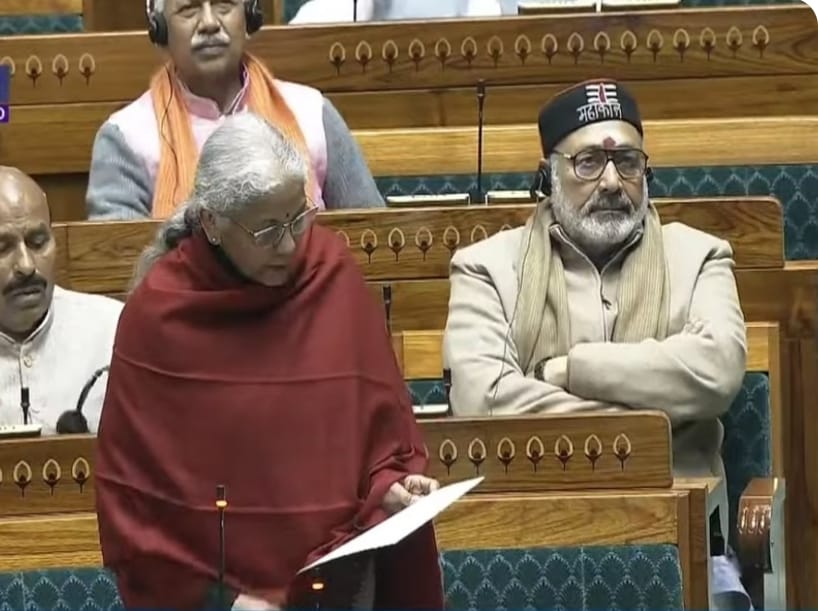
Ahead of the Union Budget 2026, Finance Minister Nirmala Sitharaman on Thursday tabled the Economic Survey 2025–26 in the Lok Sabha, offering the first official assessment of the state of the Indian economy and the policy priorities that will shape the government’s fiscal roadmap. Traditionally regarded as the intellectual foundation of the Budget, the survey sets the macroeconomic context, highlights risks and opportunities, and signals the government’s reform direction.
Prepared by the Chief Economic Adviser’s office, the pre-Budget document takes stock of growth, inflation, employment trends, fiscal health and external balances, while flagging structural challenges confronting Asia’s third-largest economy. This year’s survey places strong emphasis on domestic demand resilience, capital expenditure-led growth and the urgent need to strengthen manufacturing and exports amid a challenging global environment.
The survey projects India’s GDP growth in the range of 6.8% to 7.2% for FY27, underscoring the economy’s relative strength even as the global outlook remains subdued. It notes that domestic demand continues to underpin growth in FY26, supported by public capital expenditure and improving consumption conditions.On inflation, the government highlighted a clear downward trajectory in retail prices over the past four years. Average CPI inflation declined from 6.7% in FY23 to 1.7% in FY26 (up to December). The survey said efforts to increase fertiliser availability could help keep agricultural input costs in check, easing food inflation pressures. It also noted that the continued pass-through of GST rate rationalisation into commodity prices may temper cost-side inflation, even as currency depreciation poses risks of imported inflation.
#BudgetSession2026
— SansadTV (@sansad_tv) January 29, 2026
Union Finance Minister @nsitharaman tables the Economic Survey 2025-26 in Lok Sabha during the Budget session of Parliament #EconomicSurvey #EconomicSurvey2025_26 #BudgetSession #BudgetSession2026@nsitharamanoffc @FinMinIndia @LokSabhaSectt pic.twitter.com/5Rvy2F7b4o
The survey reiterated the need to scale up India’s domestic manufacturing ecosystem, stressing that product quality must be consistently maintained at scale and supported by a robust innovation, research and development framework. It said India must build domestic capacity in strategically critical areas to enhance resilience against external shocks, emphasising that strategic resilience is essential in an era of fractured global supply chains.In a broader reflection on global trade dynamics, the survey argued that “Swadeshi is inevitable and necessary,” given the shift away from naïve globalisation. Export controls, technology denial regimes, carbon border measures and aggressive industrial policies worldwide have altered the calculus of openness. The government said the policy challenge now lies in promoting self-reliance without undermining efficiency, innovation or global integration.
On trade, the survey highlighted strong performance in exports, driven largely by services. India’s total exports touched a record USD 825.3 billion in FY25 and USD 418.5 billion in the first half of FY26, with services exports — including IT, global capability centres and professional services — continuing to outperform goods exports. Non-petroleum, non-gems and jewellery exports also maintained steady momentum.The document noted a diversification in crude oil import sources, with higher imports from Libya, Egypt, Brazil, the US and Brunei during FY26 (April–November), while imports from Russia, Saudi Arabia, Iraq and Venezuela declined. It reported that India’s total trade deficit stood at USD 94.7 billion in FY25, with total imports rising 7.4% year-on-year to USD 919.9 billion.
The survey also flagged emerging supply-side risks, warning that rising power demand has sharply increased the need for copper and other basic metals. Copper prices surged nearly 20% in 2025 even as yields fell. It cautioned that not just critical minerals and rare earths, but even basic metals could face supply constraints as demand rises and supply tightens due to natural and geopolitical factors.On capital flows, the government said gross FDI inflows remained resilient, supported by equity investments and greenfield projects, while portfolio flows were volatile amid shifting global financial conditions. The survey stressed that financial sector regulators must carefully balance growth and stability, remaining open to global capital while insulating the domestic economy from external shocks.
Globally, the outlook remains challenging. The survey warned that downside risks to global growth continue to dominate, even as inflation eases and monetary policy is expected to turn more accommodative. It cautioned that a failure of the AI boom to deliver expected productivity gains could trigger asset market corrections, while prolonged trade conflicts may weaken investment and growth prospects.The Economic Survey also noted that India’s growth momentum remained intact even after the imposition of steep US tariffs in 2025. While growth forecasts were initially revised downward, the survey said growth eventually accelerated due to structural reforms and policy measures, underscoring the economy’s adaptability.Shortly after the survey was tabled, Lok Sabha Speaker Om Birla adjourned the House till February 1. The Union Budget 2026 is scheduled to be presented on Sunday, with the Economic Survey widely seen as offering strong clues to the government’s spending priorities, reform agenda and approach to balancing growth with fiscal prudence.
(Business Correspondent)
Related Posts
India’s manufacturing sector sees 7-month high growth in Sept
India-EFTA TEPA completes one Year, Goyal highlights trade growth
Total employment in industries cross 2 crore mark in 2024-25