 B I Saini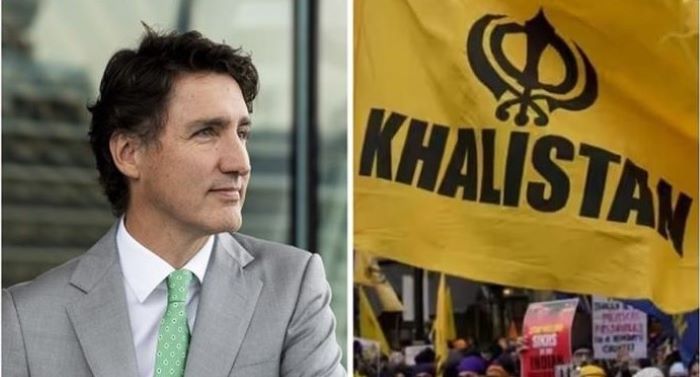
The standoff between India and Canada over the rise of so-called Khalistani elements in Canada shows no sign of abating. On the other hand, differences between New Delhi and Ottawa are growing with every day. The latest escalation comes with India’s decision that the doors will be shut on Canadian citizens seeking visas to visit India. For the present, it means that the High Commission of India and Indian consulates in Canada will not be entertaining applicants seeking to visit India. It is not clear as of now if the restriction will also apply to Canadian citizens in third countries seeking visas for India.
Earlier, both countries resorted to tit for tat expulsions of senior diplomats in their missions. Signs of the deteriorating relationship between India and Canada have been there for a long time. This was apparent even during the G-20 meeting in India. The cold vibes between the leaders of the two countries were all too apparent. The Canadian Prime Minister Justin Trudeau had to spend an extra day in the Indian capital after the end of the G-20 summit because of malfunctioning in his plane. In such a circumstance, host countries usually take steps to see that the overstaying leader of a friendly country does not feel unwanted. This usually means chalking out a meaningful programme for the foreign visitor. But nothing of the sort was in the public domain.
During the interaction between Mr. Trudeau and Prime Minister Narendra Modi, the Indian leader reportedly took up the issue of extremist elements in Canada belonging to the Sikh community raising the issue of establishing a Sikh homeland or Khalistan out of the Punjab state of India. They are also planning to hold a referendum on the issue. It is important to note that the extremist elements have no or very little support in Punjab. They have been keeping up their movement in foreign countries only with the support of some agencies in Pakistan.
To the Indian demand for action against such elements in Canada, Mr. Trudeau is reported to have responded by saying that he cannot stop anyone from expressing their viewpoint and that there is freedom of speech and expression in Canada. For understanding the Canadian leader’s stand, it is essential to understand the position of the Indian diaspora in Canada, and the role it plays in that country’s political sphere.
Out of Canada’s total population of about four crore, about 20 lakh are people of Indian origin, most of whom came from Punjab. And of the Indian origin people, one third follow the Sikh religion. Sikh people of Indian origin are significant players in the political sphere in at two provinces and can affect the electoral outcome in several more constituencies. There is also a political party headed by a Sikh. Mr. Trudeau’s cabinet itself has several ministers, whose forefathers had their roots in Punjab and other parts of India.
People of Indian origin, especially Punjabis following the Sikh faith play an active role in Canadian politics. In the normal course, Canada will go for elections in September next year. But in several instances, elections in the country have been advanced depending upon the political situation and the ruling party or coalition’s assessment of its prospects.
India is also heading for national elections in about six or seven months in the normal course. Before that, Assembly elections are due this year in five states including Rajasthan, Madhya Pradesh, Chhattisgarh and Telangana.Prime Minister Narendra Modi’s BJP is a major contender for power at both the state level, and, of course, at the national level.
One of the major selling points of the BJP, and especially Prime Minister Narendra Modi, has been their protecting the national interest at all costs. One has to look at the current tensions between India and Canada keeping this in mind. The ruling dispensation cannot allow any thing to crop up which shows that the national interest and the country’s image is not being protected. The rise of Sikh extremists and the so-called Khalistani elements is in a way detrimental to the idea of a rising India prepared to take primacy in the comity of nations.
The Narendra Modi led ruling dispensation cannot allow the impression to go around that it has been unable to preserve and protect the national image.
On the other hand, Prime Minister Justin Trudeau of Canada has his own reasons for not taking action against the so-called Khalistani elements. Whether we like it or not, tensions between India and Canada may not subside in the near future.
(B I Saini is a Political Analyst with decades of journalistic experience. Retired as DG, News, AIR)






Related Items
India Passes BRICS Baton to China, PM Modi seeks timely action on Declaration
Diplomatic achievement: Mayawati lauds adoption of BRICS Declaration
India, Russia agree to advance bilateral investment treaty talks