 Uday Kumar Varma
From Global Dialogue to Global Delivery
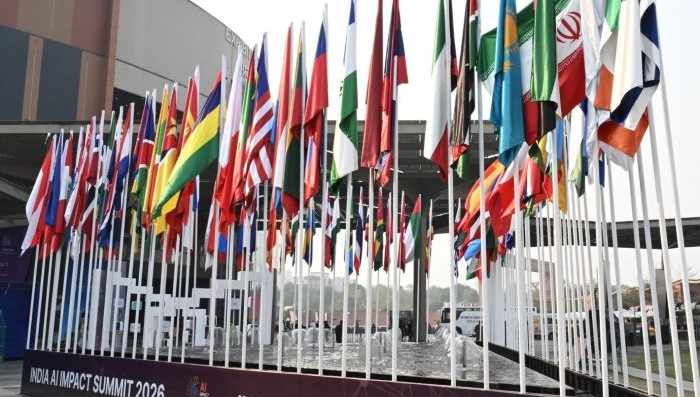
The India AI Impact Summit 2026 opened Monday at Bharat Mandapam. Remarkable for its scale and wide participation, it will reportedly be attended by more than 24 heads of state and government, including French President Emmanuel Macron and Brazilian President Luiz Inácio Lula da Silva. The scale of representation underscores a simple reality: Artificial Intelligence is no longer a sectoral technology issue; it is a structural global priority.
But symbolism alone will not define the Summit’s significance. Its importance lies in timing.
AI’s global market is projected to exceed $1 trillion in economic value within this decade, with estimates suggesting AI could contribute up to $15 trillion to global GDP by 2030. At the same time, computing power remains highly concentrated, advanced foundation models are dominated by a handful of corporations, and energy consumption by large AI systems is rising sharply. The question confronting policymakers is not whether AI will reshape economies — it already is — but whether its benefits will be broadly shared or narrowly accumulated.
Previous global convenings — from Bletchley Park to Seoul, Paris and Kigali — focused significantly on safety, guardrails, and high-level principles. The India AI Impact Summit signals a pivot: from safeguarding against harm to ensuring measurable developmental impact.
A Framework Built on Equity
The Summit’s architecture — organised around three guiding Sutras of People, Planet, and Progress, operationalised through seven thematic Chakras — reflects an attempt to structure AI governance around distributive justice as much as innovation.
Consider the Human Capital dimension. The World Economic Forum estimates that AI could displace tens of millions of jobs globally while creating new roles requiring advanced digital skills. For emerging economies with youthful demographics, this transition is both an opportunity and a risk. Without large-scale reskilling, AI-driven productivity gains could exacerbate inequality rather than reduce it.
Similarly, the Democratising AI Resources Chakra addresses a fundamental asymmetry: access to large datasets, high-performance compute, and advanced models remains concentrated in a few nations. If left unaddressed, this imbalance could replicate the digital divides of previous technological revolutions — only at far greater speed.
By foregrounding inclusion and resource access, the Summit implicitly recognises that AI geopolitics is as much about infrastructure equity as it is about algorithmic innovation.
The Energy and Sustainability Imperative
Another analytical dimension often overlooked in public discourse is environmental cost. Training advanced AI systems requires enormous computational resources, with associated carbon footprints and water usage for data centre cooling. The Resilience, Innovation & Efficiency working group is therefore not peripheral; it is central. If AI is to serve the Planet, energy-efficient model development and frugal innovation must move from aspiration to engineering priority.
For countries in the Global South, where energy and water constraints are real, scalable yet resource-light AI systems will determine whether adoption is viable or exclusionary.
What Can a Summit Realistically Achieve?
Sceptics will argue — not without reason — that summits generate declarations more readily than implementation. AI development today is driven by private capital, venture ecosystems, and national strategic interests. Regulatory philosophies differ sharply across regions.
However, three realistic outcomes are within reach:
Norm Convergence: Agreement on baseline safety, transparency, and accountability principles.
Operational Collaboration: Cross-border partnerships in AI for health, agriculture, climate modelling, and education — sectors where impact is measurable.
Institutional Inclusion: Greater representation of Global South research institutions in AI science, data governance frameworks, and standards-setting bodies.
The participatory groundwork — including public consultations, pre-summit events across multiple geographies, and co-chaired working groups — gives this Summit procedural legitimacy. The test will be whether this consultative architecture evolves into durable institutional mechanisms.
The Road Ahead
AI governance will not be resolved in two days of plenaries. The Summit’s real success will depend on follow-through: working group deliverables, measurable milestones, funding commitments, and periodic accountability.
India’s role as host is therefore consequential. It positions the country not merely as an AI market, but as a convener shaping the ethical and developmental vocabulary of AI diplomacy.
If the India AI Impact Summit 2026 manages to align ambition with implementation — even partially — it could mark a turning point: the moment when AI governance moved beyond precautionary dialogue toward coordinated global delivery.
The age of AI is already here. The question is whether global stewardship will keep pace.
(Uday Kumar Varma is an IAS officer. Retired as Secretary, Ministry of Information & Broadcasting)



Related Posts
France to preserve India’s manuscript heritage
India must lead in creating future technologies, says PM Modi
India pushes for BIOFIN, tech transfer & global cooperation