 Ira Singh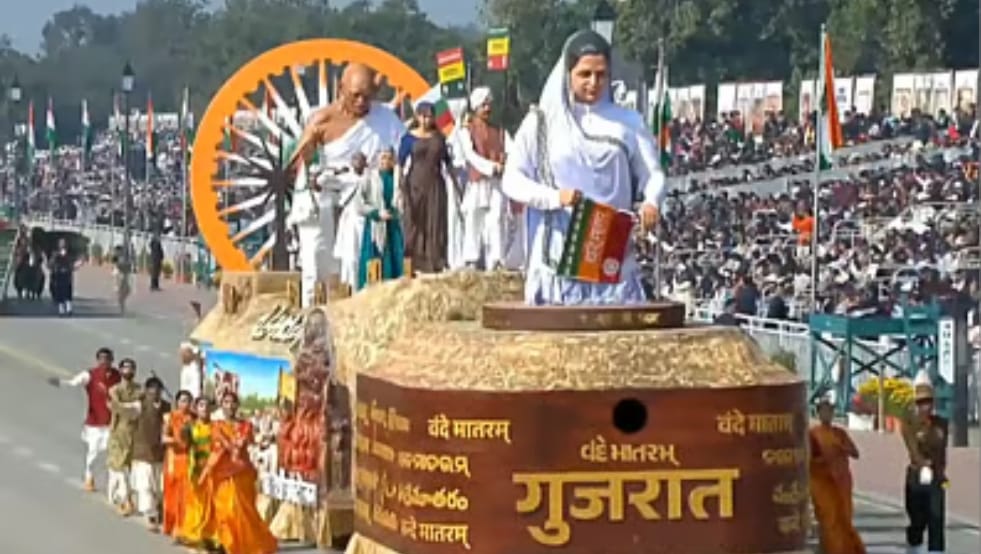
Gujarat’s colourful tableau at the Republic Day parade on Kartavya Path on Monday paid tribute to the legacy of Vande Mataram and revolutionary freedom fighter Madam Bhikaji Cama, marking 150 years of the iconic national song. The float rolled down the ceremonial boulevard to enthusiastic cheers from the crowd.Designed on the theme “Mantra of Swadeshi – Self-Reliance – Freedom: Vande Mataram”, the tableau commemorates the enduring spirit of India’s freedom struggle and the role played by Bhikaji Cama in carrying the message of independence to foreign shores.
The tableau depicts Cama holding a flag inscribed with Vande Mataram, which she first unfurled in Paris in 1907 and later presented at the Indian Socialist Conference in Stuttgart, Germany, symbolising India’s revolutionary voice abroad. Born in Navsari in Gujarat, Cama is prominently featured at the front of the state’s float.According to the official Republic Day parade booklet, “Vande Mataram is the timeless mantra that awakened the spirit of Swadeshi, self-reliance and freedom in India’s national consciousness.” Marking the 150th anniversary of Vande Mataram, the tableau honours Cama, who, along with revolutionaries Shyamji Krishna Varma and Sardar Singh Rana, spread India’s freedom movement beyond national borders.
The central section of the tableau traces the evolution of India’s national flag — from the Swadeshi movement at Parsi Bagan in Calcutta (now Kolkata) in 1906, to the Home Rule flag of 1917, Pingali Venkayya’s design presented to Mahatma Gandhi in 1921, its near adoption in 1931, and finally the acceptance of the tricolour with the Dharma Chakra by the Constituent Assembly on July 22, 1947.At the front, Cama is shown holding her self-designed flag, with the slogan Vande Mataram inscribed below in multiple Indian languages recognised by the Constitution. The rear portion of the tableau features a sculpture of Mahatma Gandhi, symbolising freedom through Swadeshi and the charkha, set against a grand Dharma Chakra.The tableau also highlights the connection between Cama’s revolutionary legacy and Mahatma Gandhi’s propagation of Swadeshi, linking it to the modern vision of Aatmanirbhar Bharat. Folk artistes performing to “Kasumbi No Rang”, composed by noted Gujarati poet Zaverchand Meghani, added cultural vibrancy and patriotic fervour, honouring the sacrifices that shaped India’s freedom and continue to inspire a self-reliant nation today.
(State Correspondent)

_(5).jpg)




Related Items
'Many forces don't want India to become Vishwaguru':Bhagwat on I Day
India celebrates 80 years of freedom, renewing shared 'National Spirit'
US Secretary of State Rubio greets India on Independence Day