 Uday Kumar Varma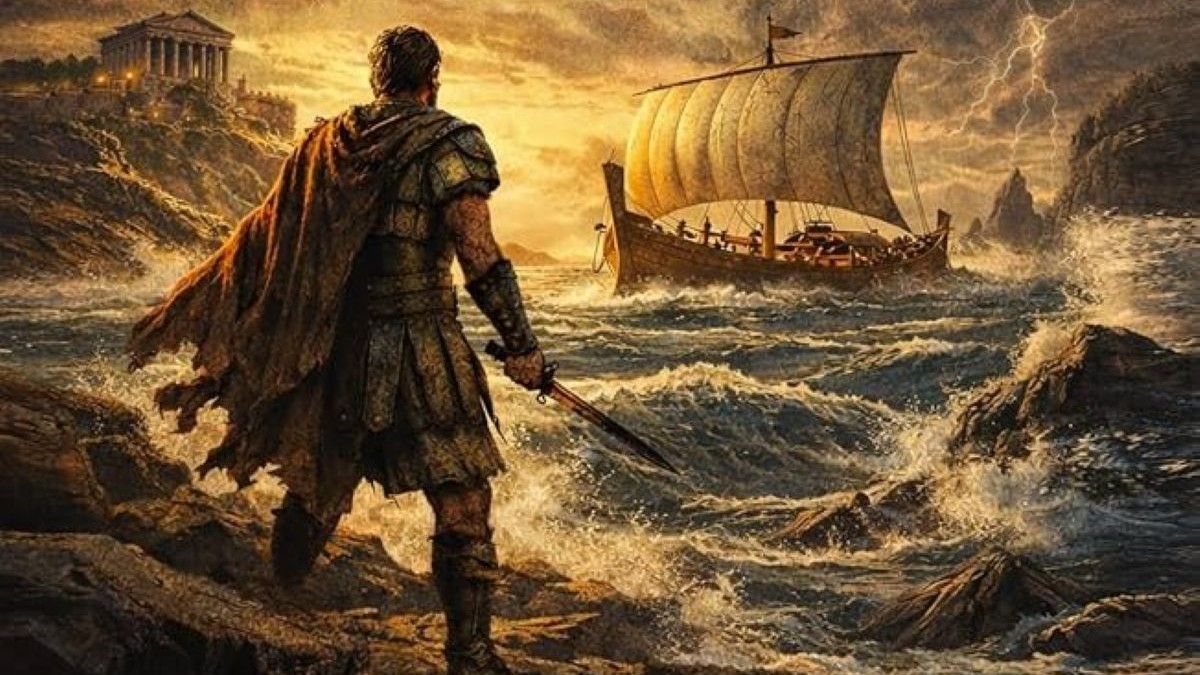
Odysseus
What does a filmmaker do when he has almost unlimited technological power and chooses to tell a story that is nearly three thousand years old?
Christopher Nolan’s answer is The Odyssey.
It is an audacious choice even for a filmmaker whose career has been built on audacity. He has taken one of the foundational works of Western literature and turned it into a vast cinematic spectacle, with Matt Damon as Odysseus and a cast that includes Anne Hathaway, Tom Holland, Robert Pattinson, Lupita Nyong’o, Zendaya and Charlize Theron. The scale is unmistakably Nolan: large locations, real ships, extensive location shooting and IMAX cameras, all deployed in the service of a story whose origins lie in an age when cinema, obviously, did not exist.
Yet the most fascinating thing about the film is not its scale. It is the fact that Homer still seems large enough for Nolan.
Why Homer, why now?
The Odyssey is an ancient story, but it does not feel entirely ancient. A warrior has spent years away from home after the Trojan War. He encounters monsters, temptations, storms and strange lands. He angers gods, loses companions and is repeatedly prevented from reaching Ithaca. Yet beneath all the mythology and adventure lies something remarkably simple: a man wants to go home. That emotional simplicity may explain much of the poem’s extraordinary afterlife.
The Odyssey has been translated, retold and reinvented for centuries. James Joyce found its skeleton beneath a single day in Dublin. Its hero became an adjective: an “odyssey” is now any long and difficult journey. The poem has survived because successive generations have discovered something of themselves in it.
Nolan may have found something else.
He is a filmmaker fascinated by time, memory and stories that refuse to move in a straight line. Memento, Inception, Dunkirk, Tenet and Oppenheimer all require the audience, in different ways, to reconstruct rather than simply receive the narrative. Homer had already done something rather similar.
Odysseus does not even appear at the beginning of the Odyssey. The poem opens with Telemachus and the crisis at home. Much of Odysseus’s extraordinary journey is narrated later, retrospectively, by Odysseus himself. The original non-linear storyteller, then, was Homer. Perhaps Nolan recognised a kindred spirit.
But whose Greece?
Even before audiences saw the film, The Odyssey became an object of argument.
The casting attracted controversy, particularly the choice of Lupita Nyong’o as Helen of Troy. Costumes were scrutinised. Some complained that the armour and clothing looked too modern; others questioned the use of particular ships and visual styles. There were arguments over accents, dialogue and the very appearance of Homer’s world.
At first glance, these may seem like familiar internet battles over historical authenticity. But they raise a more interesting question: How faithfully should cinema reproduce an ancient world?
Nolan’s film is not a documentary reconstruction of Bronze Age Greece. Its costume designer has spoken of creating a world intended to feel timeless rather than tied to a single archaeological period. His production team used an actual Viking ship for some of the sea sequences, partly because a real wooden vessel behaved differently from a studio construction. Actors learned to row and sail.
The paradox is revealing.
The film may not reproduce ancient Greece exactly as a historian would reconstruct it, but Nolan has gone to extraordinary lengths to make Homer’s world physically convincing.
Perhaps that is what cinema does best. It does not merely reproduce the past. It reimagines the past so that the present can see it.
Every age gets the Homer it deserves.
The ancient Greeks transformed epic into tragedy. Alexander Pope gave Homer the cadence of eighteenth-century England. Joyce turned him into the architecture of modern Dublin. Nolan now takes him into the age of IMAX, digital effects and global cinema.
There has never been one final Odyssey. There cannot be. A living epic survives precisely because it can be made to speak again.
And here the Indian question begins
For an Indian viewer, this should provoke an intriguing thought.Why should Homer have all the fun? India possesses not one but an extraordinary constellation of epic and mythological traditions. The Ramayana and Mahabharata have survived not merely as texts but as living traditions, continuously retold through languages, theatre, dance, painting, folk performance, television and cinema.
We have never lacked epic stories. The more interesting question is what we might yet do with them.
That is where the journey continues.
To be continued in From Odysseus to Hanuman — II: Hanuman
(Uday Kumar Varma is an IAS officer. Retired as Secretary, Ministry of Information & Broadcasting)


Related Posts
Prez Murmu presents 72nd National Film Awards in Kevadia, Gujarat
Marathi film ‘Gondhal’ is India’s pick for Oscars 2027
National Awards: Article 370 wins Best film