Ira Singh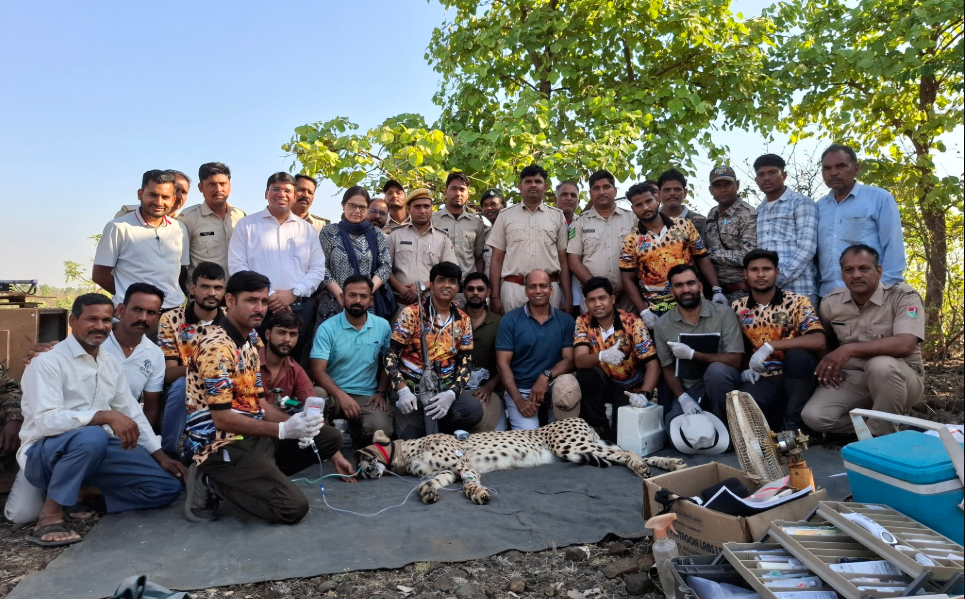
KAP13 a male cheetah released into the wild earlier this year under India’s ambitious cheetah reintroduction programme, was successfully rescued from the border region between Rajgarh district and Jhalawar after straying out of Kuno National Park, officials said.According to information,the rescue operation was launched after continuous monitoring revealed that the cheetah had moved into a human-dominated landscape over the past few days, raising concerns about possible human-wildlife conflict and risks to the animal’s safety.
Teams from the Madhya Pradesh Forest Department, assisted by the Rajasthan Forest Department, jointly carried out the inter-state operation. After being safely tranquilised, KAP13 was transported back to Kuno National Park in Madhya Pradesh and released again into the protected wild habitat.Officials said the operation was conducted smoothly and the animal was found healthy during the rescue process.“KAP13 had moved into a human-dominated zone and, considering the safety of both local residents and the cheetah, a decision was taken to bring the animal back to Kuno,” officials said .Forest officials also thanked the Rajasthan Forest Department for extending logistical and field support during the operation.
KAP13 was among the cheetahs released into the free-ranging landscape of Kuno National Park on February 5, 2025, as part of India’s cheetah reintroduction initiative launched in September 2022. The programme marked the return of cheetahs to India nearly 70 years after the species was declared extinct in the country in 1952.Under the project, African cheetahs were translocated from Namibia and South Africa to Kuno National Park, which was selected as the primary site for establishing a free-ranging cheetah population.The project initially faced multiple challenges, including the deaths of several adult cheetahs and cubs due to infections, injuries, health complications and adaptation stress, drawing criticism from wildlife experts over habitat preparedness and long-term sustainability.
However, forest authorities have since strengthened veterinary protocols, monitoring systems and habitat management practices. Over time, several cheetahs have adapted successfully to the open forests and grasslands of Kuno and adjoining landscapes.Officials said the animals are now gradually exploring wider territories beyond the park boundaries into nearby districts and neighbouring states, reflecting natural territorial behaviour common among wild cheetahs.Sources quoted the PCCF as saying that such movement outside protected areas is not unusual for large carnivores acclimatising to semi-open ecosystems, though it presents significant management challenges in densely populated regions.
The successful rescue and safe return of KAP13 is being viewed as an important example of coordinated wildlife management and rapid response capability developed under the cheetah project.Meanwhile, officials said the birth of multiple cubs in the Kuno landscape over the past year has boosted confidence among conservation managers. With another recent litter confirmed, the overall cheetah population associated with the Kuno landscape has now risen to 57.
Wildlife experts believe that sustained breeding success, prey availability, disease management and expansion of suitable habitats will remain critical for the long-term success of India’s cheetah conservation programme.Kuno National Park has emerged as the centrepiece of India’s efforts to revive the cheetah population and restore grassland ecosystems, with authorities also exploring additional sites for future relocation and population expansion.
(Asstt Editor)

_(5).jpg)