 Uday Kumar Varma
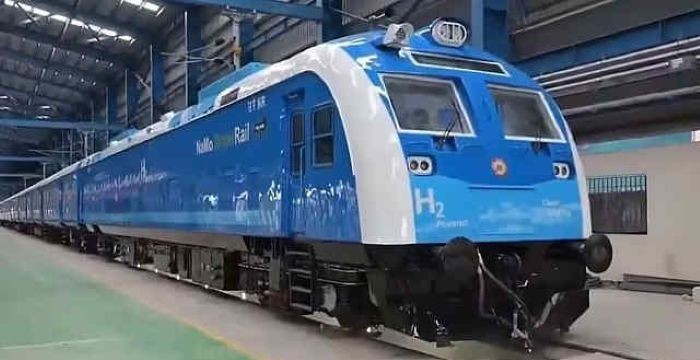
A train moved quietly across the plains of Haryana. Unlike the locomotives that have powered India's railways for generations, it left behind neither smoke nor the smell of diesel. Its only visible emission was a plume of water vapour. To many, it was simply another railway trial. Yet history often announces itself quietly. This modest journey may well mark India's entry into one of the defining technological transitions of the twenty-first century.
India's first indigenously developed hydrogen-powered train is undoubtedly an engineering milestone. But its significance extends far beyond the railway tracks. It signals India's determination to participate in shaping the next generation of energy technologies rather than merely adopting innovations developed elsewhere.
Every major leap in civilisation has been accompanied by an energy revolution. The history of civilisation can also be read as the history of humanity's successive mastery over energy—from wood and wind to coal, oil, electricity and now, perhaps, hydrogen. Coal powered the Industrial Revolution. Petroleum transformed mobility, industry and geopolitics in the twentieth century. Electricity reshaped the modern economy. Today, as the world grapples with climate change, energy security and the imperative of sustainable growth, green hydrogen is emerging as one of the most promising candidates to power the next chapter of industrial development.
Why Hydrogen Matters
Electricity is indispensable to modern life, but it cannot do everything. Batteries have already begun transforming passenger vehicles and urban transport. Yet sectors such as steel, fertiliser, shipping, aviation and long-distance heavy transport require a compact, transportable source of clean energy that batteries alone cannot efficiently provide.
Electricity may power our homes and cities; hydrogen may yet power the industries that build modern civilisation.
Produced by splitting water through electrolysis using renewable electricity, green hydrogen offers precisely such a possibility. When used in a fuel cell, the only direct emission is water vapour. It therefore holds the promise of reducing emissions from some of the most difficult sectors to decarbonise.
India's Window of Opportunity
India enters this emerging field with several natural advantages. It possesses abundant sunshine, rapidly expanding renewable energy capacity and among the world's lowest solar power costs—the essential ingredients for producing affordable green hydrogen.
The National Green Hydrogen Mission reflects this strategic vision. Its objectives extend well beyond reducing carbon emissions. It seeks to strengthen energy security, promote indigenous manufacturing of electrolysers and fuel cells, encourage scientific innovation, reduce dependence on imported fossil fuels and eventually position India as an important producer and exporter of green hydrogen and green ammonia.
India already consumes substantial quantities of hydrogen in petroleum refining and fertiliser production. The transition from conventional hydrogen to green hydrogen therefore builds upon an existing industrial ecosystem, making the pathway to adoption more practical than is often recognised.
More Than a Railway Experiment
Railways have historically been among the most visible symbols of technological progress. It is therefore fitting that India's hydrogen journey has chosen the railway as one of its earliest public demonstrations.
Ironically, however, the future of hydrogen in India does not primarily lie in railways. Indian Railways has already electrified almost its entire broad-gauge network, making electric traction both economical and environmentally efficient. Hydrogen-powered trains are therefore likely to be most valuable on heritage railways, mountain routes and isolated sections where electrification is technically difficult or economically impractical.
The real importance of the hydrogen train lies elsewhere. It demonstrates technologies whose applications extend far beyond transportation—to industries that are considerably harder to decarbonise.
The Real Race
Around the world, countries are exploring hydrogen with both enthusiasm and caution. Germany pioneered hydrogen-powered passenger trains, while Japan, China and the United States continue to invest in research and pilot projects. At the same time, experience has shown that hydrogen is not a universal solution. High production costs, expensive fuel-cell systems, storage challenges and specialised infrastructure remain significant hurdles. In several applications, battery-electric systems may prove more economical.
India should therefore avoid both scepticism and hype. Hydrogen is neither a miracle fuel nor a technological fad. Its success will depend upon identifying the sectors where it offers genuine technological and economic advantages.
More fundamentally, the real global competition is not about producing hydrogen alone. It is about mastering the technologies that make the hydrogen economy possible—advanced electrolysers, fuel cells, catalysts, specialised materials, storage systems and manufacturing capabilities. Nations that lead in these technologies will shape the industries of the future.
A Departure, Not a Destination
The quiet train that recently traversed the plains of Haryana is therefore more than a technological curiosity. It is a reminder that every great technological revolution creates two kinds of nations—those that import the future and those that help invent it.
India's first hydrogen train is not, by itself, a transformative achievement. But it reflects an aspiration to belong to the latter category. Whether that ambition is realised will depend not merely on government policy but on sustained investment in scientific research, engineering excellence, advanced manufacturing, skilled human resources and innovation.
The journey to a hydrogen economy therefore, will ultimately be decided not on the railway tracks but in laboratories, universities, factories and research centres. The train is simply its most visible symbol.
For a country that once missed the Industrial Revolution and later emerged as a global force in information technology, the hydrogen economy presents another opportunity—not merely to participate in a technological revolution but to help shape it.
The hydrogen train is not the destination. It is the beginning of India's hydrogen journey.
(Uday Kumar Varma is an IAS officer. Retired as Secretary, Ministry of Information & Broadcasting)



Related Posts
India-Poland strategic partnership should translate into JVs: PM Tusk
India wins gold in men’s recurve doubles archery at Asian Para Games
Some dream of disorder in India, Rahul failed product of Cong: PM Modi