 Newsinc24 Team

A new report by the Asia Society Policy Institute (ASPI) highlights how Asian middle powers are increasingly shaping the global order, as geopolitical uncertainty and intensifying rivalry between the United States and China drive a shift toward diversified alliances and strategic autonomy.Titled “Seeking Agency in Uncertainty: Asian Middle Powers and the Fragmenting Global Order,” the paper, authored by Farwa Aamer and Emma Chanlett-Avery, examines how countries across Asia and beyond are recalibrating foreign policy in response to a rapidly evolving geopolitical landscape. Both are Directors at New York based ASPI.
The report argues that middle powers are no longer passive players reacting to great power dynamics but are actively designing new frameworks of cooperation. “Middle powers are no longer peripheral actors… they are active designers of institutional geometry,” the authors note.At the core of this shift is a growing reliance on “hedging” strategies, where nations seek to balance ties across competing global powers rather than align exclusively with one bloc. Countries are building what the report describes as “shock absorbers”—overlapping economic, technological, and security networks aimed at reducing vulnerability to geopolitical disruptions.
Key Asian players such as India, Japan, Australia, and South Korea are at the forefront of this transformation. These nations are increasingly leveraging mini-lateral groupings, trade agreements, and critical minerals partnerships to diversify dependencies and strengthen resilience.
Key Findings Include:
•Japan is diversifying its security partnerships across Europe, Asia, and the Pacific. It is “uniquely positioned” to be a catalyst for middle power diplomacy as the only Asian member of the G7 and with deep NATO engagement.
•India has concluded or advanced free trade agreements with the United Kingdom, New Zealand, and the EU. It is aggressively building critical minerals partnerships as part of its Viksit Bharat 2047 vision, attempting to mitigate vulnerability before dependency becomes a constraint.
•Australia is positioned to provide stability and representation for its Southeast Asian and Pacific Island neighbors as a resident middle power. It has shifted its orientation from global multilateralism to more focused mini-laterals that shape the regional security environment.
•South Korea's booming defense export sector—surpassing $17 billion in 2022—has driven strategic alignment with NATO partners and elevated Seoul's role well beyond the Indo-Pacific.
•Pakistan has extended its traditional balancing logic westward, formalizing a Strategic Mutual Defense Agreement with Saudi Arabia and deepening ties across the Gulf, while leveraging its nuclear deterrent and geographic position as a net security provider in the region.
India, for instance, has accelerated trade negotiations with partners including the United Kingdom and the European Union, while simultaneously expanding its role in groupings such as BRICS and the Shanghai Cooperation Organization. The report notes that New Delhi’s strategy reflects a broader push to secure economic resilience and maintain strategic autonomy.Japan is described as “uniquely positioned” to drive middle power diplomacy, given its membership in the G7 and deep engagement with NATO. Meanwhile, Australia has shifted focus toward smaller, targeted partnerships to shape regional security, and South Korea’s booming defence exports have elevated its global strategic role.The report also highlights the growing importance of cross-regional engagement, with Asian middle powers expanding ties with the Gulf, Europe, and North America. Countries such as Canada and the United Kingdom are pursuing similar hedging strategies, reinforcing a broader trend of “strategic diversification” across the global system.
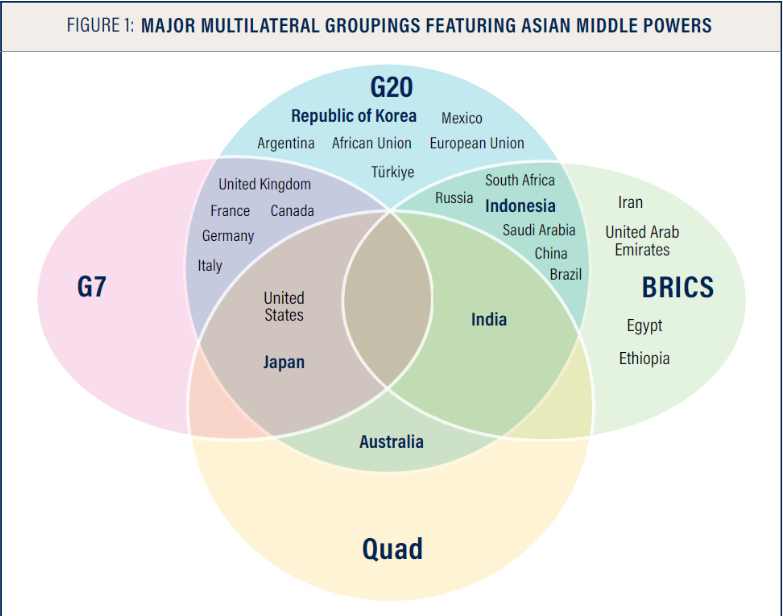
A key driver behind this shift is the perceived unpredictability of global leadership, particularly under what the report terms “Trump 2.0,” alongside intensifying U.S.-China competition. This has prompted nations to prioritise economic security, supply chain resilience, and technological cooperation over traditional ideological alignments.The study underscores that the emerging global order is neither strictly bipolar nor multipolar but a complex network of overlapping alliances and selective partnerships. While platforms like the G20 and BRICS offer avenues for coordination, internal divergences continue to limit collective action.
Despite their growing influence, the report cautions that middle powers face structural constraints, including economic dependencies, regional rivalries, and differing threat perceptions. The lack of a unified strategic vision could hinder the formation of durable coalitions.For Washington, the findings carry significant implications. The report concludes that the United States must focus on maintaining reliability and predictability to remain a central force in the evolving system. “The central question… is not how to prevent hedging but how to remain the most reliable and system-shaping node,” the authors state.Ultimately, the report suggests that the trajectory of the global order will depend not only on major powers but also on how effectively middle powers convert their hedging strategies into stable and lasting frameworks of cooperation.

Related Posts
India must lead in creating future technologies, says PM Modi
India pushes for BIOFIN, tech transfer & global cooperation
India-EU investment protection agreement under discussion: Goyal