 Uday Kumar Varma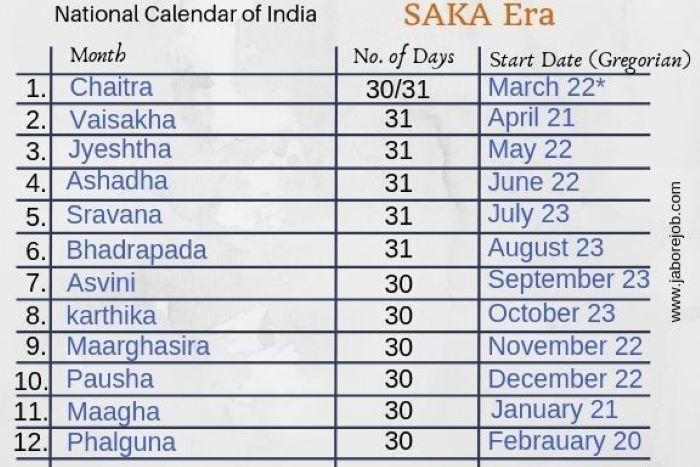
The Calendar Reforms Committee’s task was formidable, made more difficult by the fact that around that time, there were over 30 calendars in use in different parts of the country, each calendar having its unique narrative, obsessing the minds of the people in that region and reflecting a deep power struggle of hegemonic assertions. The competing popular calendars in vogue included the Bikrami, Kali, Bangla, Fazli, and Nanak Shahi, and each had its strong adherents and proponents.
Why the Shaka-era Calendar?
Following its mandate to “prepare an accurate calendar based on a scientific study that could be adopted uniformly across the country”, the committee examined the relative merits of each calendar. Finally, it recommended that the Shaka era calendar be adopted. Also called the Shalivahana Shaka calendar, it was already in use in the four southern states besides Odisha and Saurashtra (now Gujarat). The Shaka era commemorates King Shalivahana’s military triumphs. The first indication of a relationship between the King and the Shaka era was authenticated by the Kannada work Udbhata Kavya by Somaraja, a Veerashaiva scholar.
In many ways, this was also meant to assuage the feelings of the southern states, which were feeling let down after the States Reorganisation Commission (SRC) had rejected the suggestion to name Hyderabad as India’s winter capital a year ago. A major challenge came from the Bikrami calendar, which was closely aligned with the Hindi heartland and was also the official calendar of Nepal.
Whether, the committee choice to adopt the shaka calendar as the basis of a National Calendar was entirely on merit or an exercise to integrate South comprehensively in the new nation, could be an issue of debate but the decision was overwhelmingly sound and far-sighted. Happily, the names of months in all the Indic calendar traditions were common: Chaitra, Vaisakha, Jyeshta, Ashad, Sravan, Bhadra, Asvina, Kartika, Agrahayana, Pausa, Magha, and Phalguna.
The History
The Shaka calendar derives its name from the legendary king Shalivahan of the Satavahana dynasty. According to certain historical accounts, Shalivahan achieved victory over the Shakas, prompting the initiation of this calendar in 78 CE to commemorate his triumph. Some scholars correlate the commencement of the Saka era with the rise of Indo-Scythian king Chastana in 78 CE. Dineshchandra Sircar, a noted historian, challenges the historically inaccurate concept of the "Shalivahana era," proposing that it may be rooted in the victory of Satavahana ruler Gautamiputra Satakarni over some Shaka (Western Kshatrapa) kings. Sircar also speculates that the association of the northern king Vikramaditya with the Vikram era could have inspired southern scholars to invent a similar legend. Another account suggests that Emperor Shalivahana, the grandson of the legendary Emperor Vikramaditya, vanquished the Shakas in 78 CE, marking the inception of the Shaka era. This narrative finds mention in the writings of Brahmagupta (7th century CE), Al-Baruni (973–1048 CE), and others. With time, the term "Shaka" evolved into a generic reference for an era, leading to the era being known as the "Shalivahana Shaka. These debates today, however, enjoy a limited merit of merely an academic discussion, with no relevance to the Calendar’s adoption or use.
Other Features
The other major features of this new calendar included, adoption of the Solar Calendar based on the Sayana system, Year length set at 365.2422 days, equivalent to a Tropical Year, Establishment of a Positional Astronomy Centre to monitor the Vernal Equinox, Commencement of the year from the Vernal Equinox (22 March), with equal day and night, Reference for Indian Standard Time from Prayagraj (82 degrees 30’ East, 23 degrees 11’ North), Civil day starting at midnight (00:00 hrs), New Year initiating from the month of Solar Chaitra, with 30/31 days in each month, and Leap year criteria based on mathematical formulas.
In many ways, this calendar is far more scientific, and in the context of the Indian subcontinent, the agricultural season corresponds to the calendar. It accommodates the primacy of agricultural cycle in India, a feature that defined many of the regional calendars like Nanakshahi and Bangla.
Importance of the National Calendar
The National Calendar commands significance for several reasons. It is perhaps the most scientific and accurate among the existing calendars across the globe. But this is not its only attribute. It is, above all, a symbol of self-respect and identity of a newly emerged nation. It is a reflection of her constitutional values that promote a scientific temper. It has a promise and potential to resolve the financial year-end issues. Finally, it is a lasting calendar, incorporating corrective measures for Earth's precession.
The usage started officially on the first day of Chaitra, 1879, which corresponds to 22 March 1957. From this day, government notifications, All India Radio (AIR) announcements, and calendars issued by the central and state governments include dates according to the Shaka era. All central and state government notifications published in the Gazette of India mention the ‘date’ as per two calendars – the Gregorian calendar, which was the official calendar of the British Empire, and the Shaka-era calendar, which was adopted by India in 1957.
Yet Still Obscure
However, the Gregorian (English) year continues to be universally deemed as the Calendar. It is part of popular and common parlance, and most urban millennials are perhaps not even familiar with the names of the months as per the Shaka era. Despite its scientific foundation and parliamentary approval in 1956, the National Calendar faces limited adoption, and remains primarily confined to government institutions. Its use by the general public is neither widespread, not preferred, leading to its relative obscurity. The Gregorian calendar persists globally, despite many anomalies.
Why did the carefully conceived and designed national Calendar of India could not get any traction, despite being logical and scientific? It is an issue that begs consideration.
India just completed 75 year of her Independence, and has embarked on her most remarkable journey of growth, progress and development. They call it India’s Amrit Kal. There could not be a more opportune time to understand, imbibe and popularise this calendar that bestows a national identity and a sense of pride.
Indian Calendar is a fascinating and formidable exercise in finding an identity in a very scientific and rational manner in a realm where she had once neither a voice nor a case. But the times have changed. Its adoption and common acceptance by people at large may be a tall order even today but the young aspiring India needs to know the efforts made behind this very significant exercise.
(Uday Kumar Varma is an IAS officer. Retired as Secretary, Ministry of Information & Broadcasting)














Related Items
FAO, WMO report flags danger of extreme heat for agriculture
Pantnagar: Chouhan plants saplings, promotes sustainable agriculture
India's solar powered agriculture key to Africa’s food security: PM Modi