 Dr Ashok Pandey
On the full moon day of the bright fortnight of the month of Shravan, the festival of Raksha Bandhan is celebrated as an important part of the Indian festival tradition.
Fasting is also prescribed on this sacred occasion. A person observing the fast should bathe in the morning according to the prescribed rituals and offer tarpan to the deities, ancestors and sages. After noon, a yellow woollen, cotton or silk cloth should be taken and mustard seeds, gold if available, saffron, sandalwood, akshata (unbroken rice) and durva grass should be placed in it and tied together. Thereafter, a kalash should be installed at a properly purified place, the sacred protective thread should be placed upon it and worship should be performed according to the prescribed rituals. Subsequently, the raksha sutra should be tied on the right hand by learned scholars.
The mantra recited while tying the sacred thread is:
येन बद्धो बली राजा दानवेंद्रो महाबलः।
तेन त्वामनुबध्नामि रक्षे मा चल मा चल।।
There are several traditional legends associated with Raksha Bandhan. According to the popular account, after being defeated in the battle between the Devas and the Asuras, Indra became worried and approached his spiritual preceptor, Brihaspati, and narrated his predicament. Indrani overheard their conversation and said that the following day would be the full moon of the bright fortnight of Shravan. She would prepare a raksha sutra according to the prescribed rituals and advised Indra to have it sanctified and tied by his Guru with the recitation of Swastivachan. Indra followed her advice, and, according to the tradition, he was victorious. Since then, this sacred festival is believed to have been observed.
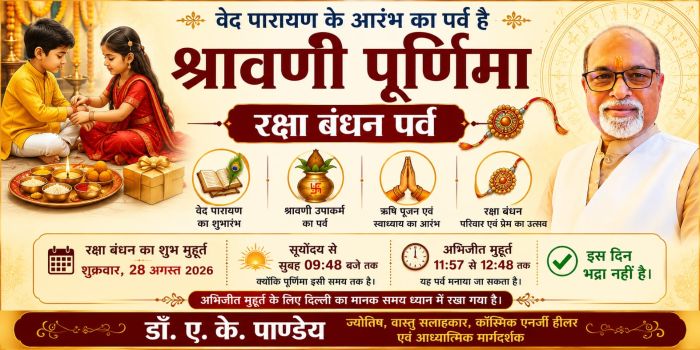
On Raksha Bandhan, sisters tie a raksha sutra or rakhi around their brothers’ wrists and pray for their well-being, prosperity and protection. The festival symbolises the bond of love, affection, trust and mutual responsibility between brothers and sisters.
Shravanī Upakarma – The Beginning of Vedic Study
Another important festival has been observed since ancient times on this very day, known as Shravanī Upakarma. It marks the traditional beginning of Vedic recitation and study.
In ancient India, the Vedas formed the foundation of the educational system. Their study was closely connected with knowledge, discipline and righteous action. After the worship of the Yajnopavita (sacred thread), it was ceremonially worn. Worship of the sages, removal of the old Yajnopavita and wearing a new one are among the important observances of this festival. In ancient times, teachers performed this sacred ceremony along with their disciples. It commemorates the noble tradition of Vedic learning and the disciplined life of the ancient ashrams.
On this day, after invoking the sacred pilgrimage places, there was also a traditional practice of making a Hemadri Snana Sankalpa as an act of repentance for knowingly or unknowingly committed sins during the preceding year, followed by the performance of the tenfold forms of charity. This was followed by the worship of the sages, Suryopasthana, worship of the Yajnopavita and the ceremonial wearing of the new sacred thread.
Shravan Purnima – The Festival of Self-Study
This occasion is also known as the festival of Svadhyaya (self-study). Self-study purifies the mind and prepares the individual for the pursuit of higher spiritual knowledge. Therefore, one is encouraged to remain continuously engaged in it:
'स्वाध्याये नित्ययुक्तः स्यात'।
In ancient times, at the conclusion of the period of Brahmacharya, when the student entered the Samavartana stage, the teacher instructed the graduate to continue self-study even after entering the household life. Later, during Vanaprastha, self-study and austerity remained among the principal duties. Even renunciates continued to engage in self-study as part of contemplation upon the Supreme Reality and imparting spiritual knowledge.
Self-study makes the mind pure, clear and transparent. This state is associated with the direct vision of the mantras, and those who attained such vision came to be known as Rishis—the seers of the mantras:
'ऋषयो मन्त्रदृष्टारः'।
The Agricultural and Spiritual Significance
India has traditionally been an agrarian civilisation. During the months of Ashadha and Shravan, people remained deeply engaged in agricultural activities. By the end of Shravan, much of the agricultural work was generally completed.
At the same time, during the rainy season, sages, ascetics and spiritual teachers would leave the forests and stay near villages. There they would spend the period of Chaturmasya engaged in teaching, learning, religious discourse and discussions on knowledge.
Devotees would visit them, listen to their teachings, acquire knowledge and serve them. This period therefore also came to be associated with Rishi Tarpan, an expression of reverence and gratitude towards the sages.
Traditionally, Vedic study was begun on the full moon day of the bright fortnight of Shravan. This is why the observance came to be known as Shravanī Upakarma.
The traditional reference is:
अथातोऽध्यायोपाकर्म।।
ओषधीनां प्रादुर्भावे श्रवणेन श्रावण्यां पौर्णमास्याम्।।
The Decline of the Older Tradition
With the passage of time, as the regular study and recitation of the Vedas gradually declined, the ancient tradition of continuous daily Vedic recitation for approximately four and a half months also began to disappear.
Eventually, people began performing the rituals of Upakarma and Utsarjana together on the full moon day of the bright fortnight of Shravan.
Self-study has always been an important part of the traditional Indian way of life. Through Svadhyaya, a person gains a deeper understanding of oneself, develops greater control over the senses, strengthens concentration and continues to expand one's knowledge.
Thus, Shravan Purnima is not merely a festival of Raksha Bandhan; it is also a sacred reminder of Vedic learning, self-study, gratitude towards the sages, spiritual discipline and the pursuit of knowledge.
(Dr Ashok Pandey,Spiritual Healer, Vastu Consultant and Astrologer Pune - +91-7574885030, +91- 9425006196)










Related Items
Keralites celebrating Thiru Onam, most auspicious day of Onam
Shravan symbolises public welfare, togetherness and service:CM Yogi
Devotees throng Har Ki Pauri for holy dip on Buddha Purnima