 Uday Kumar Varma
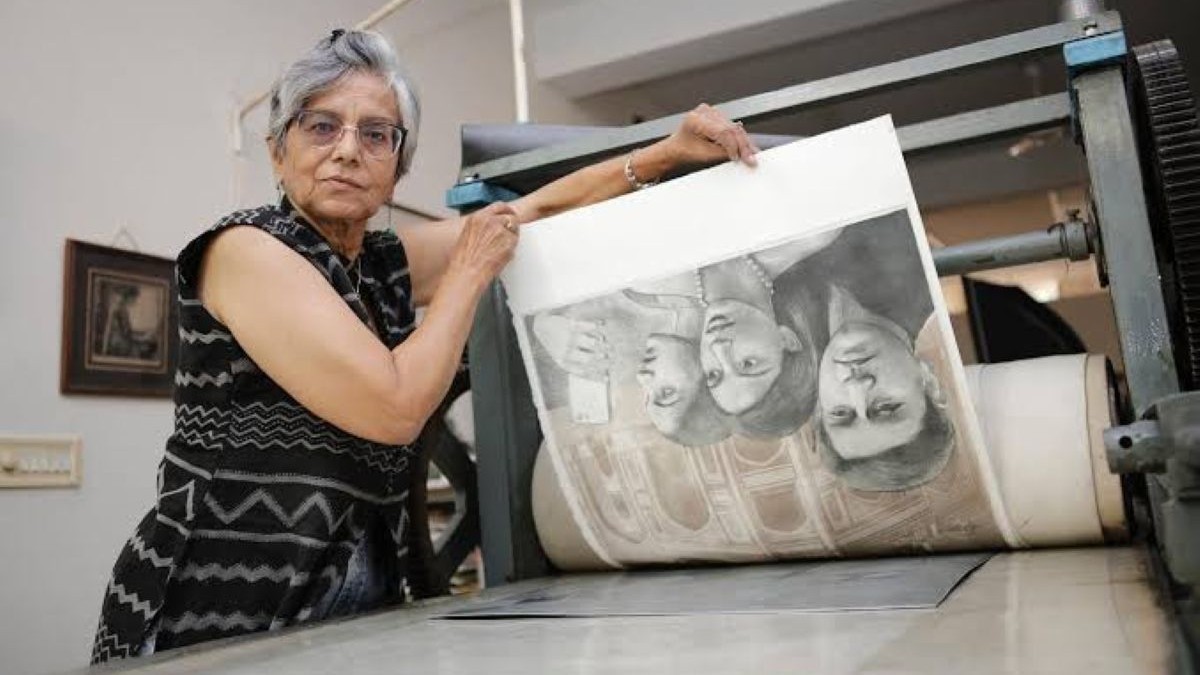
Six decades of art, a changing India, and the rediscovery of a painter.The artist whom India knows as a master printmaker has a larger story to tell. A major retrospective at the National Gallery of Modern Art seeks to reveal it.
The artist behind the reputation
Anupam Sud has spent six decades making images that invite us to look beyond the obvious. Yet there is a curious paradox in her artistic journey: the medium that established her reputation has also tended to overshadow another important dimension of her work. Celebrated as one of India's foremost printmakers, she has painted throughout her career. The retrospective In the Etched Trace of Time: Six Decades of Anupam Sud, opening at the National Gallery of Modern Art (NGMA), New Delhi, on 24 October, promises to bring this more complete artist into focus.
This is more than a retrospective of an individual career. Sud's artistic evolution offers a way of looking at the changing concerns of Indian society since Independence. Her works bear the imprint of their times, but they also explore the intimate, often unresolved questions of human existence that outlast any particular historical moment.
A demanding medium, a determined artist
Born in 1944 and raised in Shimla, Sud joined what was then Delhi Polytechnic's College of Art in 1962, initially studying painting. It was printmaking that eventually captured her imagination. A British Council scholarship took her to London's Slade School of Fine Art in the early 1970s, where she received specialised training in the medium. She returned to India with a commitment that would shape her artistic identity.
Printmaking, particularly etching and other forms of intaglio, is an exacting discipline. An image is incised into a metal plate, often with the aid of acid, and ink is transferred from the plate to paper under pressure. Unlike painting, in which the artist works directly on the surface that will bear the finished image, printmaking requires an intermediary. The artist must anticipate how lines, textures and tonal variations will translate into the final impression. The process allows multiple impressions, but it demands technical mastery, patience and a readiness to accommodate the unexpected.
The medium has a distinguished international lineage. Rembrandt explored its capacity to capture light, shadow and psychological complexity; Goya employed it to expose the cruelties and absurdities of his age. In India, Krishna Reddy, Somnath Hore and others helped establish printmaking as an independent field of artistic expression. Sud belongs to this tradition, but her achievement is also rooted in a distinctly Indian experience and a sustained engagement with the people and circumstances around her.
The making of a printmaker
 Talent alone cannot sustain an art form that requires expensive materials, specialised machinery and dedicated working space. Sud's early career unfolded at a time when these facilities were scarce. Her teacher and mentor, Jagmohan Chopra, recognised the problem and responded by founding Group 8 in 1968, bringing together young artists committed to printmaking. He also established a makeshift studio at his home, where students could continue working after leaving college.
The ingenuity of this small artistic community is revealing. Equipment was improvised, locally made and adapted to meet professional requirements. During her time at Slade, Sud sent Chopra detailed sketches of printing equipment, including an aquatint box that could mechanise a process previously performed with a cloth pouch. Such exchanges helped transform an aspiration into a sustainable practice.
Sud subsequently joined the College of Art as a lecturer in 1975. She worked to restore and develop its printmaking facilities, eventually teaching successive generations of students. Her contribution therefore extends beyond the works she produced. She helped nurture an artistic community, strengthen institutional infrastructure and establish printmaking as a serious and independent pursuit in modern Indian art.
Art in conversation with a changing India
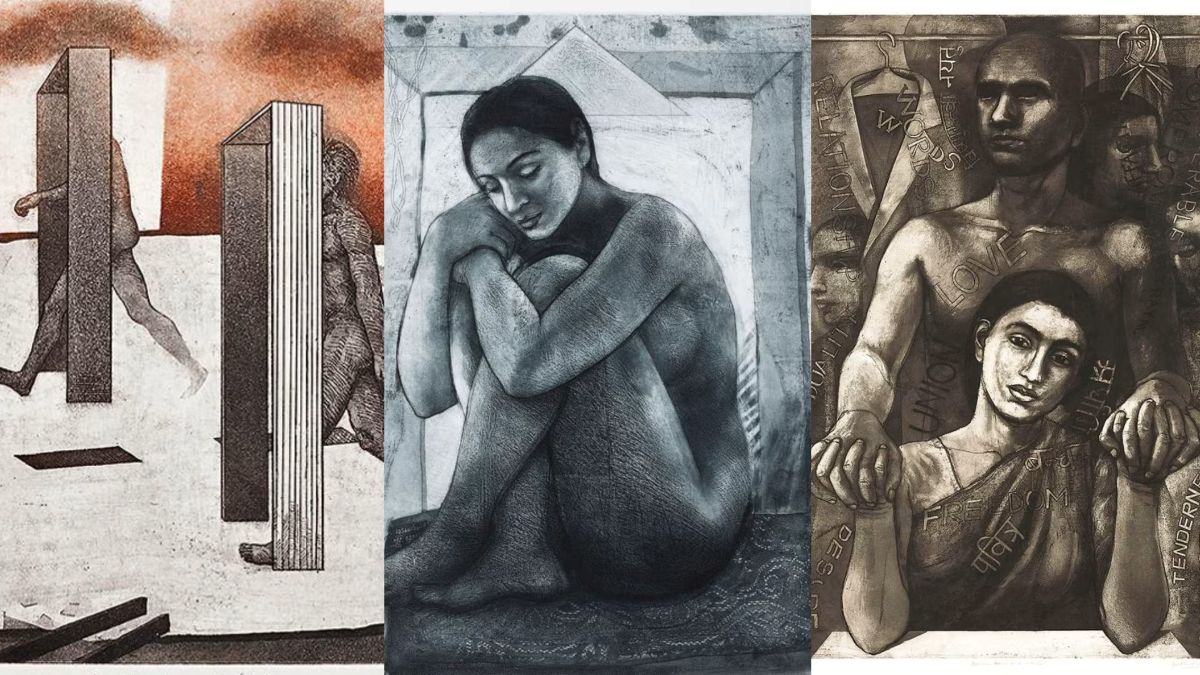
Sud's work has never been confined to technical experimentation. Her early images explored interiority and the immediate environment. Over time, her attention increasingly turned towards individuals negotiating the constraints of their personal worlds. Human relationships, identity, sexuality, vulnerability and power became recurring concerns. Her figures often inhabit situations charged with tension, their expressions and gestures suggesting conflicts that remain unresolved.
As India changed, the preoccupations of her art changed with it. The transformations surrounding economic liberalisation brought new aspirations, social divisions and uncertainties into everyday life. Sud's work engaged with these emerging realities, examining how ordinary individuals experienced and negotiated a rapidly changing society. In later years, her gaze turned inward again, towards personal and existential concerns.
This movement between the individual and the social gives her work its distinctive breadth. Her art does not need to announce a political or philosophical position in words. Its lines, compositions, expressions and silences do the work. The viewer is left to discover the connections, rather than being instructed what to think.
Rediscovering the painter
Perhaps the most important reason to visit this retrospective is its attempt to correct an imbalance in how Sud's achievement has been perceived. Although printmaking became her signature medium, she never abandoned painting, whether in watercolour or oil. An accident in 2008 affected her physical strength and led her to devote greater attention to painting. This was not a late-life conversion from one medium to another; painting had remained a parallel strand of her practice from the beginning.
By bringing paintings, prints, drawings and watercolours together across different periods, the exhibition invites us to see the continuities beneath their technical differences. Her command of line and drawing, developed early in life, connects the different forms she has explored. The complete artist emerges not through a single defining medium, but through the persistence of a visual imagination across changing circumstances.
A life brought into perspective
The accompanying two-volume publication, written and edited by curator Archana Khare Ghose, promises to deepen this encounter. The first volume traces Sud's journey from her early years in Shimla to the present, placing her development within the changing social and political landscape of India and the wider world of contemporary art. Drawing on the artist's recollections, it offers the possibility of understanding not merely what she created, but the experiences and decisions that shaped her practice.
The second volume brings together essays by artists, contemporaries and former students who have known her over many years. Their perspectives should add another dimension to the story, illuminating Sud as artist, teacher, colleague and individual. Together, the volumes promise a more rounded account of a life whose significance extends beyond its public reputation.
Khare Ghose, an experienced journalist and incisive writer, faces the challenge of making six decades of artistic evolution intelligible without reducing them to a chronological inventory. The curatorial concept draws on the narrative developed in the first volume, tracing the movement from interiority to social observation, engagement with a transforming India and, eventually, a renewed inward turn. Presented by NGMA in collaboration with Dhoomimal Gallery, which celebrates its ninetieth anniversary this year, the retrospective brings together an artist's personal journey and a wider history of modern Indian art.
The most rewarding way to approach Anupam Sud may be to resist defining her too narrowly. She is a master printmaker, but not only a printmaker; a painter, but not simply a painter. Across six decades, she has continued to explore the human figure and the complicated worlds people inhabit.
An etched line may be fixed on a plate, but the questions it raises remain open. In following those lines across the years, we encounter not just the evolution of an artist, but a changing society and the enduring mysteries of being human.
(Uday Kumar Varma is an IAS officer. Retired as Secretary, Ministry of Information & Broadcasting)
Related Posts
Former Pak minister seeks FIR against ex-wife over AI images
Italian artist gifts Varanasi painting to PM Modi in Rome
8 FIRs filed as ‘fake images’ of Manikarnika Ghat surface online