 Krishan Gopal Sharma
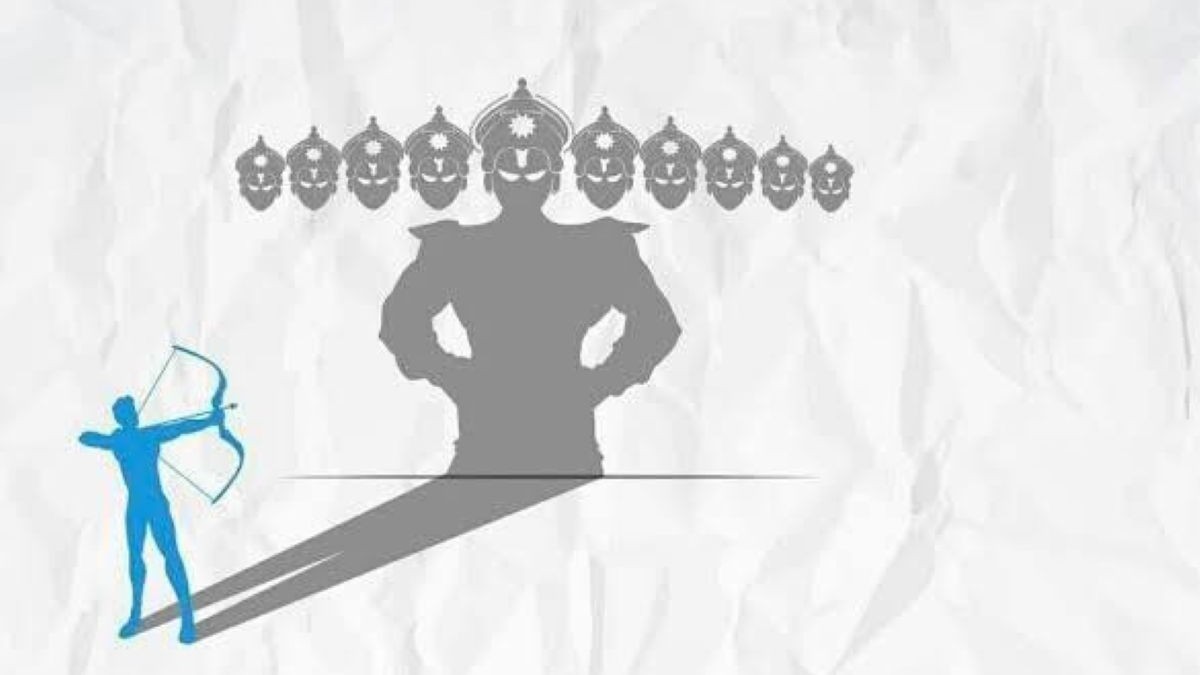
Ravana’s Last Lesson-Beyond the hero and the villain, an ancient story about time, opposition and love. We inherit stories in which the hero must be good and the villain must be evil. The distinction is useful, perhaps even necessary, but it can also become intellectually lazy. The Ramayana is far more unsettling than that. Ravana is not a cardboard villain. He is learned, powerful, accomplished and deeply devoted to Shiva; yet he is also consumed by pride, desire and the refusal to recognise the limits of his own power. His tragedy lies precisely in this contradiction. He knew much, but failed to act upon what he knew. That is perhaps why Ravana continues to fascinate. He can be condemned for what he did without denying what he knew. And in some later devotional interpretations of the Ramayana, his opposition to Rama acquires an even stranger dimension: the antagonist becomes so completely absorbed in the Divine that even enmity can be interpreted as a form of fixation upon it. The idea is associated with concepts such as virodha bhakti or vaira-bhava — devotion expressed through opposition. It is a theological paradox, not a justification of Ravana's actions. Yet paradoxes are often where old stories become new again.
The villain who knew too much
Ravana's intellectual stature is well established in the epic and its many subsequent traditions. He is portrayed as a formidable scholar, a ruler of Lanka and an ardent devotee of Shiva. Later traditions embellish his power further, including stories of his mastery over the Navagrahas, the nine celestial bodies. But knowledge did not save him. That may be the first uncomfortable lesson. Knowing what is right and doing what is right are not the same thing. Ravana possessed learning, power and opportunity in abundance. What he lacked was restraint. His downfall was not caused by ignorance alone; it was also caused by the distance between understanding and action.
Some traditions take this paradox further. They interpret Ravana's confrontation with Rama as part of a larger cosmic design in which opposition to the Divine itself becomes a route towards liberation. In such readings, his eventual death at Rama's hands acquires a meaning beyond military defeat. Yet this should remain an interpretation, not be mistaken for a universally established explanation of Ravana's motives. The distinction matters. Ravana's spiritual significance does not require us to excuse his conduct. Indeed, it may be more illuminating to hold the two truths together: a person can possess extraordinary knowledge and still make catastrophic moral choices.
When the enemy becomes a teacher
One of the most enduring episodes associated with Ravana's final moments is the story of Lakshmana being sent to learn from the dying king. The precise details vary across Ramayana traditions, but the underlying idea is powerful: wisdom does not lose its value because it comes from an adversary. That lesson has acquired an almost uncomfortable contemporary relevance. We have become remarkably good at dismissing an argument because of the person making it. Once someone is placed in the category of “enemy”, everything they say becomes suspect; once someone is placed in the category of “ally”, almost everything they say is granted a hearing. The ancient story offers a more demanding proposition: listen first, judge later. Rama's conduct after Ravana's death carries a related moral complexity. In the epic tradition, the fallen king is to be accorded the dignity due to the dead, and the end of enmity marks the end of the conflict. The precise Sanskrit formulations vary across texts, but the principle remains powerful: victory need not require humiliation of the defeated. This is not moral equivalence between Rama and Ravana. It is something subtler. The two remain ethically opposed, but the opposition does not have to survive the end of the battle.
The real enemy may be delay
This is where Ravana's story becomes unexpectedly contemporary. A popular strand of later Ramayana tradition attributes to Ravana, in his final conversation with Lakshmana, several reflections on time and procrastination. These accounts are better understood as part of the wider interpretive tradition than as an uncontested episode of the Valmiki Ramayana. Yet the lessons they preserve are striking. The first concerns the strange asymmetry of human action. We often postpone what is good while acting immediately on what is destructive. A generous thought is saved for tomorrow. A reconciliation is postponed. A necessary apology can wait. A good idea is put aside until circumstances become “more suitable”. But anger needs no appointment. Neither does vanity, resentment or impulsive desire. The wisdom attributed to Ravana in these later traditions is therefore brutally simple: when the impulse is to do something good, do not wait; when the impulse is destructive, give yourself time. How many human tragedies begin with reversing that order?
The second lesson is the illusion that there will always be time. Power creates an illusion of permanence. The powerful begin to believe that tomorrow belongs to them. Wealth, position, youth, influence and even familiarity with success can create the comforting fiction that there will always be another opportunity. Ravana's tragedy exposes that illusion. The person who believes he has mastered everything eventually encounters the one thing nobody can command: time. Procrastination, therefore, is more than poor time management. At its deepest level, it is a wager against mortality. Every postponement quietly assumes that the future has already been guaranteed. It has not. The call that can be made today may not be made tomorrow. The conversation that can heal a relationship may become impossible. The work that matters may remain unfinished. The affection that is felt but never expressed may eventually have nowhere to go. Time does not announce its final deadline.
The third lesson may be the most relevant to the modern age: do not mistake busyness for purpose. Ravana's story, as retold in later tradition, also speaks to the danger of spending one's energy on endless smaller battles while neglecting the larger purpose of life. That sounds remarkably familiar. We remain busy. We answer messages, attend meetings, fight arguments, protect reputations, pursue minor victories and react to every provocation. At the end of the day, exhaustion gives us the comforting impression that we have accomplished something. But activity is not necessarily progress. Sometimes busyness is simply a sophisticated form of avoidance. The question Ravana leaves behind is therefore not merely, What are you doing? It is more uncomfortable: Is what you are doing taking you towards what ultimately matters? A life can be crowded and still be directionless.
Beyond the binary
There is another reason the Rama-Ravana relationship deserves a second look. The language of non-duality does not mean that good and evil are interchangeable. Advaita does not require us to declare Rama and Ravana morally equal. At the human level, dharma and adharma remain meaningful distinctions. The deeper question is different: Can moral opposites exist within a reality that is ultimately non-dual? That question changes the story. Rama needs Ravana as an antagonist for maryada — the boundaries of righteous conduct — to become visible through action. But this does not make Ravana righteous. Darkness does not become light simply because light becomes visible against it. Yet darkness can reveal the value of light. Perhaps this is why the hero and the villain are never quite as simple as the labels suggest. One can reject Ravana's actions while still learning from his knowledge. One can revere Rama without turning him into an intellectually uncomplicated figure. One can recognise an adversary's wisdom without surrendering one's moral judgement. Perhaps maturity begins precisely there.
From the battlefield to the heart
After all the talk of gods, demons, power, liberation, time and cosmic purpose, the deepest lesson may finally be found not on the battlefield of Lanka but in an ordinary human heart. Consider a parent whose child lives far away. Physical distance creates its own strange mathematics. The child may be hundreds or thousands of miles away, yet a single thought can bring that child instantly into the room. A memory can cross the distance without passport, technology or permission. A parent's affection does not wait for a convenient appointment. This comes close to what Indian aesthetics calls Vatsalya Rasa — the emotional world of parental love. And here Ravana's lesson about time acquires a softer meaning. Why postpone affection? Why assume there will always be another conversation, another visit, another opportunity to say what ought to be said? Separation often strips love of its practical transactions. There is nothing to gain, no bargain to strike, no immediate reward. There is simply remembrance, concern and a quiet stream of goodwill.
Perhaps, then, the deepest lesson of Ravana is not that evil can somehow become good. It is that even an adversary can carry a truth we have failed to hear. Ravana knew much and failed himself. He possessed immense power and could not master his own impulses. He understood, at least in the traditions that later grew around his story, the value of time — but acted too late. That contradiction makes him more instructive, not less. The Ramayana survives because its characters are larger than the labels we give them. Rama is not merely a hero, Ravana is not merely a villain, and the battle between them is not merely an ancient war. It is also a meditation on what happens when knowledge, desire, power, time and choice collide. Perhaps the final wisdom lies in bringing the distance between intention and action as close as possible: do the good thing while the impulse is alive; say what needs to be said while there is still someone to hear it; do not confuse busyness with purpose; and, above all, do not postpone love.
The battle may end on the battlefield. What remains is what we chose to do before time ran out.
(Author: kgsharma1@gmail.com; The writer is a retired officer of the Indian Information Service and a freelance writer. Also worked as an international media consultant with UNICEF Nigeria and contributes regularly to various publications.)

Related Posts
IMF lauds Indian growth story amid global uncertainty
When the Monsoon Changed India's ancient rhythm in an age of extreme weather
PART III: The Echoes We Inherit