 Uday Kumar Varma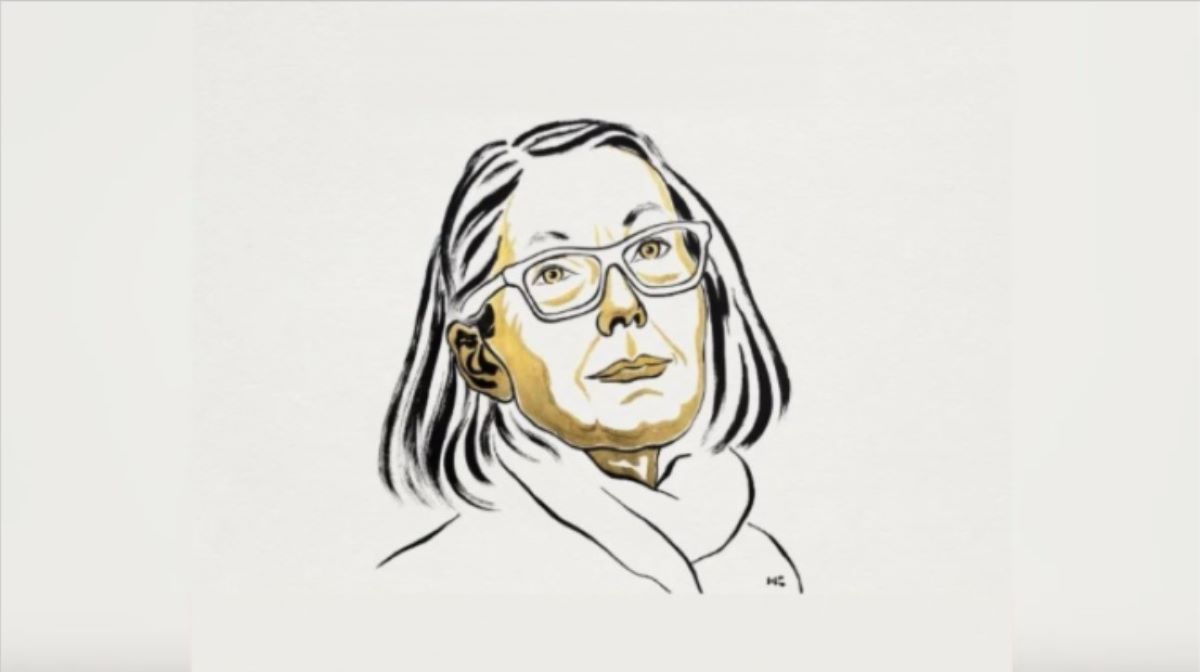
Some writers tell stories; others make us think differently about the stories we have always known. Anne Carson does both. A Canadian poet, translator and scholar of ancient Greek literature, she has found an unusual way of bringing the distant past into conversation with the present. Her Nobel Prize in Literature recognises a body of work that is difficult to fit into familiar categories, yet speaks powerfully about love, loss and the complexities of being human.
The Nobel Committee praised her “bold and inventive oeuvre” for creating new forms of contemporary literature through a playful dialogue with the classical tradition. The words may sound rather academic, but the idea behind them is quite simple. Carson takes stories and poems written thousands of years ago and discovers in them feelings and experiences that remain familiar today. She does not merely translate the past; she makes it live again.
Take ‘Autobiography of Red’, perhaps her best-known work. Inspired by fragments of an ancient Greek poem, it retells a myth involving Geryon, a red-winged monster who encounters the hero Heracles. Carson turns the monster into a young man experiencing love, desire and heartbreak. The result is neither quite a novel nor a conventional poem. It tells a story, but in a form that allows thoughts, images and emotions to move freely. An ancient myth becomes a recognisably modern story of growing up and discovering how vulnerable love can make us.
Carson has a special interest in what survives when much of the original has been lost. In ‘If Not, Winter’, she works with the surviving fragments of Sappho, the ancient Greek poet whose writings have come down to us in incomplete form. Some passages are little more than scattered words. Carson preserves these gaps rather than pretending that the missing words can simply be restored. The silences become part of the experience of reading. We are reminded that what is lost can sometimes speak to us as powerfully as what remains.
In ‘Nox’, her response to the death of her brother, fragments of memory, family history and translation come together in an intensely personal work of remembrance. Here, as elsewhere, Carson does not follow the usual rules of storytelling. She allows different forms of writing and different kinds of material to sit beside one another, much as memories do in the mind. Her work can be scholarly without being cold, and deeply personal without becoming sentimental. There is often an unexpected plainness, even a touch of humour, in the way she approaches difficult emotions.
Indian readers may find points of connection with A. K. Ramanujan, Arun Kolatkar and Girish Karnad, all of whom, in different ways, brought inherited traditions into fresh conversation with modern life. Ramanujan offers perhaps the closest parallel. A poet, translator and scholar, he drew upon folklore, classical literature and personal memory without treating the past as something sealed off from the present. Like Carson, he showed how old stories could acquire new meaning when viewed through a contemporary sensibility. Their styles are distinct, but both remind us that tradition need not be preserved behind glass; it can be questioned, reinterpreted and made meaningful anew.
This freedom from conventional forms is central to Carson’s originality. She moves between poetry and prose, between ancient texts and modern experience, without feeling obliged to choose one over the other. Her writing asks readers to make connections for themselves. Not everything is explained, and not every question is answered. But perhaps that is part of its appeal: life itself rarely arrives in neat, clearly labelled compartments.
Carson is the third Canadian-born writer to receive the Nobel Prize in Literature, after Saul Bellow in 1976 and Alice Munro in 2013. Yet her importance lies less in this distinction than in the possibilities her work opens up. She shows us that old stories need not grow old, that fragments can still carry meaning, and that literature need not be confined by the forms in which we have learnt to recognise it.
Some writers give us new books. Anne Carson makes us reconsider the very idea of a book.
(Uday Kumar Varma is an IAS officer. Retired as Secretary, Ministry of Information & Broadcasting)

Related Posts
Michael Woodford and Robert E Hall awarded Nobel Prize in economics
US imposes sanctions on ICC, hours after Nobel award to former judge
Indian-origin Jurist Navi Pillay wins Nobel Peace Prize for 2026