 Newsinc24 Team
India’s economic growth continues to be powered by a handful of states, with the top ten contributing nearly 70% of the country’s total economic output, while just three states account for 61% of exports, according to a report by Rubix Data Sciences.The report, titled ‘State of the States: Assessing State-level Performance: Driving India’s Economic Transition’, analyses data from FY15 to FY25 across ten macroeconomic and development indicators, highlighting the increasing concentration of economic activity and investment across regions.
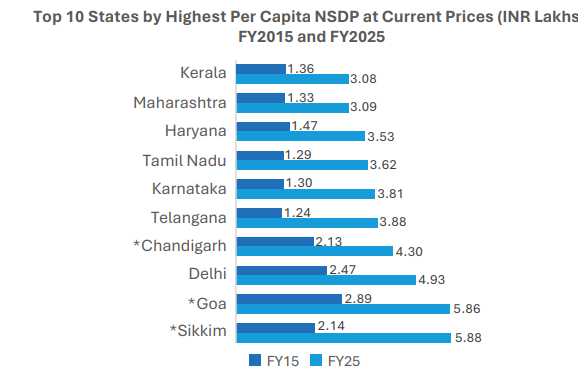
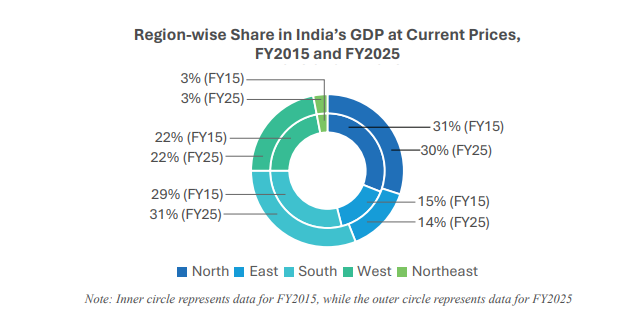
The southern region emerged as a key growth engine, contributing around 31% to India’s GDP in FY25, slightly ahead of the northern region’s 30%. Four southern states—Tamil Nadu, Karnataka, Telangana, and Andhra Pradesh—featured among the top contributors, with their combined share rising from 25% to 27% over the decade.Among them, Karnataka led in growth with an average real growth rate of 7.8%, followed by Telangana at 7.1%, Andhra Pradesh at 6.9%, and Tamil Nadu at 6.8%. Maharashtra remained the single-largest contributor to India’s GDP at 13%, though its share has moderated from 15% in FY15.
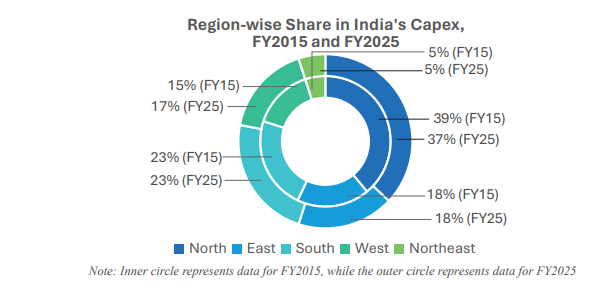
On the investment front, Uttar Pradesh, Maharashtra, and Gujarat together accounted for nearly 30% of the country’s total capital expenditure in FY25, while the top ten states controlled about 67% of national capex.Exports were found to be even more concentrated, with Gujarat, Maharashtra, and Tamil Nadu alone contributing 61% of India’s total goods exports. At the same time, the southern region’s share in exports rose significantly from 26% to 33% over the past decade, indicating a shift in export competitiveness.
The report also highlighted the transformation of traditionally underperforming BIMARU states. Bihar and Madhya Pradesh nearly tripled their Gross State Domestic Product (GSDP) between FY15 and FY25, while Uttar Pradesh has emerged as a leader in capital expenditure and domestic tourism.
India’s economy, now estimated at around $4.18 trillion, is entering a new phase of expansion where state-level performance is becoming increasingly critical. The report noted that regional disparities in industrial capacity, credit penetration, and income levels continue to shape the country’s economic resilience and future growth trajectory.It added that understanding these differences is essential for businesses, investors, and policymakers, as they influence investment decisions, credit risk assessment, and infrastructure planning. States with rising capital formation, improving credit access, and expanding industrial bases are expected to drive the next phase of growthMohan Ramaswamy, Founder and CEO, Rubix Data Sciences said India’s growth story is fundamentally anchored at the state level, adding that the ability of emerging states to convert investment momentum into sustainable industrial capacity will define the country’s next phase of economic expansion.


Related Posts
Gill, Rohit power India's eight-wicket victory in 2nd ODI, seal series
Apple Pay launches in India with Axis Bank card support
India, Qatar agree to accelerate FTA, bilateral investment treaty talks